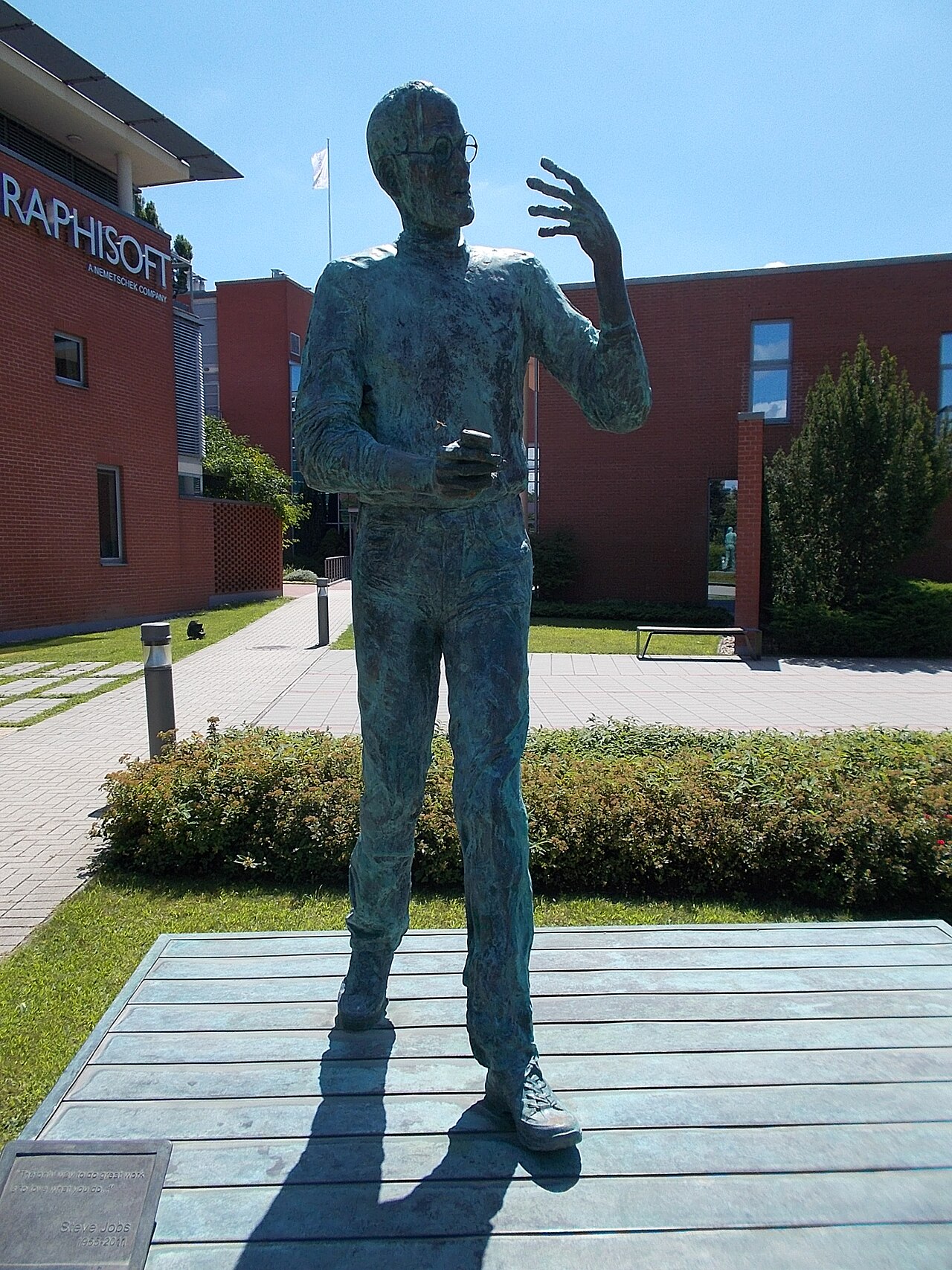
We have just one more article left to finish our series on Steve Jobs. He was not perfect, and he does not come off well in his own biography: he had huge flaws that the people who worked and lived with him could rightly hold against him. But can six big flaws, once you put them together, turn into a huge strength? Everything suggests they can.
In a 2013 article we discussed some cognitive distortions often found in highly successful entrepreneurs. After reading Isaacson’s biography and the book Ken Segall wrote from a marketing point of view, I have come to the conclusion that most of Jobs’s flaws are only flaws if you focus on the flaw itself; they are strengths if you look at what that flaw prevents.
1. Aversion to authority and rules
It is not just Steve Jobs. Most entrepreneurs and billionaires agree that to succeed you have to step outside the established rules. Jobs was a rebel by nature, and those closest to him described him as someone who enjoyed not following the rules. At the company he had his own parking space with his name on it, yet he habitually parked in the spaces reserved for disabled people. Why? Simply for the sake of not following the rules.
Even at school he did not like teachers telling him what to do, except for one teacher who managed to challenge and motivate him instead of steamrolling him. Jobs said she was the only teacher he ever came to respect.
Over his business career he formed alliances with several companies, and he did not always respect the terms of the contracts either. For example, according to Isaacson, he reached an agreement with the Beatles’ company, Apple Corps, and its label Apple Records, so that they would not sue him for using the name Apple.
The agreement stated that they would not sue Apple as long as Steve Jobs’s company never entered the music business, while Apple Corps, for its part, would never enter the computer business.
Years later, Steve Jobs broke that agreement when he created iTunes, and he was sued. It is the famous “don’t ask for permission, ask for forgiveness later”. According to Jobs, if you do not bend the rules to some extent, you are very limited in what you can do.
2. Reality distortion
Nothing was impossible for Jobs. That sounds like a good thing. But in Jobs’s case, everyone agrees it was almost pathological: he lived in his own reality distortion field.
That distortion field probably failed him only once: when he was diagnosed with cancer. Jobs completely ignored the diagnosis for nine months, thinking that if he put it out of his mind, the cancer would go away simply by following his strange diet of prolonged fasting, apples and carrots. It did not; the cancer brought him back to reality.
Otherwise, the people who worked with him agree that the permanent reality distortion field Jobs lived in made him seem crazy: crazy enough to try to close an impossible business deal, and Jobs closed it; crazy enough to think suppliers would cut their prices just because he was Steve Jobs, and they did.
Crazy enough to want to completely transform six different industries… and he did. Isaacson spoke with many Apple employees who thought he was losing his mind, and who eventually admitted that, as good professionals in their fields, they ended up doing impossible things thanks to Jobs’s constant pressure. They did the impossible because they did not know it was impossible.
As Apple’s famous advertising campaign put it: “The people who are crazy enough to think they can change the world are the ones who do.”
3. Manipulative
Steve Jobs would pull you into his reality distortion field and get people to do what he wanted. He could be extremely rude, but he could also be extremely charming when it suited him.
He knew how to bring you onto his ground in any negotiation and any conflict. What we call manipulation is also known as persuasion, and the art of persuasion is nothing more than manipulating people and crowds without them knowing they are being manipulated. Without a doubt, this was one of Jobs’s greatest talents in negotiation and in getting his way in any area.
See also: How to be more persuasive and get people to do what you want
4. Extremist
Jobs divided people and employees into just two kinds: jerks and geniuses. You were either a jerk or a genius. The same went for the ideas and products presented to him: they were either brilliant or crap.
Often, when a product was almost finished but had a flaw, he would say it was crap and they had to start over. As for people, anyone could be a genius today, slip up and be a jerk tomorrow, although if they proved their worth again they could win back their “genius” status.
The other way round was harder. If he had decided someone was a jerk, that person would rarely get the chance to become a genius, not least because Jobs would not let them stay around him for very long.
Jobs always boasted about the people who worked at Apple, because he considered each of them the best in their field. He had a first-division company that did not admit second-division players. And so he took on any challenge, because he knew he had the best.
5. Too much of a perfectionist
Jobs was a pathological perfectionist. He learned it from his father, who even painted the backs of pieces of furniture that nobody would ever see. That was the beginning of Apple’s design.
Jobs made his engineers and designers make even the inside of his devices look good. The engineers often rebelled: “But no customer is ever going to look at the computer’s circuit board to see whether the cables are neat or not,” some of them would say. To which Jobs replied: “But we are looking at it, and it is our responsibility to do it as well as we can, even if nobody is ever going to see it.”
That is why Apple has always defended the quality of its products by saying publicly: “let others make crap.”
6. Detached
When Jobs was focused on something, he could be completely detached and unconcerned about everything else, including his friends and his own family.
It was a big flaw and a very reprehensible one, although some described him as someone whose brain was like a laser pointer: it pointed at something and stayed focused only on the spot where the laser light was aimed.
Everything else disappeared. That made Jobs someone totally focused on one single thing, and until he finished it, he did not move on to the next. In fact, there was no next thing. There was nothing else at all.
In other words, Jobs could be distant with many people, but he was intensely focused on one thing.
7. Cruel and ruthless
Jobs himself admitted that he had sometimes been excessively cruel to some people, but he did not regret it either, because that was how he was. He did not see himself as running a company. He was utterly convinced that he was changing the world, and his passion and belief in what he was doing were so strong that they came before kindness and courtesy. When you are changing the world, he said, you can’t be soft.
He also acknowledged that his temperament was simply the way he was, and he did not mind showing it to you, because he felt he was being himself and not a fake like so many others he had met. He was a sincere person who told you what he thought to your face, and he hated the idea of showing you his friendly side and then stabbing you in the back.
If Jobs had a problem with someone, that person would be the first to know, unless he was playing nice while planning to send them home, as he did with some executives and board members. In that case he was being a strategist. A very ruthless one, but a strategist.
In the end, Jobs told Isaacson that he had probably been needlessly cruel to only a couple of people, three at most. In every other case it had been necessary to be cruel and ruthless; otherwise there would have been people at Apple who should not have been there, and they certainly would not have achieved what they did.
Further reading
- How Steve Jobs encouraged new ideas at Apple
- How Steve Jobs made his meetings at Apple more productive
- How Apple products got their “i”
Featured image: Globetrotter19, CC BY-SA 3.0, via Wikimedia Commons.