

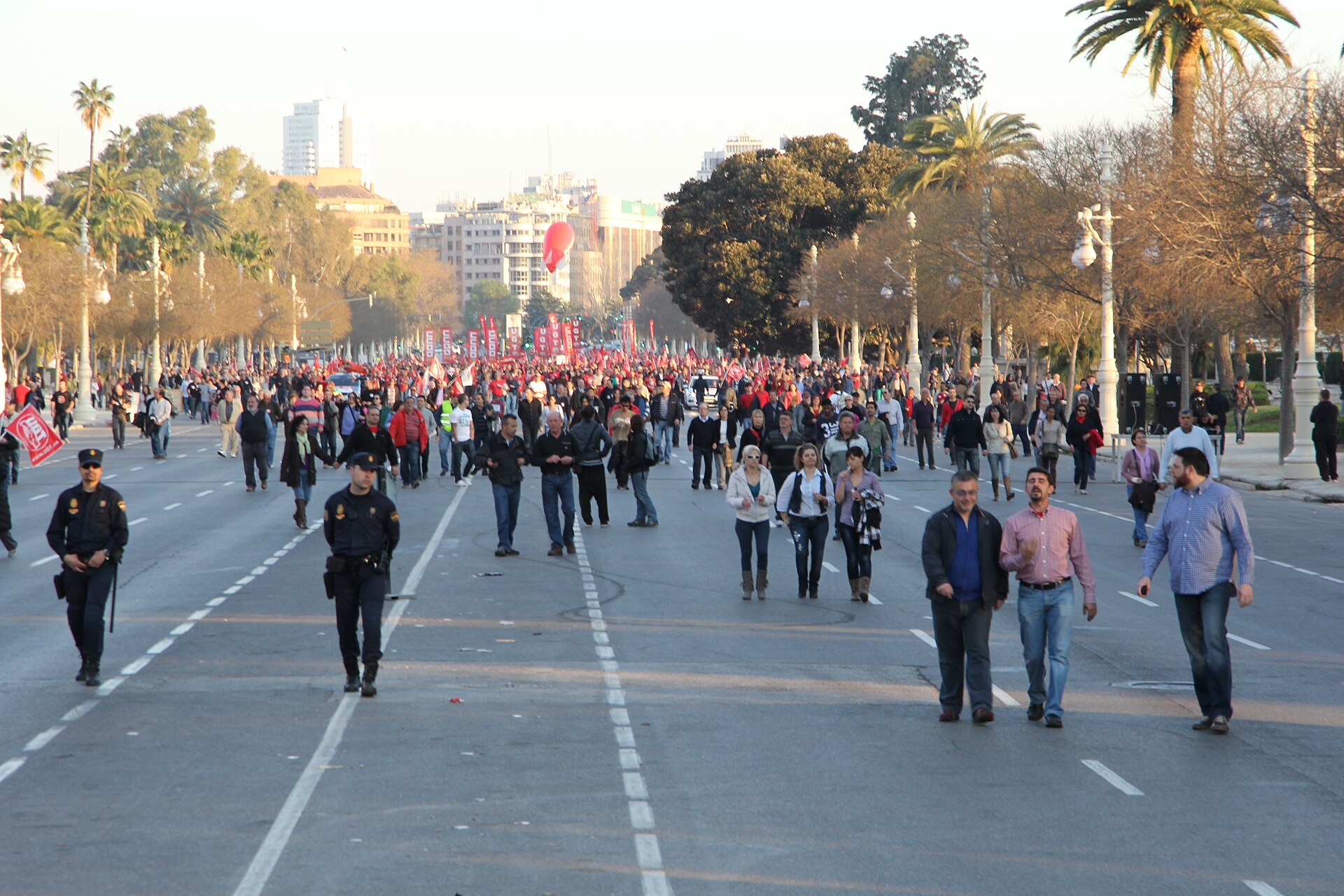
Editor’s note: This article was first published in March 2012, nine days before the general strike of 29 March 2012 against the Rajoy government’s labour reform; the strike went ahead that day. The figure of more than five million unemployed is also from 2012.
On 29 March, unless something changes, we are called to a general strike in protest against the labour reform approved by the Spanish government. The Prime Minister himself already said in Brussels that it would cost him a general strike, and for the main national trade unions, in their own words, it is “a reform that throws labour relations hugely off balance. It gives far more power and decision-making capacity to the employer and weakens working men and women.”
There are reasons on both sides for and against this measure, in a country in the middle of a crisis and with brutal unemployment rates. And since you can never please everyone, let’s look at some of the reasons, few or many, for striking or not on 29 March.
Reasons for striking
- It is a harsh reform, very harsh, in favour of the employer and against the worker; the reasons and arguments have already been laid out in various articles.
- The complete disappearance of job stability for every family whose future rests on a decent, lasting job. Those are the requirements needed to get a mortgage, to start and raise a family, and the basis of a country’s future well-being.
- The lack of any justification needed for drastic measures in companies. A single word is enough to decide the lives and futures of all their employees.
- It is a reform that is not a one-off for a period of crisis, but permanent, for the future.
- Is systematically pushing up the number of unemployed a solution to the crisis, or should we be creating jobs?
Reasons for going to work that day
- Striking is a right and, as such, worth exercising. But it should also be the last resort. Other ways out or solutions should be sought first, perhaps by checking the effects of the reform: if they are positive, it may be a solution for the country; if they are negative, that is reason enough for the government to look for alternatives.
- The financial cost for every employee, whose pay will be cut by an amount proportional to every item that makes up the payslip.
- A Prime Minister who was very clear about the consequences of his reform and did not shy away from putting it into practice, taking a firm step in his reform programme.
- A country with more than five million unemployed people has to find its own solutions to avoid total collapse.
Some tricks used by workers and employers
- Some companies will join the strike that day to avoid pickets and their consequences. What they won’t say is that their employees will make up those hours on another day, so the number of strikers goes up, but there is no effect on pay or production, because the work still gets done.
- Looking closed while working inside, without any sign of it from the outside.
Featured image: Melderomer, CC BY-SA 2.0, via Wikimedia Commons.



