Editor’s note: This article was first published in November 2010 and reports Prime Minister Zapatero’s meeting with the heads of Spain’s largest companies; the reforms, savings bank mergers and planned National Competitiveness Commission belong to that moment. Zapatero did not stand in the November 2011 general election, which Mariano Rajoy won.
Now that the meeting between the Prime Minister and the heads of Spain’s largest companies is over, it seems it has been described as positive, although there is talk that the main opposition party will need to cooperate, and, as we have been saying for a while, that may turn out to be the hardest part.
Here is a summary drawn from two newspapers and from the official website of the PSOE (the governing Spanish Socialist Workers’ Party), setting out the conclusions of the meeting.
The meeting was useful and positive
At a press conference, the head of government described the meeting as “extraordinarily useful and very positive”, because it had helped build confidence and strengthen the mutual commitment of the government and business leaders to economic stability.
Austerity and deficit reduction, changes to the financial system and pressing ahead with all the structural reforms to put them into practice as quickly as possible. These are the key points and the message the Prime Minister conveyed.
Implementing these reforms was the core of Zapatero’s remarks. He recalled that they affect the development of the labour market, the pension system and the energy sector, among others, and that their aim is to change the economic model to become more competitive.
Zapatero said: “You would have to ask Rajoy whether he is willing to contribute”
The business elite committed to merging the savings banks (cajas) within the planned deadlines, to quickly closing a pact on energy reform and to applying the labour reform. The possibility of a political dialogue between Zapatero and Rajoy (Mariano Rajoy, leader of the opposition Partido Popular) came up at the press conference. Zapatero said he was willing, but pointed out that meetings are only useful when there is a will to contribute. “You would have to ask Rajoy whether he has it.“
The government will not change course
On the possibility of opening a dialogue with the main opposition party, Zapatero said that meetings are necessary “if there is an intention to contribute” and that now is the time to find out “whether Mr Rajoy wants to reform pensions and has proposals”. If that dialogue does not happen, the head of government repeated, “the government will exercise its responsibility and will not stray from the course it has set“.
Zapatero also explained that another of the agreements was the creation of a National Competitiveness Commission, made up of business leaders and experts in the field, which will make recommendations to the government.
Further reading
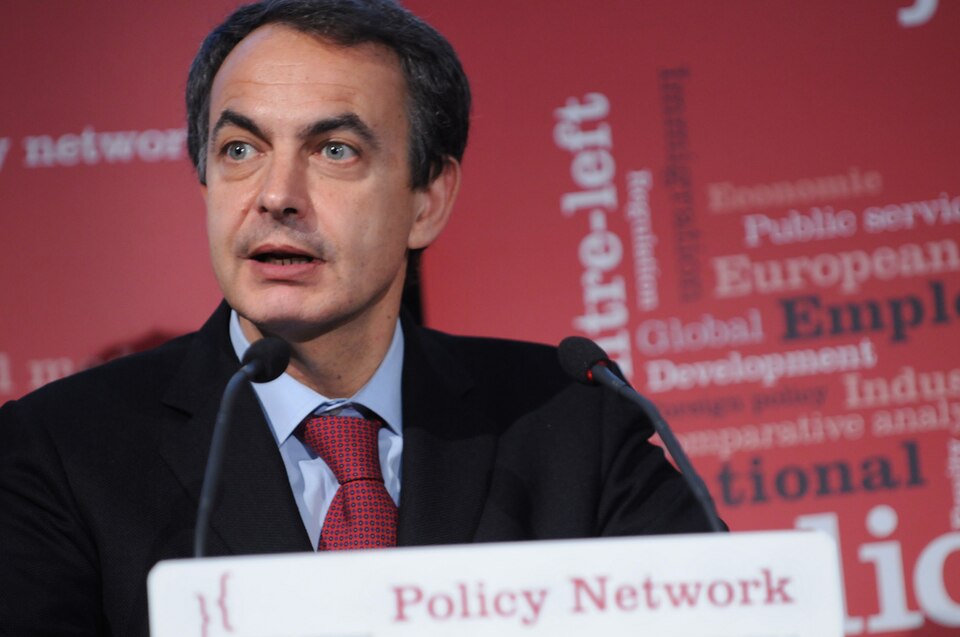
Featured image: Policy Network, CC BY 2.0, via Wikimedia Commons.