

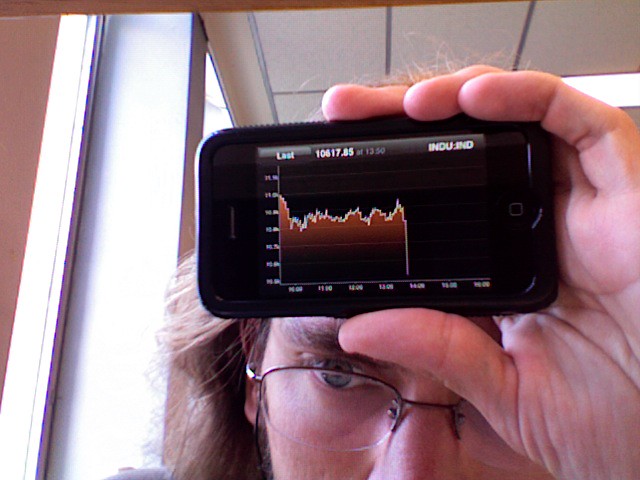
Editor’s note: This article was first published in August 2011, written on 11 August 2011 amid that summer’s market turmoil. Mapfre shares below 2 euros, Banco Popular at 3.01 euros, the ECB buying debt and fears of a French downgrade all refer to that week. Banco Popular failed and was sold to Santander for one euro in 2017.
Making money on the stock market the way the market is right now is, without a doubt, a job for intelligent investors, or rather for investors with nerves of steel. “Keep a cool head when others are losing theirs” is a piece of investment advice that sounds wonderful in theory, but putting it into practice can cause a few headaches.
I’ve never received so many emails from people who are eager to get into the stock market right now, mainly because they see share prices that are “rock bottom”. This morning, for example, you could consider Mapfre below 2 euros a bargain, and Banco Popular at 3.01 euros a share a real treat. Too tempting for an investor who is itching to get started in the stock market. We don’t think this is the best time to start investing in shares.
The problem is that, despite the big falls in share prices, it’s still hard to work out where the bottom is in this new phase of the market, although you can be sure that small, medium and large investors have already made a killing. A few months ago we published an article on what to do when the market is falling, in which we gave three options (there are no others): sell, buy, or hold and acquire new shares. One thing is clear: anyone who held on to their shares this past week without taking new positions has missed out on a high return. We won’t talk about losses, since a loss isn’t real until you decide to sell your shares at a loss.
Will the market go up or down in the coming days?
Nobody can know. If anyone did, they wouldn’t be a financial analyst or a guru, they’d be a fortune-teller. The markets are walking a tightrope, and any news from a rating agency could trigger new falls in share prices.
Investors have their finger on the “panic” button, because right now the markets are watching the (weak) eurozone and keeping an eye on France, where if you blink you may find its credit rating has been cut. The US is watching Europe closely and Europe is watching Wall Street. The markets are all keeping an eye on each other.
That’s why, even though share prices look very low, they could go lower still, or perhaps not. The fact is that nobody can know, and these days a medium-to-long-term investment is a risky investment, so it’s more effective to think in the short term.
For those who do decide to invest in the stock market now, the strategies can be divided into three, always based on the advice and practices of great investors:
1. Pull out of the market
It may seem a “cowardly” strategy, but many investors have taken the advice to head for the beach and stay away from the stock market for now, leaving the risk until September. Let others handle the risk. After all, a stock market investor isn’t a gambler, so there’s no need to be in the game all the time, and sometimes it’s smarter to step back when things are adverse or unpredictable.
2. Fish for what you need
Then there’s another kind of investor who isn’t in the game but is glued to the computer screen. As soon as they see a fish within reach, they reel it in. Now more than ever, the moment you buy into a stock matters more than the moment you sell, since few of us can know when and under what conditions we’ll get out.
This kind of investor follows the market minute by minute while keeping up with the news and the situation in the markets. They know exactly how a piece of news will affect the stock market: the ECB will buy debt (the market relaxes), France could see its rating cut (fear in the market).
They have no intention of holding on to their shares. Having made gains over the course of today, tomorrow, at the slightest sign of another change in the market’s direction, they won’t hesitate to get rid of their shares and buy again when there’s a new dip (as long as there’s no news that sets off investor panic).
3. A cool head: the intelligent investor
This is the investment strategy of the great investors (the masters of investing). These investors know that the market’s movements can’t be predicted, so they won’t attach any importance to them. They’ll go in with large sums of capital, and so they’ll focus above all on one criterion: dividend payments.
They’ll look for companies that pay good dividends, companies whose survival is clearly assured if things turn really ugly. If the company they’ve invested in falls further, they’ll buy more shares in the same company at a much lower price.
They don’t know whether the market will take 3 months, 2 years or 10 years to recover. That doesn’t worry them, because they know that in 15 years’ time they’ll have capital gains as well as having made a lot of money from dividends.
This investment strategy may be for investors who go in with large amounts of capital. Keeping a cool head is only possible when you invest money you won’t need for at least 10 years, and when you also have capital in reserve to increase your position if the market falls a little further.
These investors see investment opportunities while everyone else panics. So now, what will your investment strategy be?
Further reading


