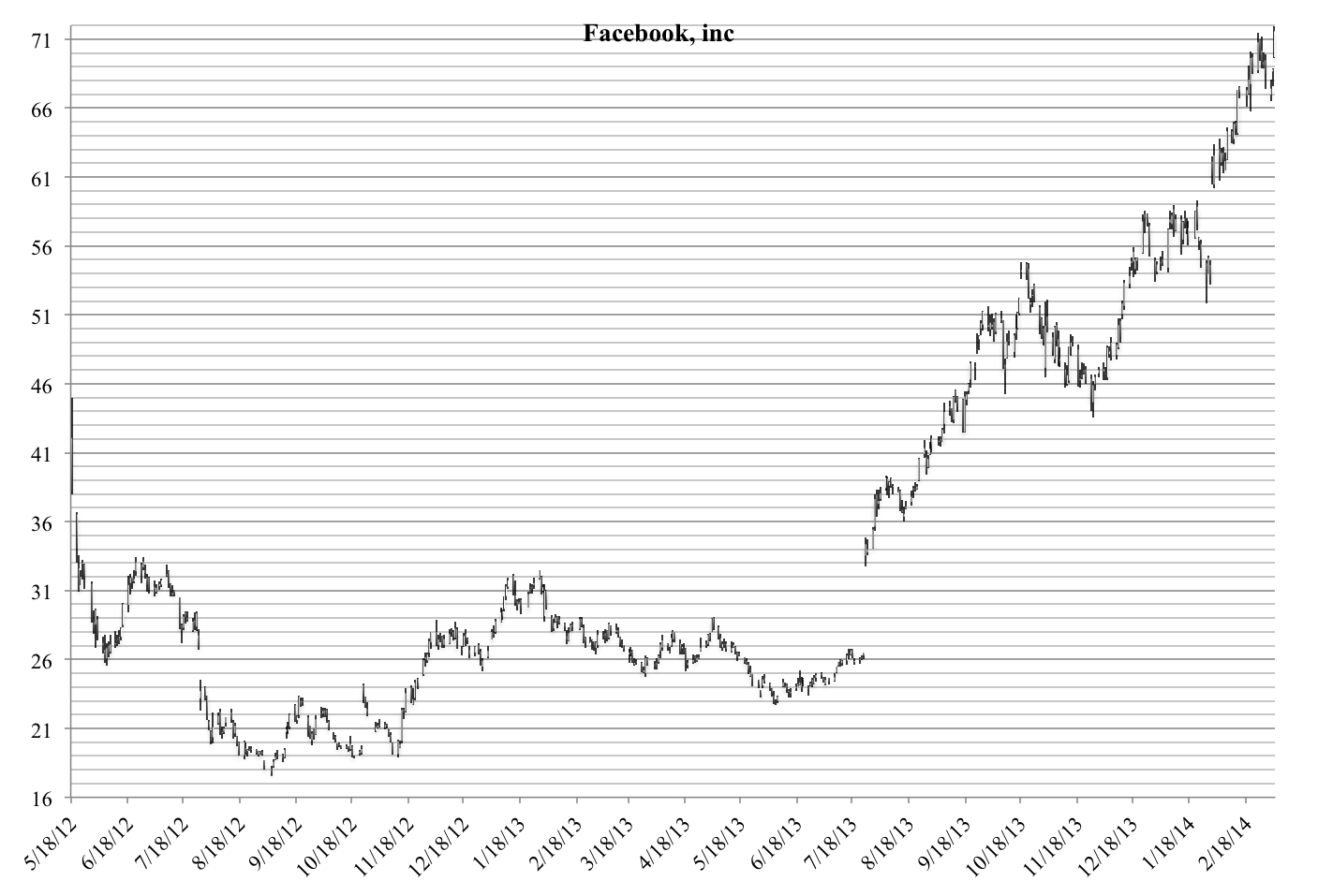
Editor’s note: This article was first published in December 2013; the Facebook share prices discussed ($20, $40, $50 and a possible $60 target), its paid reach for brand pages and the comparison with WhatsApp, Snapchat and Twitter reflect that time. Facebook bought WhatsApp in February 2014. This December 2013 trading decision is kept as a historical record. It is not investment advice.
Last Wednesday I shared on Facebook the decision by our colleague Victoria Bernal to sell her entire stake in Facebook.
She always argued that Facebook had great potential if we stopped seeing the company as just a social network, since in the future Facebook could bring any kind of physical device to market, as Google is already doing. It seems, however, that diversification is not Facebook’s strong point.
Victoria bought a sizeable number of the company’s shares on the very day of the IPO, as I did myself. The difference is that I sold mine the next day to cut my losses, while she held on and averaged down in the $20 area, waiting patiently for the shares to rise. After the price went above $50 a share and fell back to $40, Victoria B. decided to take her profits as soon as the price got close to $50 again.
Her reasons, besides the obvious profit-taking, are a loss of confidence and the acknowledgement that she may have been wrong in how she valued Facebook.
“Even though Facebook is overvalued on fundamentals right now, it is in the hands of speculation, and if it behaves well technically it could reach and even go beyond $60 a share. But having analysed Facebook and tech valuations in general, we would be facing a new risk situation. The dangers will not be immediate, but they are lurking once again.”
If the battle is fought on mobile, Facebook won’t win it
The rise of the smartphone has opened the door to a future loss of profitability for many giants that bet on free services funded by advertising. That model could become obsolete and push companies into decisions that annoy their own users.
Ultimately, if the social media battle is going to be fought on mobile, it is more likely to be won by WhatsApp, or even by apps like Snapchat, which would only need a few changes to become what we know as a social network. Facebook will not win the mobile battle, and although Twitter may have a better future, it will also struggle to monetise its content.
Facebook’s bad strategies
According to Victoria B., Facebook has very good engineers, but lately it seems to have very few people with decent ideas.
As a company, Facebook is not diversifying, even though a considerable number of users are drifting off to the new services that keep appearing. The number of users is still growing, but their behaviour is starting to show signs of fatigue.
Stopping brands from reaching their own followers unless they pay is perhaps the riskiest strategy in the long run. That way, users are not choosing the content they want to see on their wall; they are seeing content that some other brand, one they never chose, is paying for. And brands are annoyed by this decision too.
Annoyed brands + annoyed users = good luck with that.
Facebook says it will show advertising based on your interests, but many users already choose their interests by following the pages they want to see.
Users may accept a few sponsored posts slipping in, but what they will not put up with is having their walls bombarded with unwanted advertising while they miss the posts they really wanted to follow.
This could push Facebook’s revenue up over the next few years, but it will be close to hitting a ceiling in its revenue and profits.
In short, for Victoria B., Facebook is a company whose priorities are currently out of focus, serving fickle users who have more and more alternatives.
As a good follower of the advice of great investors such as Buffett, she also reminds us that technology fads change very quickly (read: Before Facebook and Twitter, TheGlobe was the future. Now it’s gone).
She points out that none of this means Facebook’s stock is going to collapse, only that at $50 the risks are already higher than the potential gains. On the stock market, that equation does not pay off, especially when you can get out with a profit.
And I have to say I agree with her.
Featured image: Joseph A. Rinaldi. Jrinaldi97 at English Wikipedia, CC BY-SA 1.0, via Wikimedia Commons.