

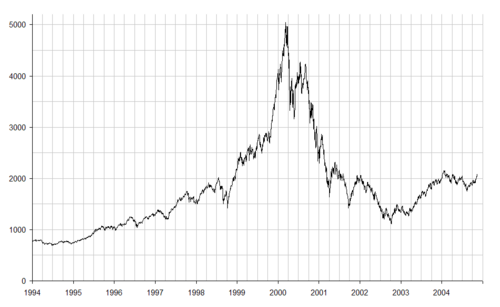
Editor’s note: This article was first published in September 2011, before the Facebook IPO and Groupon’s later fall. The Bubble 2.0 debate and every valuation it cites are from 2011.
We compare the situation of internet companies in the late 1990s with today’s. The comparison is striking: the combined valuation of 25 companies in 1999 is lower than the current valuation of just 5 companies. Note that we did not include Google in the comparison, because in our view Google’s business is now diversified: it has moved into selling hardware, mechanics and renewable energy.
In 1999, more than 300 companies went public during the dot-com bubble. It’s said that at the time this was neither a profitable business nor one that could last, and that those companies were overvalued. Now you hear voices saying that this time is different, because these new companies have a viable business model.
The problem we see is that in today’s market the business is clearly viable, but that doesn’t mean it has to be sustainable over time. It’s also worrying that a company like Groupon, which is losing around 400 million a year, has a valuation of 3.4 billion euros, and a much higher one on secondary markets.
Only time will tell what happens to these companies. Where some analysts say that this time will be different, we think it may be very different indeed: these companies are now valued more highly, have more employees and more private capital, so if the bubble bursts, the consequences for the economy and the markets would be much worse.
Further reading
Featured image: Made by ed g2s • talk ., Public domain, via Wikimedia Commons.



