Editor’s note: This article was first published in October 2014 for the 27th anniversary of Black Monday; the phrase 27 years ago today in the title and opening paragraph refers to 19 October 2014.
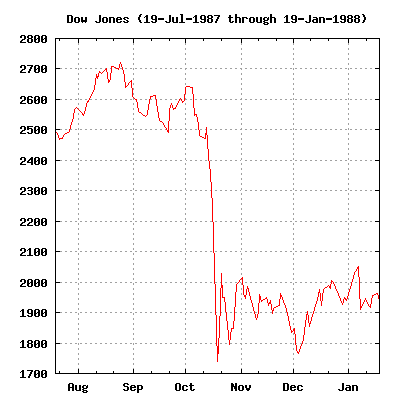
On this day, 19 October 1987, 27 years ago now, stock markets around the world collapsed in a way never seen before in the stock market’s 220-year history.
It is known as “Black Monday” because, in a single trading session, the New York Stock Exchange fell 22.6%. Veteran investors are unlikely ever to forget that day.
The fall began on the Hong Kong stock exchange, which lost 10%, and because of the time difference the losses spread to the European markets as they opened, and then to the United States. By the end of October, Hong Kong had lost 45%, Spain 31% and the United Kingdom 26%, although the hardest hit was New Zealand’s market, which ended up falling 60%.
The crash on that Black Monday set a historical record as the largest percentage drop ever in a single session.
Some brokerage firms ran out of liquidity and were sold that same night, while others were bought the following day.
Despite the panic, the popular advice was to “take advantage of the fall to buy”. Some investors did just that, without counting on the following Tuesday, which was another murky day for the markets.
The Dow Jones opened on Tuesday 200 points up. Buy orders came in one after another, because investors did not want to miss the chance to make money on the recovery from that dizzying fall.
But the Dow Jones soon lost those 200 points and fell another 100, forcing those investors to sell again at a loss as they watched market regulators begin halting trading in some of the biggest companies in the United States to keep them from collapsing.
In the end it was just a scare for those who chose to hold on to their stock portfolios for the long term. Unfortunately, though, many investors and brokerage firms, gripped by panic, decided to sell when the fall was already well advanced, and lost large amounts of money.
In the long run, the stock market carried on with its upward path, and that day left several investing lessons that Warren Buffett himself has made a point of preaching:
- Don’t try to catch a falling knife.
- Don’t make investment decisions based on emotions (panic, greed).
- Buy when everyone else is selling.
- If you are not prepared to watch your shares fall 50% without losing sleep, the stock market is not for you.
See also: A full documentary on the Crash of 1929
Featured image: Edward, Public domain, via Wikimedia Commons.