Editor’s note: This article was first published in November 2014; the results of the 9 November non-binding vote, the references to the Scottish referendum and the recent recession, Podemos as a newly rising party and JP Morgan’s view on Spanish bonds were current then.
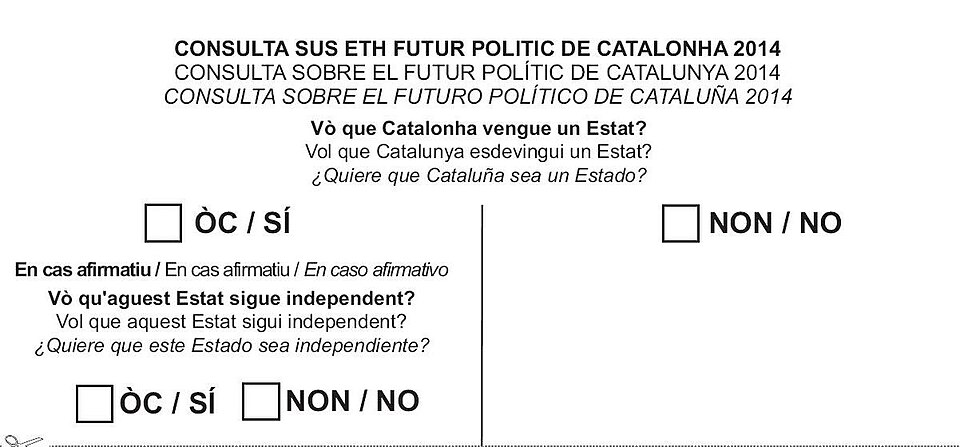
In Spain itself, some are calling the vote on Catalan independence a success, since 81% of voters said yes to independence. But of course, you could also call it a failure, considering that of the roughly 6 million Catalans called to vote, only about 32% actually voted.
In the foreign press, on the other hand, you can find headlines that could be misleading and spook the markets about Spain.
Business Insider’s headline reads “81% of Catalans vote to secede from Spain in symbolic referendum”. A reader who doesn’t go on to read the whole article might think that almost 5 million Catalans have voted for independence.
The Los Angeles Times stresses the Spanish government’s censorship in trying by every means to stop the vote from taking place, casting Artur Mas (then president of Catalonia’s regional government) as the hero of a nation fighting for its independence despite repression by the central government.
The paper also mentions the Spanish Civil War, after which Catalonia suffered four decades of repression under military rule, when Catalans were banned from using their language and holding their local festivals.
It also covers more recent history, presenting a very wealthy Catalonia as a region that has unfairly been subsidising Spain’s poorer provinces.
Reuters, meanwhile, has written a very even-handed article drawing on all sorts of sources and testimony, including the views of expert analysts, who believe these results should be interpreted with caution.
Even so, Reuters could not avoid also talking about a country called Spain where the memory of Francisco Franco and the dictatorship, and of the repression in Catalonia and the Basque Country, still stirs strong feelings.
They mention the fifth of Spain’s economic output that Catalonia accounts for, and whose push for independence has grown during recent years of deep recession.
They also report the remarks of Rafael Catalá (Spain’s Justice Minister), who accused Catalonia’s leader of “organising an act of pure political propaganda without any democratic validity, a sterile and useless event”.
What is clear is that abroad, Catalonia was seen in the same way as Scotland, and many thought a referendum in Catalonia would end in a “no” from Catalans.
With the current figures and the foreign press headlines, it is inevitable that many people will now think there is a high chance that Catalans want independence. So, for now, as JP Morgan has advised, Spanish bonds are not advisable for investors, given the risks of Catalan independence and of Podemos (the left-wing party founded that year) entering government.
With a bad (or good) reading of these figures (I’m the first to admit I don’t know how to analyse them), turbulence on the Spanish stock market could be guaranteed.
Featured image: Generalitat de Catalunya, Public domain, via Wikimedia Commons.