Editor’s note: This article was first published in December 2014; its GDP growth, inflation, policy rate, deficit and debt figures, company data and fund returns are as of late 2014. The UN population projection it cites was overtaken when India passed China in 2023. This December 2014 report by an advisory firm names specific funds; it is kept as a historical record and is not investment advice.
By Lidia Hidalgo, Financial Department, Aspain11.com
India is one of the so-called “emerging countries”, and more specifically it belongs to the BRICS bloc (Brazil, Russia, India, China and South Africa). Even so, it ranks 11th among the world’s largest economies by GDP.
India has a fairly diversified economy. The primary sector has been losing weight, and its future lies in developing higher value-added activities. Industry has opened up considerably to private initiative and foreign capital since 1991; textiles stand out, accounting for around a fifth of the country’s total exports. However, it is the service sector that has given this economy most of its dynamism, contributing more than half of its GDP growth.
The Indian economy is characterised by high savings and investment rates, a fast-growing workforce, a marked expansion of the middle class, and a shift from low-productivity agriculture to higher-productivity manufacturing.
With the election of the new Prime Minister, Narendra Modi, in May 2014, India seems to have returned to the path towards being, along with China, the fastest-growing emerging economy. That had been lost under the previous government, which failed to manage rigorously the reform programme that began in 1991.
This inability to carry out reforms took India from 9% growth to less than 5% over the past four years. According to UN forecasts, India will be the most populous country on Earth by 2028. By then, Modi wants to have completed a programme aimed at making the country a leader of this century. That means attracting capital, improving infrastructure and creating jobs.
See also: The new emerging markets aren’t the BRICs but the MINTs
India’s GDP growth rose to 5% in the 2013/2014 fiscal year, compared with 4.7% the year before. Growth is expected to reach 6% in 2014/2015.
Inflation, meanwhile, remains high: it stood at 10% in 2013. It is expected to end 2014 at around 8% and to reach 7.5% in 2015.
Interest rates were last raised in January 2014, to 8% from 7.75%, with the aim of curbing inflationary pressure and stimulating economic growth, as well as protecting the Indian currency from the turbulence that was hitting emerging-market currencies.
The public deficit fell to 4.5% of GDP in 2013/2014, from 4.9% the previous year. The Modi government set a deficit target of 4.1% for 2014/2015.
On the external side, India’s current account deficit narrowed in 2013 to 2.6% of GDP, down from 4.9% of GDP in 2012. Forecasts for this year have been negative because of more expensive oil purchases and rising imports. The deficit is expected to shrink from 2016 onwards, thanks to higher merchandise exports and a stronger manufacturing sector.
India’s financial system
India’s financial system is largely controlled by the state. The State Bank of India, its associate banks and other nationalised banks hold 80% of deposits and 74% of loans. This shows that the system is not sufficiently developed. However, the controls exercised by the central bank (the Reserve Bank of India) over capital inflows and outflows have limited the impact of the international crisis on the Indian market.
As for the country’s currency, the rupee is expected to appreciate from 2015 onwards, thanks to stronger economic momentum, the adjustment of international markets, the end of the Fed’s QE and the resulting rise in US interest rates.
Main economic sectors
India is the world’s fourth-largest agricultural power. Agriculture accounts for roughly 14% of GNP and employs more than 60% of the working population. The main crops are wheat, millet, rice, maize, sugar cane, tea, potatoes and cotton. India is also the second-largest producer of cattle, the third-largest of sheep and the fourth-largest in fish production.
Coal is the country’s main source of energy (India is the world’s third-largest coal producer). Textiles play a leading role in manufacturing, and the chemical industry is the second-largest industrial sector by size (12% of GNP).
The service sector is the most dynamic part of the Indian economy. It contributes more than 55% of GDP and employs just over a quarter of the working population (around 471 million workers). The rapid growth of the software sector is boosting service exports and modernising the Indian economy.
Investing in India
In recent years, technology, pharmaceuticals and consumer goods have been the sectors that have grown most in the country. Capital goods, oil, gas, infrastructure and banking, however, did not perform as well.
The sectors most attractive to foreign investment are electrical equipment, services (financial and non-financial), telecommunications, transport, fuels, chemicals, construction, medicines and pharmaceuticals, food processing, cement and gypsum products, and of course information technology.
With the new prospects of opening up to foreign investors, the trend may change, and attention may start to turn to the sectors that have been less developed so far.
One factor that has raised some doubts is debt: although it is not very high, debt stands at 67.72% of gross domestic product, despite having fallen in recent years.
Investor confidence has grown, and among the countries shaping up as major investors in India are Japan, the United States and France.
India’s main companies
These are some of India’s largest companies with the strongest presence worldwide. All of them are listed on the Bombay Stock Exchange (S&P BSE Sensex):
- NTPC Limited: coal- and gas-based power.
- Hindalco Industries Ltd: aluminium.
- Tata Group: information technology and communications, engineering products and services, materials, energy, consumer products and pharmaceuticals.
- Oil & Natural Gas (ONGC): oil and gas.
- Bharti Airtel Ltd: communications and technology.
- ITC Ltd: active in five different segments: freight transport, hotels, packaging, agribusiness and information technology.
Oil & Natural Gas (ONGC)
This company is the leader in the energy sector, fifth in Asia and 21st worldwide. Its milestones include:
- It has discovered 6 of the 7 producing oil basins, and has produced 851 million tonnes of crude oil and 532 billion square metres of natural gas.
- It produces more than 1.24 million barrels of oil a day, accounting for 64% of India’s oil production.
- The company holds most of the hydrocarbon production areas.
- ONGC owns roughly a tenth of India’s total refining capacity.
- It also has a good transport network for those hydrocarbons.
- It is the only organisation in the world with all its operating offshore and onshore installations accredited with internationally recognised certifications.
The company focuses on domestic and international oil and gas exploration and production and on generating business opportunities. It also provides links with other parts of the energy business. At the same time, it works to grow this business and to maximise shareholder value.
Its strengths
- All the crude it extracts is “sweet”, the name given to crude with sulphur levels below 0.50%, and 76% of it has a sulphur content of between 0.02% and 0.10%.
- A solid base of intellectual property, information, knowledge, skills and experience.
- It owns and operates more than 26,000 kilometres of pipelines, including subsea lines. No other company operates even 50% of that figure.
- It is engaged in modernising, expanding and integrating all its software and development services.
Tata Group
This company pursues excellence in every sector where it is present, focusing on meeting global standards in every aspect of its operations through processes and systems that reinforce and enable that excellence.
The sectors where this Indian giant operates are:
- Services
- Materials
- Engineering
- Energy
- Consumer products
- Pharmaceuticals
- Information technology and communications
The group’s revenue for the 2013-2014 fiscal year came to $103.27 billion, 6.7% more than the previous year ($96.79 billion). This reflects growth in sales, assets, international revenue and foreign-currency income.
In terms of market value, the most recent figures show that the group’s capitalisation represents 8.5% of the total capitalisation of its benchmark index, the BSE Sensex. It has 3.9 million investors.
By business sector, the group’s workforce is dominated by technology and communications, whose headcount far exceeds the rest and makes up more than 50% of the total.
India investment funds
- Franklin India A Acc $ (LU0231203729)
It seeks long-term capital growth by investing in Indian shares of any capitalisation that offer the best opportunities over the medium and long term. The largest weightings in its portfolio are spread across different sectors of the Indian economy: financials, industrials, technology and consumer cyclicals.
The fund has a Morningstar rating of 4 out of 5 stars and is in the second quartile for returns among the 100 best funds in its category. It is priced in dollars. Its year-to-date return is very high (60.60%), above the rest of the funds in its category and well above its benchmark index.
Its returns: 1 year: 65.31%; 1 month: 4.65%; 3 months: 13.75%; 6 months: 31.20%; and 3 years: 18.50%. Its volatility is 21.14%. Its beta is 0.96, which means that when the benchmark index rises or falls, the fund behaves in a similar way, although being below 1 it carries less risk.
Management fee: 1%.
- BlackRock Global Funds – India Fund A2 (LU0248272758)
The fund seeks to maximise total return by investing at least 70% of its total net assets in equities of companies domiciled in India or that carry out the predominant part of their economic activity there. Most of its portfolio is in financials, technology and consumer cyclicals.
Returns: YTD: 58.75%; 1 year: 62.94%; 1 month: 3.76%; 3 months: 11.71%; 6 months: 30.42%; and 3 years: 17.25%. Its volatility is slightly higher than the previous fund’s (21.44%), with somewhat lower returns.
Management fee: 1.5%.
- Fidelity Funds – India Focus Fund A-USD (LU0197229882)
Like the previous funds, it seeks long-term growth, mainly by investing in equities of Indian companies listed on that country’s markets, as well as in non-Indian companies that carry out a significant part of their activities in India.
Returns: YTD: 56.27%; 1 year: 59.46%; 1 month: 2.90%; 3 months: 11.27%; 6 months: 29.84%; and 3 years: 18.03%. Despite these good figures, the fund has been beaten by the average return of funds in the same category since 2012. Like the other two, it is in the second quartile of the top 100 funds in its category. Its volatility is somewhat lower than the previous ones (20.25%).
Management fee: 1.50%.
- HSBC Global Investment Funds – Indian Equity Class AC (LU0164881194)
This fund focuses its investments on large, liquid companies listed on local exchanges or as ADRs. It offers a year-to-date return of 49.70%, below others in its category (including some of those mentioned above). This fund is already in the third quartile among the 100 best in its category. As well as lower returns than the funds above, it has considerably higher volatility, at 29.62%.
Management fee: 1.50%.
Performance of the Indian stock market (S&P BSE Sensex)
India’s Sensex index began to expand in early 2012 and is still growing today. As I have mentioned throughout this report, over the past two or three years Indian industry has swung from more traditional activities such as farming and livestock towards a new export market in software technology and energy, although the traditional activities remain important for the economy.
India is an excellent location for companies that want to outsource their R&D, software development, call centres or information technology processes.
Because of all this, investors are placing a great deal of confidence in the country, and that is reflected in the performance of its main index, which includes fast-growing global companies that lead their sectors.
Inflation in India seems to have been easing over the past two years (although it remains high), and the local currency has depreciated somewhat, which favours exports and the arrival of new investors who want to set up in the country.
Between 2012 and early 2014 the trend was upwards, but flatter than it has been from that point to the present. This has to do with the rate rise in early 2014 mentioned above, which was meant to control inflation caused by excessive demand for the currency, and therefore raised its value.
As well as the rate rise, this upward trend is due to the change of leadership in May this year, with the arrival of Modi, who from the start of his term has wanted to carry out a programme aimed at making the country a leader of this century. That means attracting capital, improving infrastructure and creating jobs. This message to the outside world seems to be getting through, and India is shaping up to be the fastest-growing emerging economy in the coming years.
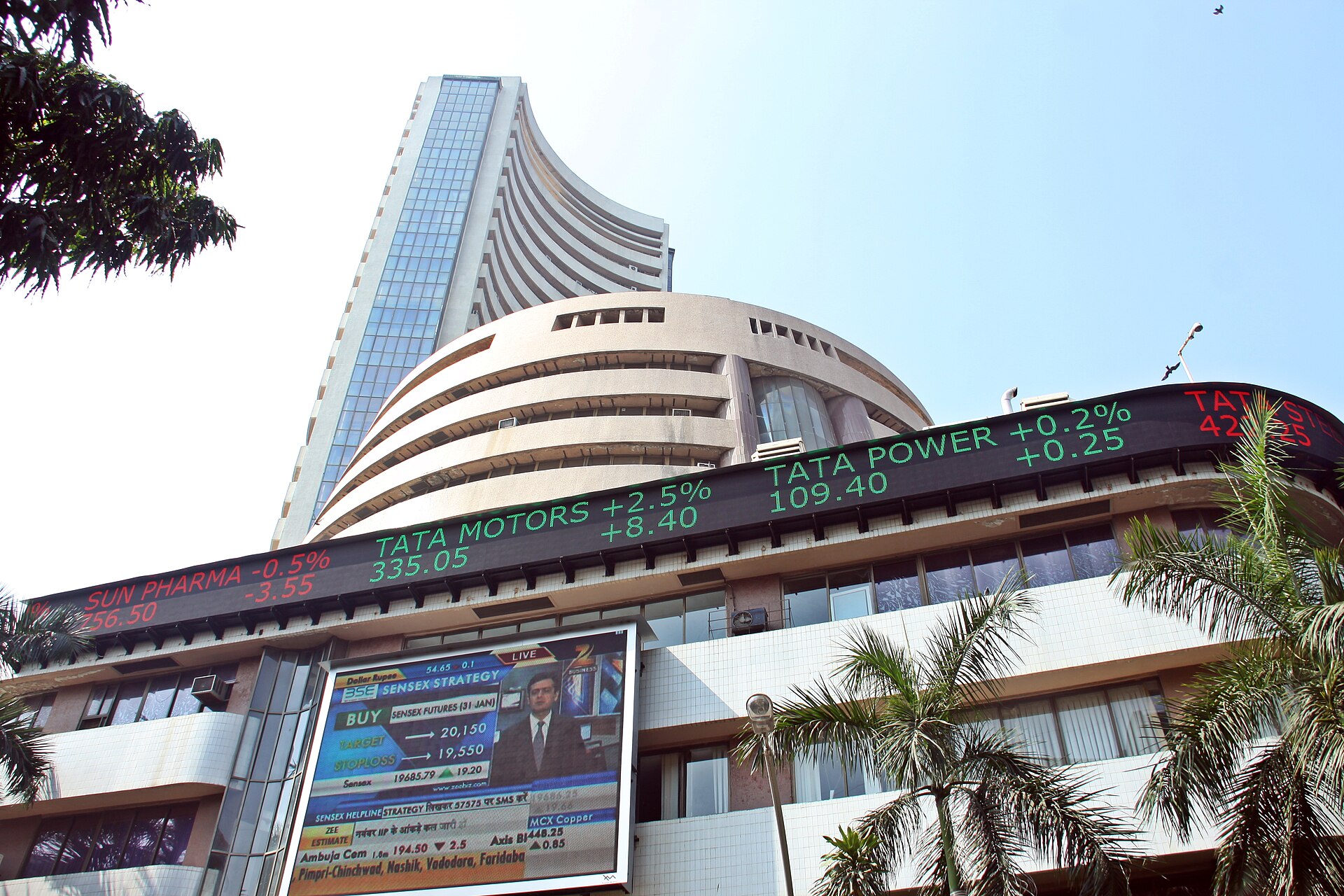
Featured image: BSEINDIA, CC BY-SA 3.0, via Wikimedia Commons.