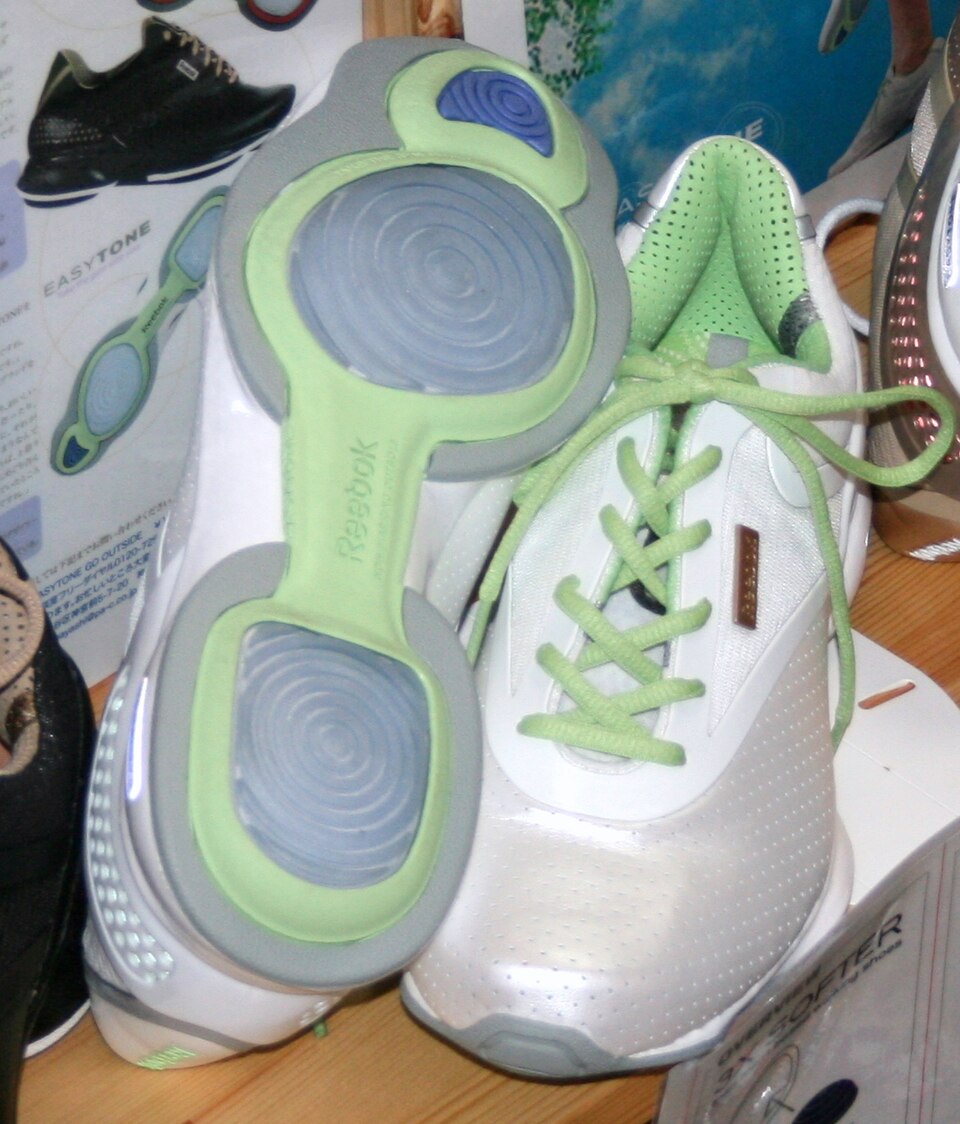
Editor’s note: This article was first published in April 2012. It is a news and opinion piece about Reebok’s EasyTone marketing as it stood at that time.
In September 2011 we reported that the US Federal Trade Commission had ordered Reebok to pay $25 million for misleading advertising over its controversial Reebok EasyTone shoes, because the company was unable to provide the evidence needed to show that the footwear delivered the benefits it claimed.
Reebok hasn’t sat idly by: it commissioned a study from an American university. After 12 weeks of research, the results have been released: women who wore these shoes during physical activity reduced their body fat by 2.5% more than those who wore other shoes.
How is the Reebok EasyTone technology supposed to work?
Reebok EasyTone shoes feature balance pods with Moving Air Technology™, which moves air around in response to your footstep and creates micro-instability with every step. This supposedly helps burn fat and shape and tone the body, and even without weight loss, the reduction in body fat among women wearing EasyTone shoes corresponded to an equivalent gain in muscle mass.
With this new study, Reebok now has a free hand to carry on with its marketing campaign and sell the benefits of the shoes without fear of another complaint for misleading advertising.
For my part, in this particular case I see the same situation as with “double-baked” bread sold as natural bread (in Spain, part-baked loaves finished off in a second baking). Just as double-baked bread isn’t natural, all I see in the Reebok EasyTone case is that the shoes may or may not be what they claim to be. What is clear, though, is that scientific studies find benefits or take them away depending on who the “payer” is, the company funding the study.
Situations like this neither improve nor damage Reebok’s image. What ends up in tatters (once again) is the reputation of science, which sells itself to the highest bidder.
Featured image: Buntyo, CC BY-SA 3.0, via Wikimedia Commons.