

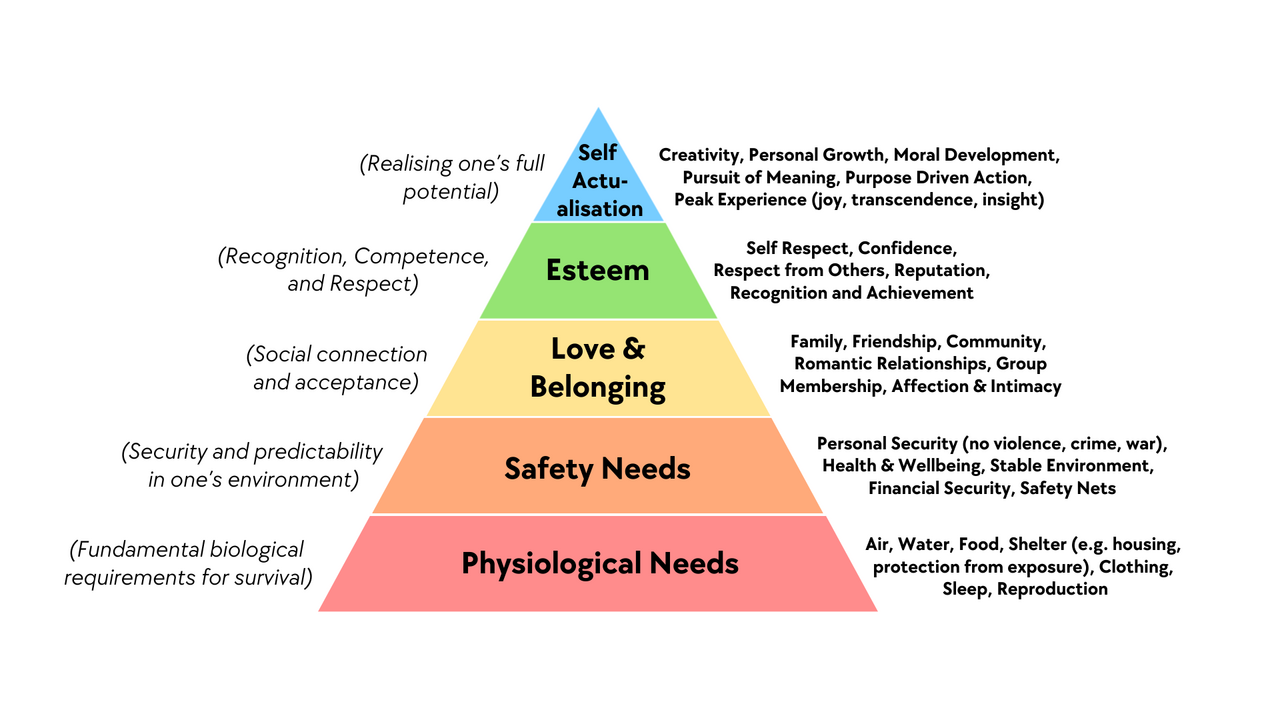
The sum of survival and development is what gives a person true stability, in both their personal and professional life. You, me and the person across the street — all of us, in short — operate on this principle, and the result is who we are and where we are heading.
Many of our daily activities keep us alive, and thanks to those survival needs we go on to reach open-ended, individual goals. A break at any of these stages can spoil a life full of hopes and plans.
At the centre of Maslow’s pyramid sits employment, which sustains survival and lays the foundations for development. That is why it matters so much to a company’s human resources.
Maslow and his theory
The American psychologist Abraham Maslow believed that people have two great motivations throughout their lives: survival and development. Building on these broad principles, in 1943 he drew up the popular Maslow’s pyramid, in which he defined human needs on the basis of those two motivations.
From there he defined five needs — physiological, safety, social, esteem and self-actualization — which have since become fundamental laws for any human resources department.
He called physiological needs those that come from life itself: breathing, eating, sleeping, getting dressed… These are the basic individual needs that allow a person to survive, and he placed them at the base of his pyramid.
Once these primary needs are covered, what are known as safety needs appear: the ones that let a person get by in life. A job that pays the bills, a home that keeps out the weather and shelters the family, and health good enough to handle day-to-day activities in the short, medium and long term.
Next come social needs, supported by family, friends, children and partner. They give a sense of belonging to a society and to a particular group of people, along with the emotional and sentimental side of life that helps a person turn bad things around and cope with the negative side of everyday life.
Esteem needs are the ones that involve the person’s whole environment: what others think of them, the level of self-esteem they have reached, their reputation and the recognition of the people around them. That independence or dependence is what feeds a person’s fears, or their support, in their wider environment.
We reach the top of the pyramid with the needs for self-actualization, or self-development, which only 2% of the population ever reaches. These are especially brilliant people who, surrounded by friends and family, seek beauty, goodness, truth, vitality, creativity, perfection, strength and self-sufficiency. They are like great leaders.
Maslow in human resources
There are no magic formulas or closely guarded secrets, but whether an employee is motivated in their job will depend on how the company develops the levels of the pyramid.
Once their primary or physiological needs are covered — with a workplace and a decent job that satisfies their survival motivation — a person has the motivation and the drive to develop personally.
That climb up the pyramid, the second human motivation, is worked on from both a personal and a professional angle. On the personal side, they will build a worthwhile social life, backed by their personal qualities, that forms a social network together with their family. On the professional side, recognition will support their career: they will earn standing at work and, with their survival secured, keep moving forward in their development.
Esteem is the battlefield of human beings. It swings up and down, depending on a person’s aptitudes, their social networks and how the company treats their professional effort. Once this stretch of the pyramid has been successfully reached, we will get the employee to climb to the next one: that of the leader.
Featured image: Hamish.croker, CC BY-SA 4.0, via Wikimedia Commons.



