

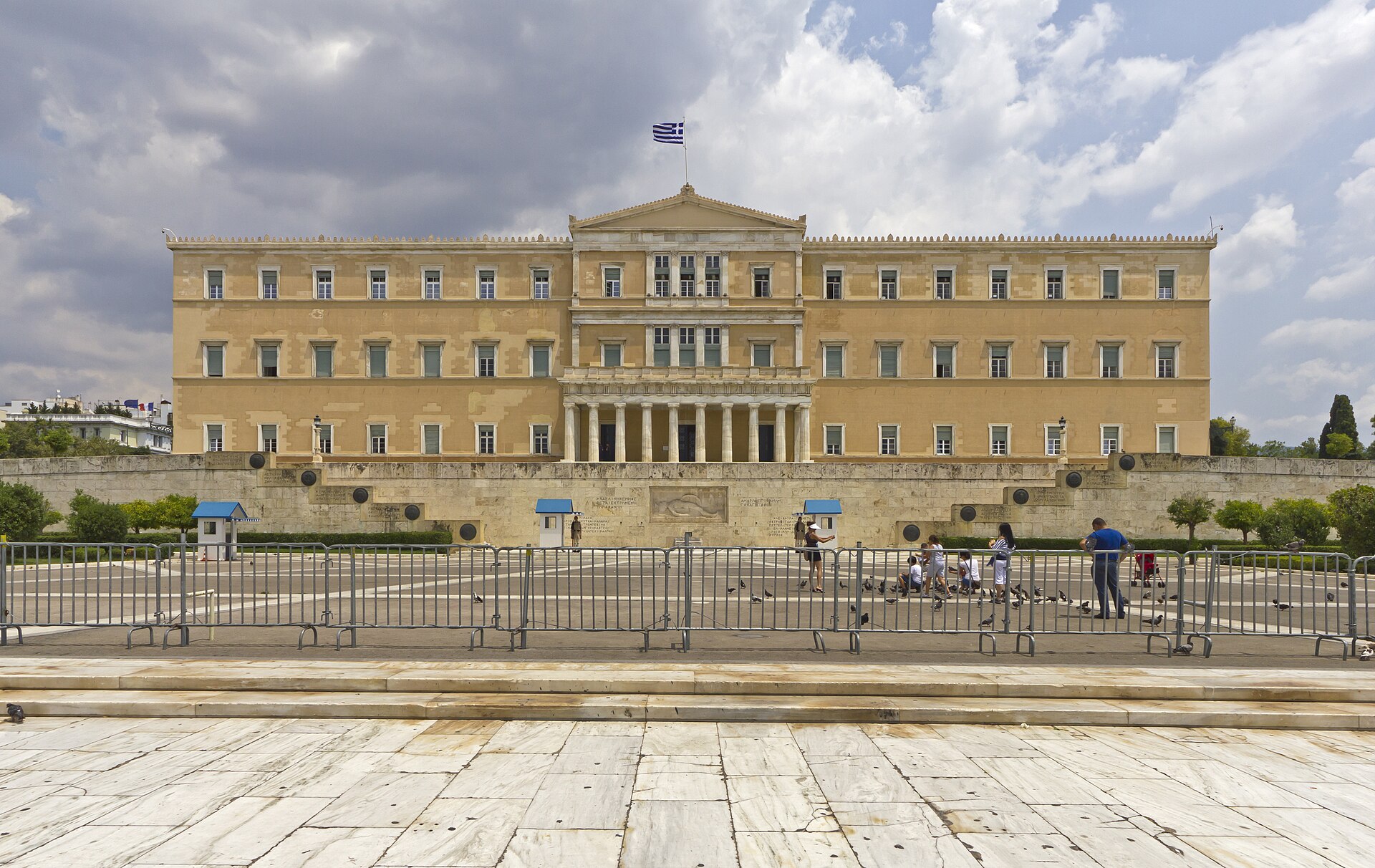
Editor’s note: This article was first published in June 2012 on 16 June 2012, the eve of the Greek election of 17 June. New Democracy won and formed a coalition government, and Greece stayed in the euro. “The bailout” refers to the up to 100 billion euros agreed for Spanish banks on 9 June 2012.
This Sunday Greece holds its general election, and it’s fair to say that what the markets do next depends to some extent on the result. Investors will spend the whole weekend watching the Greek vote. The Spanish financial daily Expansión published Goldman Sachs’s view of the three possible scenarios that could play out.
First comes the scenario Goldman Sachs considers most likely: the newly elected government decides to stay in the euro, though without unconditionally accepting the austerity measures imposed by Europe. In this scenario, Greece would not receive aid from the Troika, although it could keep benefiting from European Central Bank support.
Here, the safe-haven premium on US and German bonds would gradually fade, so their yields would rise. Stock markets would probably go up, but only moderately at first, since the outlook of weak growth would remain.
Then there is a rapid Greek exit from the eurozone, with Greece introducing its own currency. In that case, the ECB would stop its euro funding to the country. Greece would be shut out of the capital markets, forcing the government to run a basic cash budget. Stock markets could plunge into a period of sharp temporary falls, although Europe would already be preparing a contingency plan to soften the impact.
The third scenario would be a slow, orderly and planned exit. Greece would be pushed out even though there is no legal mechanism to force it to leave; in practice this could be done by denying Greek banks ECB support. Goldman Sachs considers this scenario less likely than the first but more likely than the second. The markets would technically have priced it in already, although that wouldn’t prevent volatility.
The same paper also reported the view of the fund manager Henderson Global Investors, which said we are being sold a “fantasy” scenario: if Greece leaves the euro, it won’t be an amicable exit, and if it stays, it will never accept the austerity measures, not least because they have done little good so far. Political mediation would therefore be needed to ease the negotiations and reach a deal.
And while we look at Greece… what’s happening in Spain?
As the old saying goes, Spain is busy pointing at the speck in Greece’s eye and forgetting the beam it’s carrying on its own shoulders, because we could end up like Greece.
Ana Botella (now mayor of Madrid) once came up with a complicated mathematical equation about homosexuality: “If we add an apple and a pear, we can’t get two apples.” That same equation applies to the Spanish economy. If we add an apple (bailout) + a watermelon (debt) + a pear (VAT increase) + a cherry (cuts) + a peach (rising unemployment), blend it all and add a splash of liqueur (more austerity), I don’t get five apples (economic growth) either. What I get is more like a churro, Spanish slang for a botched job (another bailout).
The international media don’t trust us. Bloomberg seems convinced that Spain won’t pull through. The New York Times was even more certain: with a stagnant economy, Spain’s bailout will end in another bailout, and not of the banks this time but of the country, because it has already been shown that austerity measures don’t contribute to economic growth. It’s impossible to grow if we cut people’s purchasing power and raise taxes and VAT. If we don’t grow, we can’t meet the deficit target, and if we can’t meet the deficit target, goodbye to the “credit lines”.
Here are the words María Dolores de Cospedal said forcefully when her party was in opposition: “NEVER, NEVER… NEVER… has any country come out of a crisis by raising taxes and VAT.“
I don’t see why we should think that what wasn’t the solution a few years ago is the solution now, since the situation hasn’t improved; quite the opposite.
That said, the problem isn’t only Spain. Ever since we decided to join this wonderful experiment called the euro, we’ve been part of a community that overindulged as a whole (Spain more than anyone, it must be said), and now we’re in the famous two-speed Europe, where the fastest, Germany, has even more external debt than Spain itself.
The European Union is made up mostly of sick countries, a situation nobody planned for when the eurozone was created. If you put one rotten pear in a crate, it can spoil some of the others; but if you put in 20 rotten pears and a single healthy one, what comes out of that crate? Obviously, the apple Ana Botella was missing.
People often say that once whatever has to happen in Greece happens, there will be no more bad news for the markets. That isn’t true. Once the Greek elections are over, the ghost of bailouts will appear in other eurozone countries, and we’ll also face a new economic slowdown in the United States, Japan and Europe. That will lead us into the long-predicted Perfect Storm, where one conclusion will become clear: we have piled up debts that can never be repaid, so the solution will lie in measures other than the ones the major economic powers, and above all Europe, have been using so far.
Featured image: A.Savin, CC BY-SA 3.0, via Wikimedia Commons.



