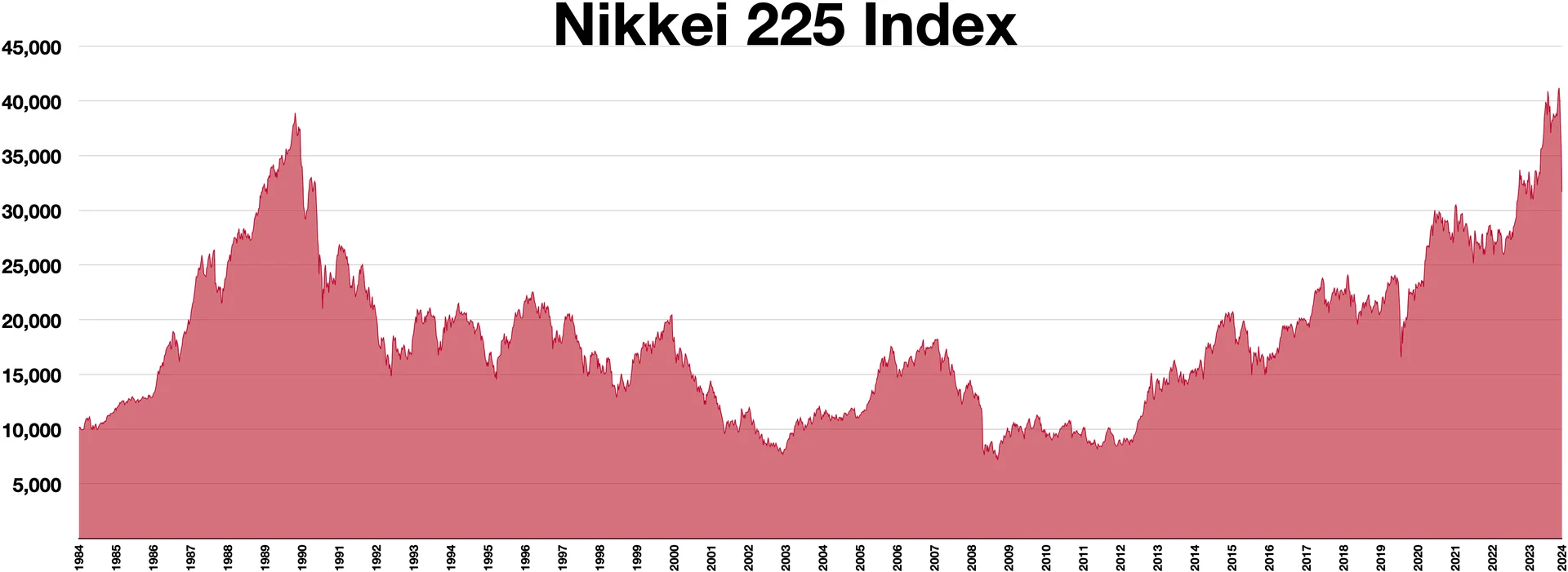
Editor’s note: This article was first published in June 2012; the index levels cited (Nikkei, Nasdaq, Ibex 35) are as of that month, as are its comments on the market, the eurozone and the Greek elections. The Nasdaq passed its 2000 high in 2015 and the Nikkei its 1989 high in February 2024.
If someone asks me what the most profitable long-term investment is, my answer is still the stock market. Of course, if we look at the world’s indices in the wake of the global financial crisis, Japan’s stock market (the Nikkei) hit its all-time high about 23 years ago, at 38,900 points. Today it stands at around 8,400 points, a loss of 78%.
The Nasdaq closed at 5,048 points 12 years ago. Today it’s at 2,850 points, down 43%. In other words, anyone who put leveraged money into the stock market thinking long term has lost a lot of capital, and in some stocks as much as 85%. As for the Ibex, I remember that in October 2007, when a few “conspiracy theorists” were already warning about the crash we were heading for, I decided to get out of the market when it stood at 15,507 points. Today the Ibex is struggling not to fall below 6,700 points, and at times it has dipped below 6,000, hitting its all-time low. As we can see, even though it’s the most profitable investment, it isn’t always the best investment option.
If someone asks me which part of Spain is best for a few days at the beach, I’d recommend the Andalusian coast. But if you go on 3 February, you’ll be a bit cold and won’t find what you were looking for. So yes, the stock market is the most profitable investment, but not when the market is falling, as is more than obvious. There are thousands of manuals on investing in the stock market, but each piece of advice they give has to be interpreted individually, looking at our investor profile and, of course, at the market.
Since the way big fortunes invest often doesn’t fit our investor profile, today we look at the mistakes people like you and me make when following the guidelines you’d find in the “good stock investor’s manual”.
1. Be a long-term investor
Investing for the long term only requires buying a portfolio of shares that is as diversified as possible and ignoring the financial news so you don’t panic. You’ll see your shares fall, rise and fall again, but over time they should rise above inflation, and if you’ve picked a good, undervalued company with potential, you could make up to 30% in a couple of years.
Of course, when markets fall, very few stocks escape the “fire”, and as a rule, with a few notable exceptions (Inditex, Grifols, Apple, Coca-Cola…), everything goes down. Our friend Gregorio Horga published an article on Rankia arguing that the stock market pays off in the short term, not the long term. “Invest short term and take your profits before the market turns,” he says. He also advises: “Don’t put all your savings in the stock market.”
Why does he say this? Quite simply, Gregorio invested his savings during the boom years, and his portfolio includes bank stocks, among others (some of the hardest hit), so he has watched it fall and fall until it lost 50%.
There’s nothing wrong with putting your savings into the stock market as long as you choose a rising market, because then your savings will multiply. In a way, Gregorio’s mistake was not selling his shares after two weeks of falls, even if it meant taking a loss. Of course, most people didn’t realise how serious this crisis was and thought that after the market drop everything would go back to normal.
2. There are no short-term or long-term investors, only short-term and long-term shares
People say that a long-term investment is a short-term investment that went wrong. The problem is that few people have a clearly defined investment strategy.
Some people starting out on the stock market tell you they’re not long-term investors: they plan to buy some shares and, as soon as they go up a little, sell them and take the profit. That’s when you ask them: “And if you buy at €3 and the shares drop to €2, what would you do?” They answer that in that case they’d wait for them to go back up. Well, there we have a long-term investor, because the short term didn’t work out.
So there are no long-term or short-term investors, just shares that are worth holding for the long term and others you need to get rid of as soon as possible.
3. Invest like Warren Buffett
Warren Buffett is the best example of an investor. You can read his investment advice and guidelines. Then again, we also published an article warning that if you’re not Warren Buffett, be careful about investing like him.
What does Buffett do when his shares fall 10%? Mr Buffett holds on to them, because he’s a long-term investor. That’s what Gregorio did, and the strategy didn’t work for him.
If your shares fall 5% and there’s nothing to suggest they’ll recover next week, quite the opposite, and they look set to keep falling, why should you sit and watch your investment lose 15% (whether or not the price recovers later)?
If there are signs that the shares will keep falling for a week, sell them and buy them back cheaper. You might lose an initial 5% when you sell, but on the way back up you can gain instead of losing the other 10%, which was a certain loss.
I’ve made the mistake of averaging down myself. I learned my lesson, so now, if a share falls more than I’d expected, I sell it and take the loss, planning to buy it back later if I really want it in my portfolio, because news about companies changes very quickly.
See also: Peter Lynch’s principles: beating Wall Street
Then again, we’re back to the same point: maybe I make this decision at a time when the market is still bearish, and I don’t want to risk a bad outcome in the Greek elections sending the share price to new lows. If we were in a bull market, I wouldn’t worry about seeing my shares fall 10%.
4. Stay away from market noise
This advice comes from the good stock investor’s manual, and in fact it was great advice. I say was because it no longer is. In the past, people talked about shares as if they had a life of their own, setting a resistance level or a floor “all by themselves”, forgetting that investor panic would break through a share’s floor (support) in 0.2 seconds at the first macroeconomic scare.
Today technical analysis has become useless, overtaken by political news. In fact, if you want to make the right decisions on the stock market, forget technical analysis and focus on studying countries’ economic policies and possible agreements.
Whether the Ibex goes up or down next week won’t depend on support and resistance levels but on Greece, Merkel, the IMF and so on.
In a calmer scenario, you should keep an eye on what’s being said about the companies in the index you invest in.
5. Buy when everyone is selling and sell when everyone is buying
Clearly, if we sell when lots of people have bought, we’ll sell our shares at a much higher price than we paid for them. That’s a profitable investment by any standard. When everyone is selling, we have the chance to buy the stock much cheaper. We buy it nice and cheap and sell it when it goes up. That’s the theory. Now let’s move on to practice.
Buy when everyone is selling, but… if they’re selling, there’s a reason. Buying a share at its all-time low is a bargain, and this is one investing mistake I can personally own up to. I’ve bought shares at their all-time lows, letting myself be swayed to some extent by technical analysis, because the share had spent weeks testing that support and everything suggested the support was solid. Well, those shares have been hitting new all-time lows week after week.
As the great investors say, buying shares while they’re falling is like trying to catch a falling knife. You risk cutting yourself.
The reverse is also true: if we bought a stock cheap and it’s rising steadily, why sell it? Those are the shares worth holding until they’re no longer worth holding.
6. If you’re going to do it, do it now!
I know a young investor with a talent for investing who has a rather unusual method for making an average of €60 a day, trading with blocks of €1,000–1,200. His thing is linked conditional orders. First thing in the morning he sends an order to the market with a limit price well below the opening price. He picks highly volatile stocks, ones that swing through the session with more than 6% between the high and the low. He only looks for a 5% gain, not a euro more.
He rarely gets it wrong, because if the price isn’t reached that day, the next day he usually finds the counter-order has been triggered.
The other morning he told me what had happened to him. Relevant news about listed companies usually comes out outside market hours, although sometimes it arrives during the trading session.
This young man learned that Telefónica would finally invest 100 million euros in Grupo Prisa, news that had already pushed up Prisa’s share price earlier. Prisa was trading at €0.38 when the alert reached him.
He started to have doubts about whether the news would push Prisa’s price up or whether it wouldn’t matter. In those seconds or minutes of second-guessing, Prisa shot up 9%. He quickly decided to buy, but by the time he placed the order, Grupo Prisa had already risen 16%, and it went no higher.
As we’ve said on other occasions, intuition is sometimes the best adviser on the stock market. If you’re going to do something, do it as soon as possible, because taking too long to decide can cost you part of the profit you were hoping for.
These are some of the pieces of advice usually given for investing in the stock market, and that same advice, or a poor reading of it, can lead us into disastrous mistakes. The truth is that there’s no good or bad advice, only situations where it can be applied and others where it can’t.
What is certain is that right now the stock market isn’t one for the long term, because it isn’t clear whether the market is in a rebound phase or still falling. Macroeconomic and political news from the eurozone is giving investors around the world a hard time, and since there’s no clear scenario, now is not the moment to think long term, and certainly not to put all your savings into the stock market. That said, I would advise you to build up positions in some stocks with the short term in mind, without making any of the investing mistakes we’ve been discussing on the blog over time.
Featured image: Wikideas1, CC0 1.0, via Wikimedia Commons.