Editor’s note: This article was first published in March 2011. It was written on 14 March 2011, three days after the Tohoku earthquake and tsunami. The toll of 1,600 dead and 10,000 missing, the damage estimates and the 1.7% Tokyo market fall were early figures; the final death toll was far higher.
As of today, it is already possible to estimate the losses caused by the powerful earthquake in Japan. To begin with, the greatest loss amounts to 1,600 lives and, so far, 10,000 missing, and a new tsunami and stronger aftershocks cannot be ruled out, according to Italy’s National Institute of Geophysics and Volcanology (INGV).
The earthquake shifted the Earth’s axis of rotation by 10 centimetres and moved the island of Honshu by about 2.4 metres.
As for economic losses, the figure being discussed is more than $100 billion for the country’s economy, not to mention the losses for insurance companies, which according to estimates will have to cover more than $35 billion in damage to insured property.
But the economic disaster isn’t limited to Japan. The world’s third-largest economy is not only a producer but also an importer of food: most of what the Japanese eat is imported. Food supplies are already running short, and people are calling on the government to solve the problem quickly.
Then there is energy production, more than 11% of which is nuclear. With the nuclear reactors shut down, industrial production is being affected.
Another issue is sovereign debt. After disasters like these comes the work of reconstruction, which drives up public spending. Although most of Japan’s public debt is financed domestically, the country will be forced to seek help at a time when distrust among international markets prevails.
For now, the Tokyo Stock Exchange has not suffered significant losses, having fallen only 1.7% after news of the earthquake. For comparison, after the 1995 Kobe earthquake the Japanese stock index lost 15% in the first week and 25% over the six months that followed the disaster, although it is still too early to predict how the Japanese index will perform.
The World Bank has already offered its help with the country’s recovery, and the Bank of Japan (BOJ) has already injected 483 million euros into more than 10 financial institutions in the devastated area. Let’s hope the country gradually gets back on its feet.
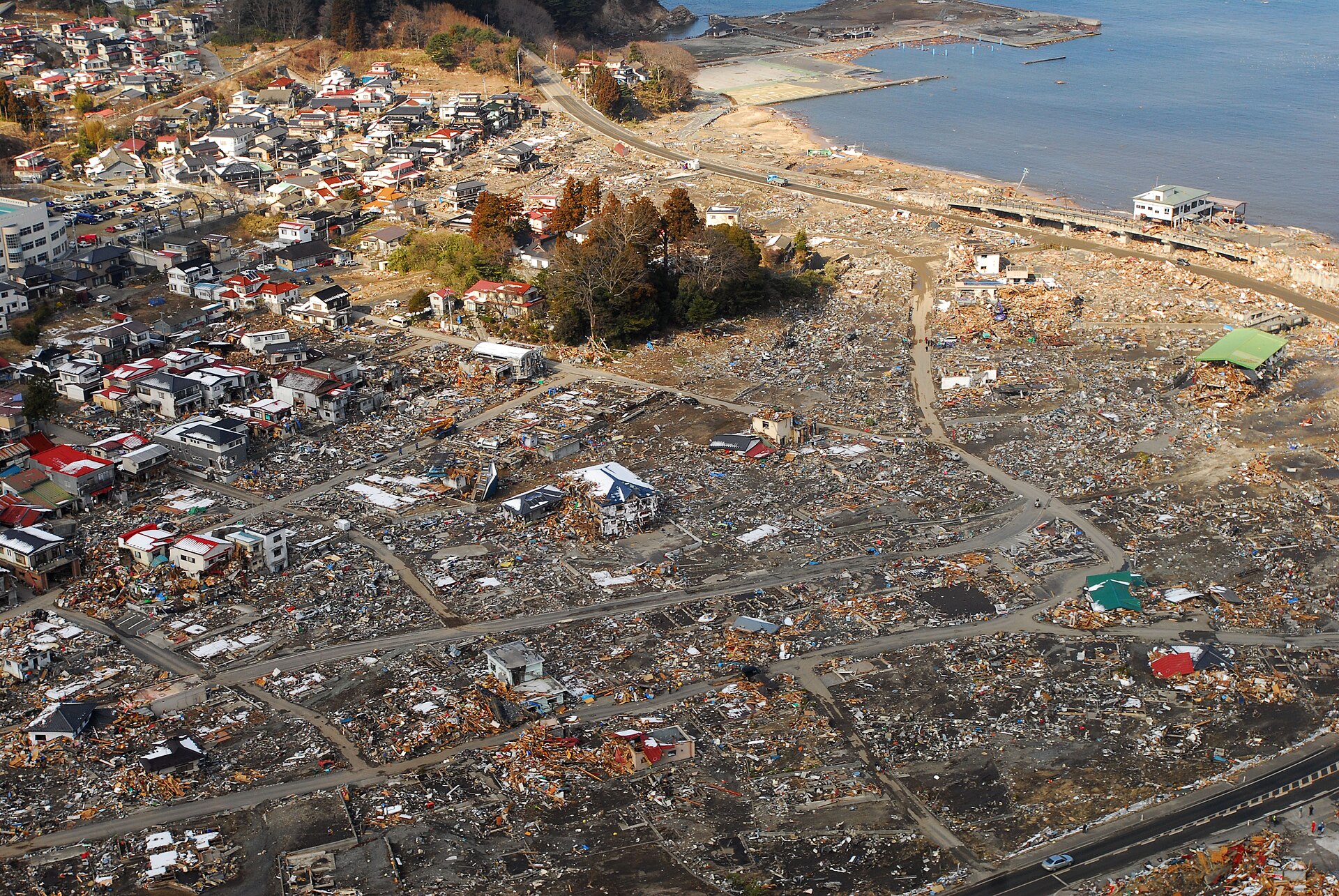
Featured image: U.S. Navy photo by Mass Communication Specialist 3rd Class Dylan McCord, Public domain, via Wikimedia Commons.