

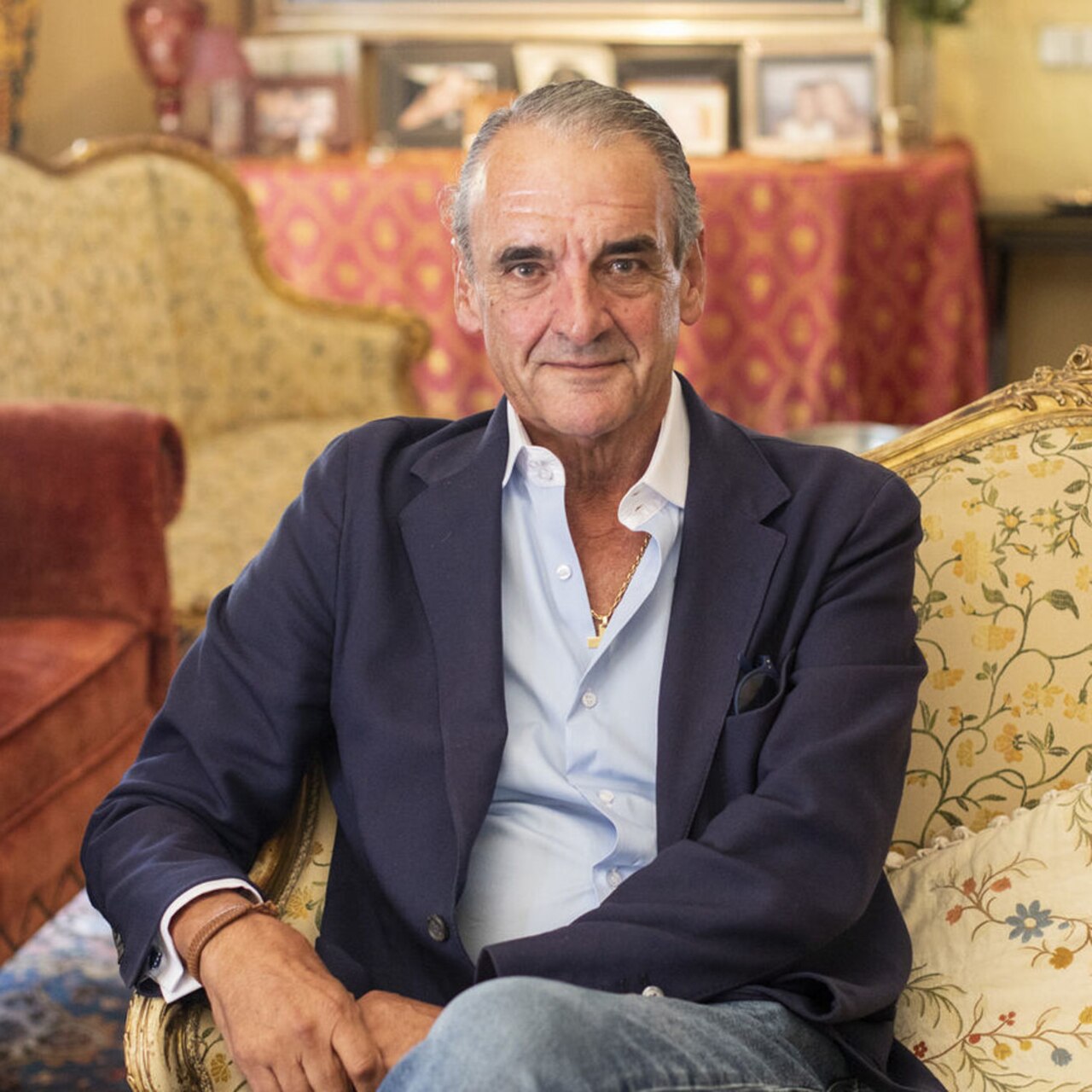
Editor’s note: This article was first published in June 2011, when the launch of ‘Una hora con Mario’ on Intereconomía made the news. The show and Mario Conde’s situation have changed since then, and his statement “I am currently completely free” dates from 2010.
Mario Conde is going to present a new programme on the Intereconomía channel, “Una hora con Mario” (“An hour with Mario”), and it has already ruffled some feathers on social media. Amid the protests and demonstrations against the banks and corruption, you could say that Mario Conde isn’t exactly the most fitting figure right now. Nothing personal: it’s just that he was a banker, and he was also accused of misappropriating a few hundred million of the old pesetas.
Even so, Intereconomía is guaranteeing itself a good audience share with this slot. Like it or not, plenty of young people, and not so young people, will be curious to hear what Mr Conde has to say. I should point out that Mario Conde had an enviable professional career and climbed the ladder on his own merits until he crossed over to the “dark side” of the law, as seems to be happening more and more lately with people who reach positions of power.
For those who don’t know Mario Conde’s career, here is a short biography he wrote himself, taken from his own blog on Intereconomía.
Mario Conde’s biography
I was born in Tui (Galicia) on 14 September 1948. My mother’s family comes from Covelo (Galicia) and my father’s from Allariz (Galicia). So there’s no doubt about my Galician roots.
I studied law at the University of Deusto, and in 1973 I joined the State Counsel Corps (Abogados del Estado), first in my year and, some say, with the best mark in the entire history of that prestigious legal body.
But I was drawn to the business world, so three years later I started out at Laboratorios Abelló S.A., and from there I became vice-chairman and chief executive of Antibióticos S.A., as well as a shareholder with close to 25 per cent of the share capital.
In 1987 I led the sale of Antibióticos to Montedison, the powerful Italian chemical and pharmaceutical group. They paid us 450 million dollars of the time for 100 per cent of the company. My share came to 13 billion of the old pesetas. Together with Juan Abelló, we decided to invest a large part of the money from the sale of Antibióticos in Banesto, a bank with an industrial tradition.
In October 1987 we were both appointed directors and vice-chairmen; in November I was appointed chief executive, and in December chairman. I created Corporación Industrial Banesto and was its chairman. I also chaired the insurer La Unión y el Fénix and the Fundación Cultural Banesto. On 28 December 1993 the government, with the agreement and consent of the opposition PP (Aznar), decided to take over Banesto. In November 1994 the public prosecutor, on the government’s orders, filed a criminal complaint against some members of the board, but not all of them: only those closest to me.
On 24 December 1994 I was sent to prison on remand. On 26 February 1998 I was sent to prison a second time, for misappropriating 600 million pesetas in a case known as Argentia Trust. Five years later the Swiss courts sent documents proving beyond the slightest doubt that I had not taken a single peseta of that money, which had been collected by well-known intermediaries in Spanish society, who were never convicted, not even for lying at trial.
On 29 July 2002 I went to prison for the third time, now under a Supreme Court sentence that doubled the one imposed by the National High Court (Audiencia Nacional) in the Banesto case, raising it to twenty years. In 2008 I was granted parole. The UN Human Rights Committee, to which I complained against the Spanish state (defended by the State Counsel), annulled the sentence imposed by the Supreme Court for violation of human rights. The Spanish state has not complied with the Committee’s annulment, despite having signed and ratified the Covenant on Civil and Political Rights.
I wrote a first book, “El Sistema: mi experiencia del poder” (The System: My Experience of Power), in 1994. Some say it had something to do with my going to prison… I am also the author of “Derecho penitenciario vivido” (Prison Law, Lived, 2006), “La palabra y el Tao” (The Word and the Tao, 2008), “Cosas del camino” (Things Along the Way, 2009) and “Memorias de un preso” (Memoirs of a Prisoner, 2009), which as of today (8 April 2010) is in its ninth edition. For now, that is all I can tell you in summary about my outward career, except to make clear that I am currently completely free.
Featured image: Periodista digital, CC BY 4.0, via Wikimedia Commons.



