Editor’s note: This article was first published in September 2021, but several of its figures are older: the UNIDO manufacturing rankings date from 2002 and 2010, and the poverty figures for China and India from the mid-2000s. The World Bank’s poverty line of 1.25 dollars a day has since been raised.
There are many clichés about economics and capitalism, and it never hurts to question some of these myths from another angle. Here are 10 things you probably didn’t know about economics and capitalism.
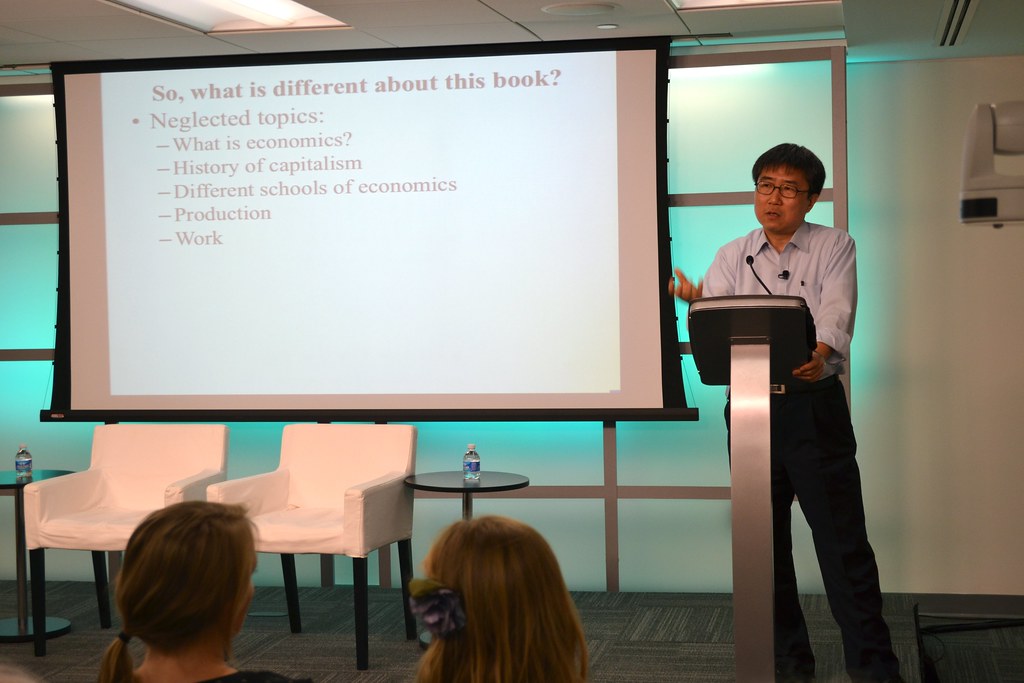
To do this, we are going to draw on the work of Ha-Joon Chang, one of the most respected economists in the world, author of the theory that “the washing machine has changed the world more than the internet”, and author of 23 Things They Don’t Tell You About Capitalism, among other books. His work offers a totally objective and impartial view, free of political colours.
Some economists from the neoliberal school might not agree, but Chang brings up some curious facts that can’t be ignored.
10 things you didn’t know about economics and capitalism
1. Economics was originally called “political economy”
Economics has never been, and never can be, a science. Economics is politics. However, the dominant neoclassical school of economics managed to change the name of the discipline from the traditional “political economy” to plain “economics” at the beginning of the 20th century.
The neoclassical school wanted economics to become a pure science, stripped of its political dimensions, so that it would be an ethical discipline. And that change was a political move in itself.
But it didn’t succeed, so economics will inevitably always involve subjective value judgements.
Economics is the only field in which two people can win a Nobel Prize for saying exactly the opposite.
2. The Nobel Prize in economics is not a real Nobel Prize
Unlike the original Nobel Prizes, such as those for physics, chemistry, physiology or medicine, literature and peace, which were established at the end of the 19th century by the Swede Alfred Nobel, the Nobel Prize in economics was created by the Swedish central bank (Sveriges Riksbank) in 1968.
That is why its official name is the “Sveriges Riksbank Prize in Economic Sciences in Memory of Alfred Nobel”.
Today we know that members of the Nobel family criticised the Swedish central bank for giving prizes to free-market economists whom Alfred Nobel himself would not have agreed with, and whom he might even have disapproved of.
3. The world’s first welfare state was created by the right, not the left
It was the arch-conservative Otto von Bismarck who first introduced the welfare state. So, contrary to what many people believe, the welfare state was originally an invention of the right, an invention of capitalism.
Bismarck hated socialism, but he was not an ideologue. Basically, he realised that if workers weren’t given a minimum safety net, the socialists would win them over.
So he kept workers happy by creating the world’s first welfare state. This suggests that, contrary to their own self-image, the greatest enemies of capitalism may be the very people who want to destroy the welfare state.
4. Capitalism did better in the era of heavy regulation and high taxes, between the 1950s and the 1970s
Despite what we hear these days about the economic harm done by high taxes and heavy government regulation, the advanced capitalist economies grew fastest between the 1950s and the 1970s, when there was more regulation and taxes were high.
Per capita income in Western Europe grew at an astonishing rate of 4.1% a year.
Japan grew even faster, at 8.1%, starting the chain of “economic miracles” in East Asia over the following half-century.
Even the United States, which at the time was the slowest-growing economy in the “rich world”, grew at an unprecedented rate of 2.5%.
Since then, the per capita income of these economies taken together grew by only 1.8% a year between 1980 and 2010, when they cut taxes for the rich and deregulated their economies.
5. No single economic theory can explain Singapore’s economy
This is what is called the “Singapore problem”. If we read the “standard theories” about Singapore’s economic success, you will only hear about free trade and Singapore’s welcoming attitude to foreign investment.
What people, analysts and economists don’t understand is that almost all the land in Singapore is owned by the government, while 85% of housing is supplied by the government’s housing corporation.
Twenty-two percent of GDP is produced by state-owned enterprises (including Singapore Airlines), when the world average in this respect is only around 9%.
To put it more clearly, no economic theory on its own can explain Singapore’s success. Its economy combines extreme features of both capitalism and socialism.
In this case, every theory is partial. Reality is more complex.
6. The internet was invented by the US government, not by Silicon Valley
If we look at the big tech companies that exist today, their business models and their high profits, we would no doubt think that all of this is the result of the entrepreneurial spirit and genius of Silicon Valley. But all these projects came about not thanks to the private sector, but thanks to the US government.
The Pentagon funded the development of the first computers, and the internet grew out of a Pentagon research project.
The semiconductor, the foundation of the information economy, was initially developed with funding from the US Navy.
7. The “lazy” Greeks, Italians and Spaniards are the hardest-working people in the rich world after the South Koreans
After the eurozone crisis, the Greeks were vilified as lazy people living off the workers of the north.
But they put in more working hours than any other country in the rich world except South Korea. Greeks actually work 1.4 to 1.5 times as much as the Germans and the Dutch, who are supposedly labelled workaholics.
Italians and Spaniards also defy the myth of the “lazy Mediterraneans”, working as much as Americans and 1.25 times as much as their German neighbours.
The problem with the countries of southern Europe is not a question of working hours, but a question of productivity.
8. Switzerland and Singapore don’t live on banking and tourism alone
Many analysts argue that we have entered a post-industrial world in which “making things” is not very important, since service industries have become the engine of economic growth.
And they cite Switzerland and Singapore as examples of success stories based on services. Haven’t these two countries shown that you can become very rich through services such as finance, tourism and trade?
In fact, these two countries show exactly the opposite. According to UNIDO data, in 2002 Switzerland had the highest manufacturing value added (MVA) per capita in the world, 24% higher than Japan’s. In 2010, Singapore ranked first, producing 48% more MVA per capita than the US.
Switzerland came third in that ranking.
9. Most poor people don’t live in poor countries
Currently, around 1.4 billion people, or roughly one in five people in the world, live on less than 1.25 dollars a day, which is the established international poverty line. Below this level, survival becomes a challenge.
But most poor people don’t live in poor countries. More than 70% of people living in absolute poverty live in middle-income countries.
In the mid-2000s, more than 170 million people in China (about 13% of its population) and 450 million people in India (around 42% of its population) lived on incomes below the international poverty line.
This shows the huge challenge facing the two most populous countries in the world.
10. Finland, one of the most equal countries in the world, has grown faster than the US
Not only is there plenty of evidence showing that greater inequality produces worse economic and social outcomes, there are also many examples of more equal societies growing much faster than comparable but more unequal ones.
And this is where Finland comes in. Despite being one of the most equal societies in the world, Finland has grown much faster than the United States, one of the most unequal societies in the rich world.
See also: 10 funny quotes by economists about economics
See also: The financial crisis and the stock market bubble of 2022
Featured image: New America, CC BY 2.0, via Flickr.