

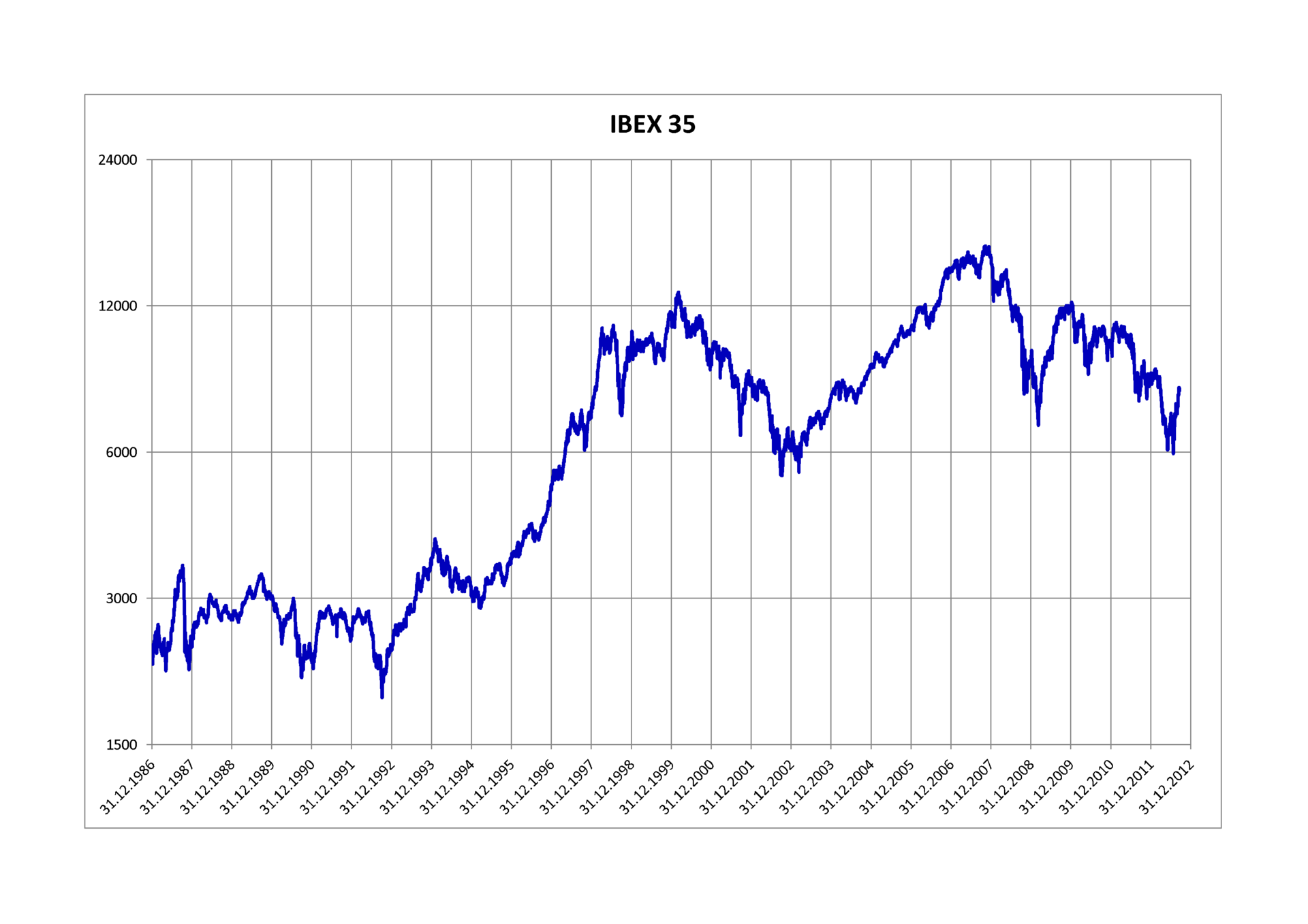
Editor’s note: This article was first published in June 2012; all market levels and forecasts are from 1 June 2012 and have long expired, including the IBEX around 6,000 points, a risk premium above 540 points and Bankia needing €19 to 23 billion.
About two weeks ago, various financial media were announcing that the IBEX rebound was near, since there was little further it could fall. Retail investors were even being advised to start buying in gradually to build positions, because once the rise begins, small investors tend to miss the first leg up.
The truth is that everything that could go wrong has gone wrong. We still have doubts about the financial sector, doubts about Greece, and even several economic “gurus” hinting at the likelihood of Spain leaving the euro. As for Bankia, all we know is that it needs a €19 billion injection, although others say the final figure will be around €22–23 billion. And we still don’t know how the nationalisation is going to be carried out, because neither the government nor the ECB is speaking clearly.
Meanwhile, during today’s session the IBEX “at times” dropped below 6,000 points, so far from being close to a rebound, we would more likely be on our way to 5,500 points. Some experts say the index’s real support is at 5,200, and it can’t be ruled out that within a few weeks, dragged down above all by bank stocks, we will reach that support. So what would have to happen before we can talk about a possible rebound in the IBEX?
The first and most important thing would be to dispel the doubts about the financial system. The markets already know that our financial system is not sound (I would even say they never really believed it was), which would explain why many institutional investors have pulled their exposure to Europe. Now that we know our financial system is not “healthy”, investors want to know how it is going to be cleaned up, so the ECB would need to announce measures to calm the markets. That would ease the risk premium (the gap between the yields on Spanish and German government bonds), because although it is a psychological figure, the truth is that above 540 points it does not inspire confidence.
Knowing what will happen with Greece would be the second key point, because although the market has more than priced in Greece leaving the euro, the mere uncertainty means that any IBEX rebound lasts no more than 30 minutes.
Many other experts say the IBEX is now a falling knife, so you have to wait for it to finish falling before you can catch it without risk. It might even be necessary for governments and the European Central Bank to release all the bad news and future plans (however painful) in one go. Only then, once everything that is coming is known, after a “provoked” fall, would the IBEX begin a slow but probably steady climb.
To talk about a rebound, we would need to see the IBEX close in the green for at least a week. Only then could we consider the possibility of a rebound, although seeing the IBEX in the green for a whole week is, as things stand, practically a pipe dream.
There will be a rebound sooner or later, but one thing is clear: the rebound is not near until one of these two situations occurs:
-
The IBEX falls to 5,500, 5,200 or 5,000 points and we already know all the problems, their possible solutions and the measures that are going to be taken.
-
All the doubts mentioned above are cleared up, so that short positions, used by the big banks, are no longer calling the shots.
Finally, if we use technical analysis, everything suggests that the IBEX will soon lose the 6,000-point level, especially given the large amounts of capital betting against the index.
Once the long-awaited rebound arrives, the stock market will once again be the most profitable investment in the short, medium and long term, without a doubt.
Featured image: Jashuah, CC BY-SA 3.0, via Wikimedia Commons.



