Editor’s note: This article was first published in July 2012, and its data and forecasts are from then: Spain’s risk premium of 612 points, the 100,000 million euro bank rescue and a forecast full bailout. Spain never requested a full sovereign bailout; the ECB’s whatever it takes and bond-buying programme changed the picture.
Today, the only difference between Greece and Spain is that Greece has a lower unemployment rate than Spain. The Spanish government has carried out exactly the same measures that led Greece to a bailout. With Spain’s risk premium now at 612 points, a bailout is imminent unless the government reverses some of the measures it has implemented. A sovereign bailout is no longer a possibility; it is now very likely.
I understand that in the past, when José María Aznar was in power, there was a policy of cuts that hit citizens hard and bore fruit in a very short time. That policy helped reduce Spain’s deficit and allowed the country to recover remarkably, helped along by the European economic cycle.
Aznar’s policy of cuts worked for one simple reason: it was Aznar who governed Spain, not Angela Merkel, as is the case today. Many Spaniards placed their trust in Mariano Rajoy, even knowing that he would apply a policy similar to Aznar’s. I imagine that, after watching a previous prime minister (José Luis Rodríguez Zapatero) act as Germany’s puppet, many Spaniards loved hearing a candidate say that nobody outside Spain was going to tell him what measures to take in Spain, since that was one of Zapatero’s most visible mistakes.
Then there was the promise not to raise taxes, since no country can get out of a crisis that way, but to lower them in order to boost consumption. I would have loved that part (had I believed it).
See also: Europe’s “austericide”
The fact is that, if Zapatero went down in history as one of the worst managers of a crisis, Mariano Rajoy will undoubtedly go down as the prime minister who dealt the country the final blow. Of course, we’ll always have the “inheritance” from the previous government, although that inheritance included a risk premium of around 400 points, not 612.
At this point, what are Spain’s only options?
If some of the measures are not going to be reconsidered, the government has to choose one of these two options:
1. Ask for a sovereign bailout NOW!
Why prolong the agony for Spaniards? If all Rajoy is going to do is raise taxes and make cuts, we shouldn’t ask for 100,000 million euros for the banks, along with the measures imposed by Angela Merkel (more austerity), only to have to ask later for another 300,000 million euros, which is what the sovereign bailout has been estimated at (on top of the other 100,000 million).
Make no mistake: the full bailout is coming, and it will probably arrive right at the end of the summer. I repeat, it will come if that is the only recipe we apply.
2. Show some guts and/or leave the euro
- Force the ECB to buy debt on a massive scale through whatever mechanisms it has and, if it refuses again, leave the euro.
- Renegotiate the terms of the rescue for Spanish banks. In other words, a direct recapitalisation of the banks, but with no conditions of any kind for people who have nothing to do with the financial sector. And if that is refused again, well… leave the euro.
Why do we keep insisting on leaving the euro?
Besides the reasons Jonathan Tepper has already given, there is another explanation, simpler and just as rational.
Quite simply, because if we stay in Europe and Angela Merkel keeps calling the shots, Europe will disappear anyway. The moment Spain was bailed out, speculators would start betting against Italy until they forced an Italian sovereign bailout.
Nobody would trust Europe, and it would prove what many economists thought: “The euro was a fine experiment, but now that the experiment is over, it has been shown not to work.”
What is Europe today? Europe is a group of sick countries, where the one in charge (Germany) has even more foreign debt than the country about to be rescued (Spain).
If we have to choose… do we ask for a bailout or ask to leave the euro?
Personally, I like to tackle problems at the root. Leaving the euro would have fairly serious consequences for citizens, although within about 12 months, if the government does its homework properly, the country could start creating jobs thanks to currency devaluation. We would once again control our own currency, and our leader (whoever that may be) could actually run their own country.
Being bailed out would put us in a situation similar to the one we would face by leaving the euro, only dragged out over a longer period. We start from the assumption that Spain will not create jobs in 2013 and probably won’t in 2014 either. We are heading towards the forecasts of the more realistic economists, who say Spain will reach unemployment of over 30%.
In short
If we are in a monetary union and the body responsible for calming market turbulence sits on its hands, which is what the ECB is doing, then it’s time to say goodbye to that union, because the message it is sending to the outside world is that it won’t buy our debt because it doesn’t trust us.
As Rajoy put it when he talked about choosing between “bad and less bad” measures, the only solutions lie between “drastic and even more drastic”.
The difference lies in the close-up. The leader of a country like Spain can do one of two things: bend over for Angela Merkel or give Angela Merkel a kick in the backside. If he chose the second option, Rajoy would have my full support.
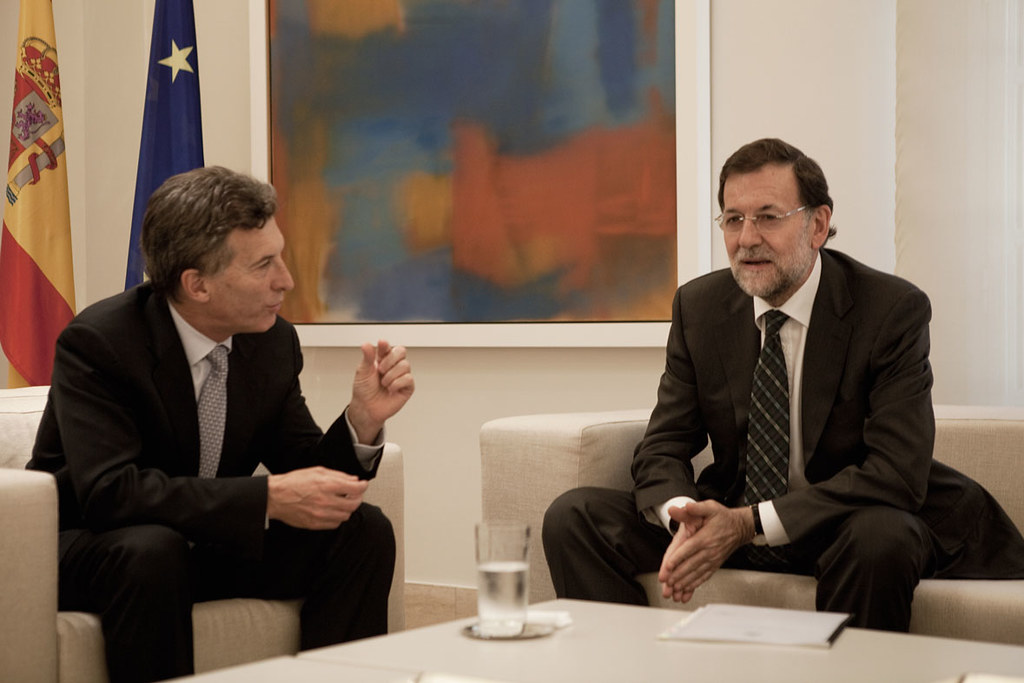
Featured image: Gobierno de la Ciudad de Buenos Aires, CC BY 2.0, via Flickr.