Editor’s note: This article was first published in April 2013, and reports April 2013 news: the Acapulco attack on six Spanish women, the Rio de Janeiro minibus case, Brazil preparing for the 2016 Olympics and post-revolution Egypt. Its country lists are unsourced and long out of date, and it is not current travel advice.
In recent years, news of all kinds of attacks on women tourists has made big headlines. The two most notorious recent cases were the six Spanish women raped in Acapulco, and an American student who was raped repeatedly by several attackers on public transport in Rio de Janeiro.
Many people may fall back on the idea that these are isolated cases that get blown out of proportion, when the truth is that there are countless cases in different countries that never come to light, partly because in certain countries this kind of complaint isn’t accepted, whether because of machismo or because of police corruption.
Human Rights Watch has produced several reports on the most dangerous countries in the world for a woman, urging all women who plan to travel to one of these destinations to always do so in a group and/or with their partners. That’s how the six Spanish women were travelling, though, and it did little good: the men were tied up and beaten by the attackers so they would have free rein with the women.
1. India
Tourism in India has already fallen more than 35% because of police incompetence in the face of numerous scandalous rape cases. A student in New Delhi and a Swiss tourist were gang-raped, and a British tourist jumped out of a hotel window to escape an assault. According to Human Rights Watch, reports of sexual assault in India keep rising, while the government does nothing despite the loss of tourists it is causing.
2. Brazil
Rio de Janeiro is the most popular tourist destination in the southern hemisphere, but according to HRW, Brazil is known for its macho culture, its record of gender violence and for having too many conflict zones outside the tourist areas. That’s why the advice is not to leave the tourist areas under any circumstances. Even so, the government is said to have adopted more security measures after the rape of the American student and will punish such attacks twice as hard, because Brazil is hosting the Olympic Games and cases like these don’t help.
3. Turkey
Violence against women is a major problem in Turkey. Embassies and consulates receive numerous reports of all kinds of attacks on women. The police and courts have a dismal record when it comes to helping women who are victims of assault.
4. Egypt
Tourism accounts for 20% of Egypt’s GDP, and it has started to decline since the revolution, because crime has soared and attacks on women and girls are an everyday occurrence. The country is climbing the list of destinations with the highest risk of sexual assault against women.
5. Mexico
According to the US State Department, the Mexican government makes a considerable effort to protect the millions of American tourists, but… according to HRW, the Mexican justice system often fails to protect victims of violent crime, especially women and girls, because of inadequate training and, above all, corruption. HRW also reports that there are legal provisions that make sexual offences depend on the victim’s “chastity”, and that women who report an assault are routinely ridiculed by the authorities and may even be treated as suspects of provocation or prostitution.
The HRW ranking of sexual assault risks for women tourists would continue with Kenya, Guatemala and Colombia.
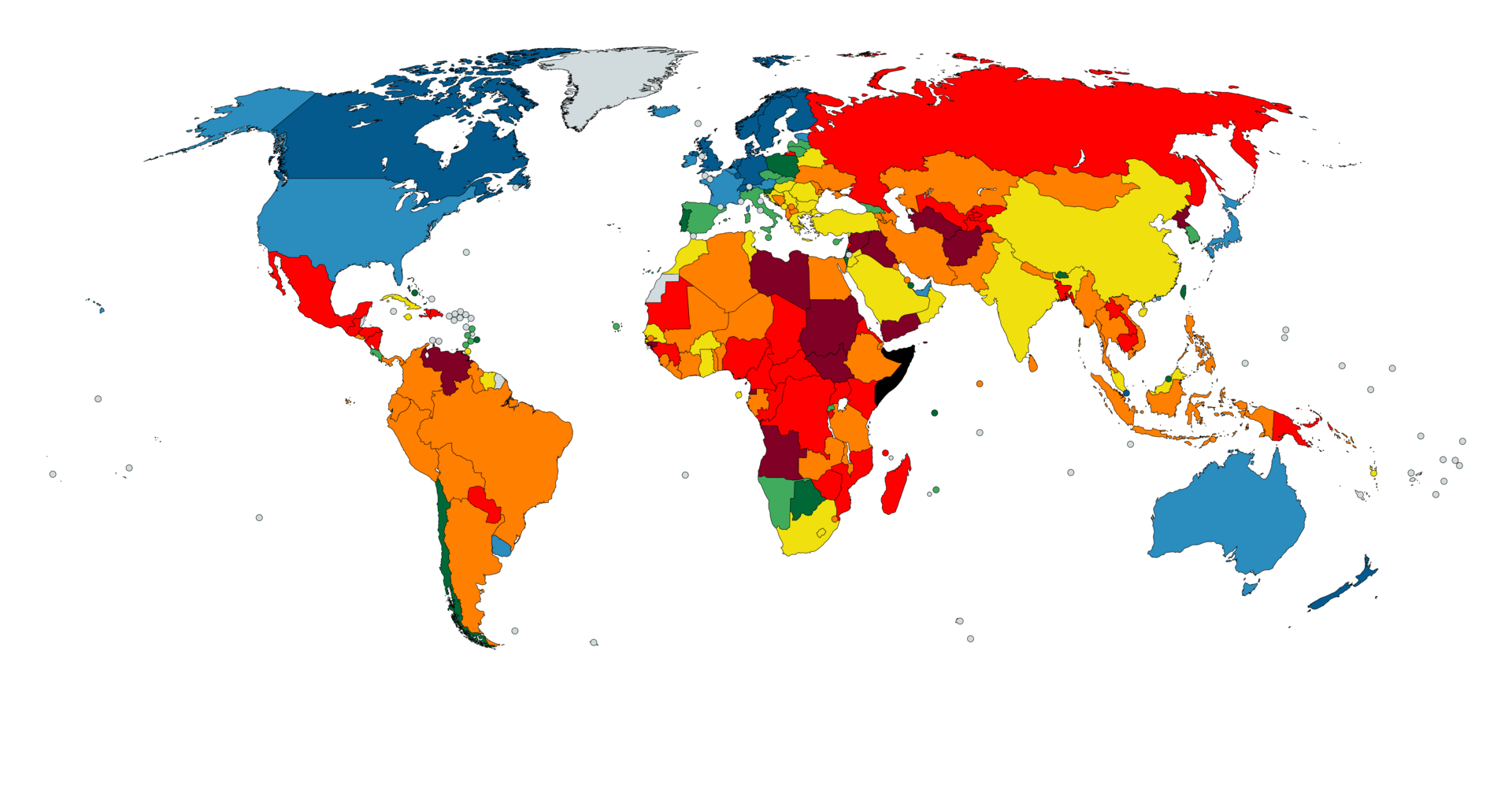
Of course, if we step outside the HRW report, most of the world’s governments advise women tourists not to travel under any circumstances to Afghanistan, Chad, the Democratic Republic of the Congo, Haiti, Iraq, Lebanon, Liberia, Nigeria, Oman, Papua New Guinea, Somalia, Sri Lanka, Sudan, Timor, Uganda, Uzbekistan and Yemen. In most of these countries there are added risks, such as the danger of Westerners being kidnapped, terrorism and so on.
Finally, other countries you could travel to as long as you take extreme precautions would be Burundi, Brunei, Bangladesh, the Central African Republic, Gambia, Indonesia, Iran, Lesotho, Pakistan, Rwanda and Sierra Leone.
Because of the risk of armed conflict, terrorism or epidemics, you should also avoid travelling to Cambodia, Burkina Faso, Ivory Coast, Djibouti, Ethiopia, Gabon, Ghana, the Republic of Guinea, Guinea-Bissau, the Solomon Islands, Jamaica, Kazakhstan, Kyrgyzstan, Laos, Madagascar, Malaysia, Malawi, Mali, Mauritania, Mozambique, Myanmar, Nepal, Tanzania, Zambia and Zimbabwe.
In short: if they had written a report telling us where we can travel safely, we would have written a lot less.
Featured image: Megan Eaves, CC BY-SA 2.0, via Flickr.