People often say that sales takes innate talent. They also say that people can’t change. The truth is, I think I broke both clichés many years ago. If ever there was someone with little talent for sales, it was me. Either that, or under all those kilos of coal there was a diamond in the rough.
I think I set a national sales record, maybe even a world one, because I have never heard of any salesperson who went more than 3 months without signing a single contract and without getting paid. I’m not saying there weren’t worse ones than me, but normally nobody lasts into a second month without selling and without getting paid.
And that was me.
Eighteen years old, my first job, in direct sales and on a commercial agency contract (in Spain, a contrato mercantil, paid purely on results). That meant that if I didn’t sell anything, I didn’t earn anything. But I was completely motivated to learn to do what others did and to gain the sales experience I needed to become a good salesman. And it all went wrong.
Six of us started together at a new branch. After two weeks of training on the product and basic sales techniques, we spent another week going out with the veteran salespeople. I loved what they did and how they did it. You know it’s not the job you’re going to retire in, but I was sure it would be the best sales school I could ever attend, and I’d be earning money on top of that.
When that week was over, the moment of truth arrived. We new salespeople would go out to sell on our own.
The first day of selling.
I remember it didn’t go as I expected. I got so many rejections I didn’t even have time to absorb them. At the end of the day we got back to the office, and of the 6 new salespeople, 4 came back with a signed contract. Then came the first words of consolation from our boss:
“Don’t worry. You don’t sell every day. You’ll see, tomorrow you’ll get one.”
The thing is, I didn’t get anything the next day either. Or the next week. I was the only one in that group who still hadn’t managed to sign a contract after 3 weeks. The words of consolation came back:
“You remind me of so-and-so, one of the best salespeople we have, and the one who took longest to close a sale.”
I don’t think it was true, but it was appreciated.
Then the reinforcements arrived.
After I finished my first month without selling anything, they appreciated my persistence, and that was when they paired me with one of the company’s best salespeople so he could see where I was going wrong.
I wrote down everything he told me, and even took notes on many of the techniques he used, which I found amazing. Of course, for some reason, when I used them they didn’t get me the same results they got him.
Desperation started to take hold of me, because I couldn’t afford a second month without pay when I had rent to pay.
The manager, who would later become an excellent mentor to me, thought my techniques were good, but that I probably wasn’t selling because I didn’t fully believe in the product I was selling. He had the idea of taking me to head office so I could see first-hand that our company helped people.
There I saw how we really did something good for people. The confidence that manager had in me also motivated me. After that day, and a great motivational talk from him, I got up ready to take on the world. More motivated than ever. A motivation that faded as the hours and days went by and I still wasn’t selling.
(Read: 6 myths about great salespeople.)
More reinforcements.
They offered to send me to another province for a week to work alongside the best salespeople in the country. They were passionate and certainly excellent professionals who pocketed between 3,000 and 4,000 euros every month (in those days that was 500,000 to 600,000 pesetas, a real fortune). They were young, self-assured and lived practically like rich people.
Every day I asked myself why I couldn’t do what they did.
To give you an idea of how self-assured they were, several of them told me:
“Today I’m going to get two contracts for myself, and we’re going to get a third one for you.”
No sooner said than done. Over the course of that week I came back with 4 signed contracts, which at least helped me pay my rent and gave me a little financial fuel. Have you ever had colleagues who literally helped you earn (gave you) 600 euros?
I knew I hadn’t made those sales myself, since they had done 90% of each sales visit.
Back at my branch, everything was the same. I couldn’t sell on my own, even though everyone agreed I had complete command of all the sales pitches and techniques.
Then the problems came.
I started to drag my group down: because my colleagues had nobody to look up to, the best salespeople considered themselves good for doing just 6 contracts a month.
That was when my group leader’s job came under threat for not meeting targets. In fact, they gave him a 30-day ultimatum. If he didn’t meet his targets that month, he’d be fired.
My boss called a meeting to ask us, please, to pull our socks up. He was a great person, and I swear to God I went out ready to sell, no longer for my own sake but to stop him being fired. But we couldn’t prevent it.
There was a change of management at that branch, and separate groups were formed: the good salespeople in one group and the bad ones in another, just to avoid contagion.
We bad salespeople got into the habit of going out in pairs, and curiously, when we went out together we did close contracts practically every day. In fact, we agreed to split the contracts, one for each of us in turn, regardless of who had made the sale. That way, at least, we were still bad, but we were earning some money.
That first national awards meeting.
I remember that Friday in December when the more than 400 salespeople from the southern Spain division got together for the awards to the best salespeople.
I’ll never forget that while I watched some of them collect cheques of up to 1 million old pesetas (6,000 euros), I was worried because I didn’t know how I was going to pay everything I owed with the mere 60,000 pesetas I had earned. And this was already my fifth month at the company.
I wasn’t even motivated by that big celebration, which was meant to show that “if they can do it, you can do it”. I accepted that I would never be one of them. I didn’t have that talent.
Something very curious happened.
See also: Profitable business ideas: advertising sales representative
After 6 months, while I was still a terrible salesman, the company began hiring salespeople en masse, and all the old hands, including bad salespeople like me, would get the chance to teach sales techniques to the new recruits.
Curiously, the new people I taught sales techniques to usually turned out to be very good salespeople. Ironically, they would go out and manage to sell more than I did, even though I was, after all, the one teaching them.
In just 2 months, many of the new salespeople we had trained were already outselling us. That was demoralising.
Some time later I found out that there had been meetings between the company’s executives to stop people like me from continuing to work there, since we neither produced nor set a good example for the rest, but my manager stood up for me, saying that this persistence of mine was bound to break through somewhere.
And then it happened.
Since we were the dead weight of the company, they sent us for a week to an area where not even the company’s best salespeople had managed to get a single contract. Our company had a bad reputation there, and on top of that it was an extremely over-canvassed area.
Since we were the worst and they didn’t want us burning out good areas, they sent us there, in what I believe was a strategy to wear us down and make us suffer.
After a dreadful first day that confirmed the area was as bad as they said, on the second day I thought about quitting the job. I even decided not to work that day and to go into a café in the area to kill time. I was completely exhausted and burned out.
A customer in that café started talking to me. The usual: “Where are you from, what do you do?” and so on. After a conversation of about 20 minutes, the man told me his wife might be interested in what I was selling. He told me to come with him.
I explained to his wife what I was selling, and she said it was perfect. Contract signed. While she was signing that contract, her sister came along and asked: “What’s that?” Once I’d explained it to her, having seen that her sister had bought, she told me she wanted one too. Second contract signed.
Believe me, I was walking on air. And as if that weren’t enough, they told me to visit a neighbour of theirs who would probably need what I was selling. Sure enough: third contract. And in that same area I ended up signing a fourth and a fifth contract.
Everyone thought I was joking when I told them I’d done 5 contracts in a single day. The next day we all went back to that area to ask for referrals to potential customers. We shared out the contracts as we got them. There was no need to motivate customers or counter their objections. They were waiting for us with open arms and already knew what the product was and how much it cost.
In an area where nobody had achieved absolutely anything, by the end of the week our group of 4 had got more than 50 contracts, an all-time record for the company. At the end of the month we beat every sales estimate. For the first time I was going to see a cheque for more than 3,000 euros. Every member of the team was going to see one.
Those sales made us the best sales group in the whole southern region that month.
It was a stroke of luck, but…
From that experience I drew several fundamental principles of selling which, combined with all the sales techniques I already knew, would make me, from that day on, simply unstoppable.
I became group leader of that bad team of salespeople, and we finished that year as the best sales team in the southern region. The following year we became the best in the country, both as individual salespeople and as a team. We did what not even I believed possible. In fact, I had never even imagined reaching that goal, not even hypothetically.
Selling is a conversation.
This point became very clear to me. I could win any debate, counter any excuse and even get the better of the customer, whatever their level of education. But I was a salesman. And people don’t like that.
So from that day on I understood that a sale is simply a conversation between two people, in which at some point one of them asks how much the thing that would meet that need costs.
Selling is a natural process, not a set of techniques programmed for each situation, although when you manage to put all the pieces together, you are in control of the situation at every moment and the customer is led, without realising it, where you want to lead them.
Trust is key. I began to study human psychology, which shows that a person can end up buying “crap” if their influential neighbour has bought it first. I understood what it means that a customer is not a rational person.
(Read: 15 habits of successful salespeople.)
Above all, I learned that clichés about salespeople shouldn’t be taken literally. Supposedly I had the attitudes required to be a good salesman. I was an outgoing person, capable of making a priest doubt the existence of God. I came across to the customer as a very intelligent person who had all the answers. The customer felt so inferior that he was afraid I was tricking him.
And that, as I discovered over time, is where I was going wrong. I was 100% technique and 0% heart and empathy. Even though I wasn’t selling, I was an excellent salesman, capable of teaching anyone the sales techniques they needed to sell. But when money is involved, people look for other signals in a person.
They like people who listen to them, people who can identify with them, and they certainly like humble people rather than arrogant ones: authentic people.
Until I stopped seeing selling as a job of applying techniques and started having fun and enjoying the company of the people I was selling to, I never really became a salesman.
But the most important thing I learned at company level was the importance of human quality in an organisation. I have never found the camaraderie I saw in that company in any other.
If someone in our company had a problem, we all threw ourselves into solving it. I never saw envy between colleagues, only admiration. If one of us got promoted, everyone was happy, and every single person in the company really could be promoted. All you had to do was prove yourself through your work and be the best. There were no tricks, no catch. The results spoke for themselves. And sadly, I haven’t seen that practice in most companies either.
Read: 14 truths and principles about selling
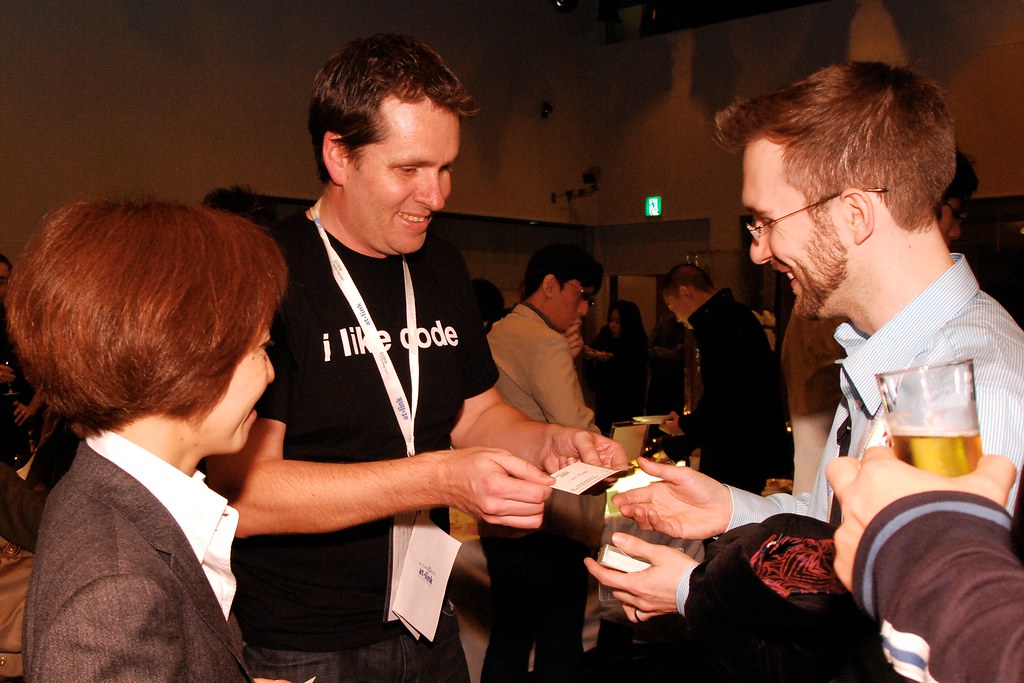
Featured image: gaikokujinkun, CC BY 2.0, via Wikimedia Commons.