

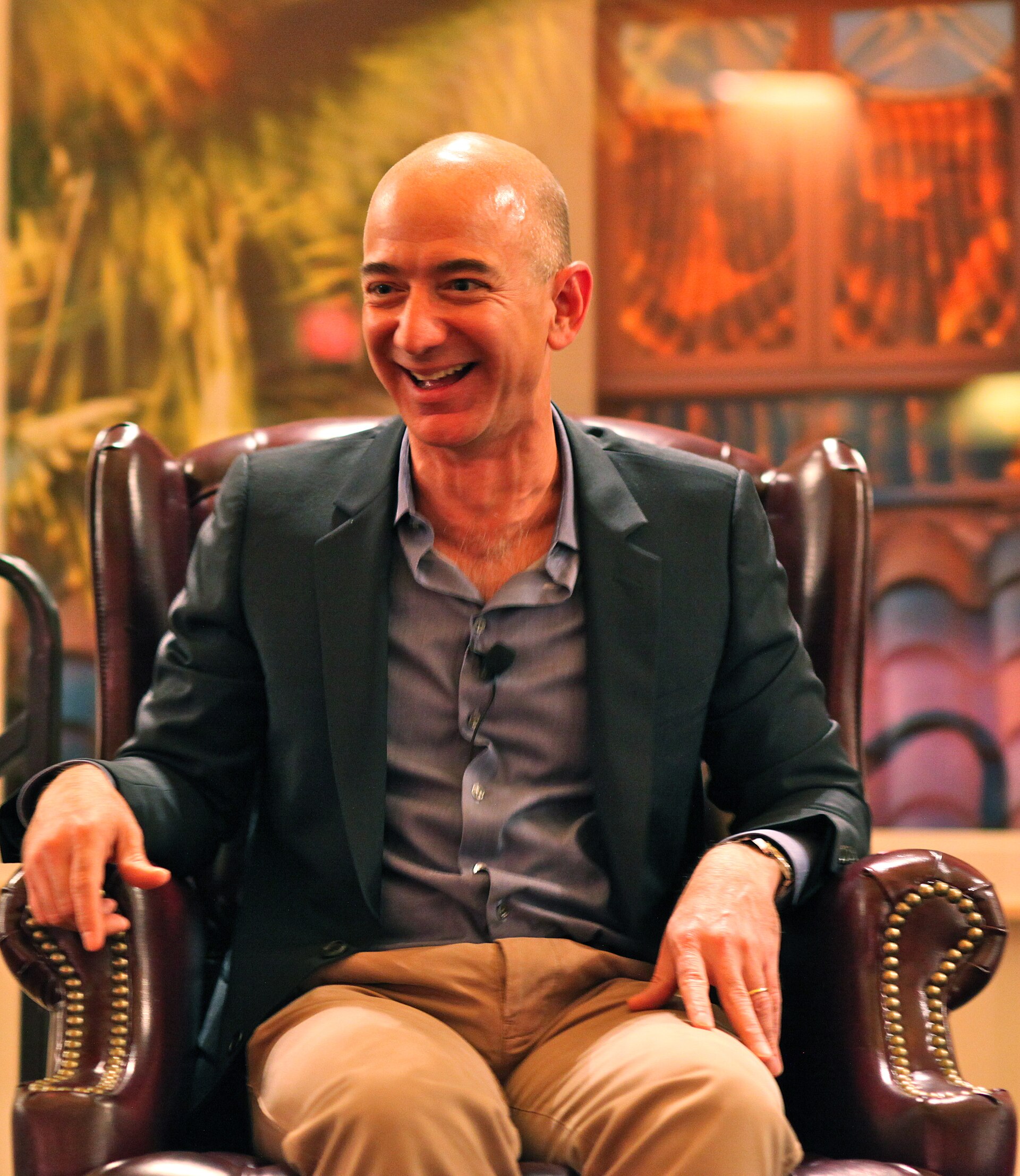
Editor’s note: This article was first published in November 2017, and its framing reflects 2017, with Bezos as the richest man in the world, Trump as the current president of the United States, Ortega as the third-richest man and Virgin with more than 400 companies.
While many people know exactly what they want to do in life from a very young age, others prove the theory that the road to success is neither linear nor a steady climb. Some of these successful people radically changed the path they were on to take a chance in another field. Others had that “aha” moment Meg Jay described. Whatever the case, each of the people we are about to name was leading a very different life at the age of 25.
What were Jeff Bezos (currently the richest man in the world), Elon Musk (considered the genius of this century), Donald Trump (current president of the United States) and 10 other successful people doing at 25?
1. Jeff Bezos was developing software for financial institutions
At 24, the founder and CEO of Amazon (one of the companies with the most growth potential today) started working at Bankers Trust, developing software for banks. In 1994 he told his boss that he wanted to start his own project, an online bookstore. His boss told him to think it over, since he had a good, well-paid job. In the end, Bezos decided to take the risk and fight for his dream.
Here you can learn more about Jeff Bezos’s philosophy, in which he shares some interesting thoughts on life, business and work, as well as the 9 books that changed the way he thinks.
2. Mark Cuban became a bartender when he couldn’t find a job after college
At 25, billionaire Mark Cuban had just graduated from university and, after making the rounds of different companies in an unsuccessful job search in Indiana, finally moved to Dallas, where he had no choice but to work as a bartender until “something better came along.”
He later got a job at a PC software store. He was fired, and as a result, instead of continuing to look for work, he decided to open his first business, MicroSolutions. From that moment on, his success was steady and upward, to the point where he is now a business icon in the United States.
3. Donald Trump was taking over his father’s real estate company at 25
There is no doubt that Donald Trump started out in business with a clear advantage, having grown up as the son of a real estate magnate. At 25, Trump took control of his father’s company and expanded his empire enormously. It hasn’t all been smooth sailing for Donald Trump: he ended up bankrupt, 5 billion dollars in debt. But this businessman soon got back on his feet. In 1991, Donald Trump shared a series of tips in his book Surviving at the Top, which includes a line that stands out today: anyone who thinks his story is about to end is making a mistake, because it has only just begun.
Who would have thought that the man who wrote those words would go on to become president of the United States?
4. Amancio Ortega worked as a delivery boy for a shirt shop
The third-richest man in the world, the Spanish businessman behind the Inditex textile empire, lives up to the expression “self-made man.” At 20, Amancio Ortega was working as a delivery boy for a shirtmaker.
He later went to work at a haberdashery. He learned everything he could about the textile sector in these shops, and at 27 he decided to start his own business, Confecciones GOA, the initials of Amancio Ortega Gaona in reverse. It wasn’t only his vision for fashion but also the development of a low-debt business model that led him to success.
5. Elon Musk dropped out of his PhD at Stanford to ride the dot-com boom
Before he turned 25, Musk abandoned his doctoral program to do business in the tech boom at the height of the dot-com bubble, starting his own company, Zip2, which provided business directories and maps.
Compaq bought the company for 307 million dollars four years later, and Elon Musk used that money to launch his next company, PayPal.
6. Martha Stewart was a model at 20 and a stockbroker at 25
Martha Stewart led a fascinating life from the age of 20. At that age she earned money as a model, babysitting and even looking after elderly women in exchange for lodging. At 25 she started working on Wall Street as a stockbroker, one of the few women in that world. You could say that, for anyone at the time, simply working on Wall Street already counted as success in life. But after five years, Martha decided to leave Wall Street to look after her children. Once her stay-at-home period was over, she set out in search of success again, starting her own catering company and her various magazines in several fields. A fascinating example of a woman entrepreneur.
7. Richard Branson was already shaping his record business
At 20, Richard Branson, founder of the Virgin Group, which is made up of more than 400 companies, had already opened his first record shop, and at 22 he launched his first label, Virgin Records. By 30, Branson already had several international businesses and was a millionaire, according to his memoir Losing My Virginity.
They were not easy years, as Branson admits. In his words, it is much harder to own a small business that is starting from scratch than to own 400 companies with thousands of employees working for him; he remembers building a business from nothing as a job of 24 hours a day, 7 days a week, which made it really hard to hold family life together.
Here are some curious facts about Richard Branson’s life.
8. Ralph Lauren took on a whole series of odd jobs to get by
Few people know that Ralph Lauren‘s real name was Ralph Lifshitz. He came from a poor family and grew up on the dangerous streets of the Bronx in New York. He decided to change his name at 15. He held all kinds of jobs, even before he was old enough to work, so he could study business administration. He served in the army until he was 24, and on his return he started working at the clothing chain Brooks Brothers. At 26 he designed a wide, European-style tie that caught on with the brands, quickly opening the door to creating his first clothing label, “Polo.” From then on, his business career never stopped.
9. J.K. Rowling worked in an office while shaping one of the biggest hits of recent times
Rowling came up with the idea for Harry Potter at a train station, during a four-hour delay, when she was 25. She began writing the book at night while working in a London office during the day. The book took several years to finish, and during that time she was fired for daydreaming at work. She used her severance pay to focus exclusively on the book. She went through a divorce and was diagnosed with depression before finishing the book in 1995. It was finally published in 1997. In my view, she took too big a risk by betting everything on a single card, although she is an example of how, when you have a dream, you should fight for it. She risked everything for that dream, and it ended well, but… what if it had ended badly? At least Rowling now knows the result of her efforts.
There are other kinds of stories with a more linear start on the road to success at that age, such as that of Juan Roig, chairman of Mercadona (the Spanish supermarket chain), one of the fastest-growing companies in Spain despite the crisis. In his case, Mercadona grew out of the family business Cárnicas Roig, a meat business in which the whole family worked, including Juan Roig’s five siblings.
In the case of Warren Buffett, his talent soon hinted at what he would become, although at 26 he was working as an investment analyst for a brokerage firm while, part-time, he set up his first company, Buffett Partnership, an investment partnership based in Omaha. Buffett always had a very clear view of what he wanted to become, and he never took a single step off the professional path he wanted to follow. A well-defined goal, together with the skills to reach it, meant that Warren Buffett’s story was already written by the age of 25. Nobody is surprised that Buffett has got to where he is today.
That said, in the new technological era people tend to make better use of their twenties: the opportunities technology has opened up have created more millionaires in their twenties than at any other time in history.
Featured image: Steve Jurvetson, CC BY 2.0, via Wikimedia Commons.



