


Editor’s note: This article was first published in June 2022. It reflects that moment: Facebook down 45% from its highs, Sheryl Sandberg’s just-announced departure, Musk’s bid for Twitter (completed in October 2022) and Netflix’s subscriber losses. Amazon Prime at a little over 30 euros a year in Spain was raised to 49.90 euros in September 2022.
When it comes to tech stocks, it is hard to analyse them with traditional financial metrics, but there is one thing we shouldn’t overlook when we analyse them: the famous metric of the investor Warren Buffett, the economic moat. An economic moat is what keeps a company safe from the dangers of competition. It is what makes a company unique and special, and worth holding in your portfolio despite the economic dangers on the horizon. Put another way, it is a company’s competitive advantage.
The FAANGs (the acronym for Facebook, Apple, Amazon, Netflix and Google) are in trouble in the current environment. The bad omens for Facebook and Tesla are showing up loud and clear, so it’s time to take a quick look at the situation and consider whether it is worth investing in these companies now that they have fallen so far. Facebook has already lost 45% of its market value from its highs.
The differences between Google and Facebook
If we look at operating margins, Facebook dazzles us, and that is in fact what draws investors in. Facebook’s operating margin was 45%, while Google’s was only 25%, even though Google had three times Facebook’s revenue.
Put simply, for every $10 of revenue, Google (Alphabet) makes $3 in profit, while Facebook makes $5.
According to Adam Seessel, author of Where the Money Is: Value Investing in the Digital Age, the reason behind this is dangerous in the long run in the digital age. Maximising profits like this lets you squeeze everything out of your business today, but you miss the chance to maximise it later.
We might think Facebook is doing better than Google, but Google has something Facebook doesn’t: an economic moat. Google could boost its profits at any time by raising its operating margin, even tripling it, whereas Facebook has already pushed its margin to the limit.
As Peter Lynch said in his famous book One Up on Wall Street, the best companies are the ones that are greedy in the long term. The problem is that Facebook has been greedy in the short term, and it is already paying the price.
Unlike Google, which takes a longer-term view, Facebook not only didn’t share its revenue with content creators from the start, it actually wanted to charge them, so that creators had to pay to reach their own followers on their pages.
Facebook overloaded its users’ feeds with all kinds of ads, without restraint. Rather than a social network, it has become a commercial network. Facebook has made it clear that its users are the product, whatever the cost. And of course, all this increased the company’s revenue, which in turn attracted investors.
Google, meanwhile, decided from the start to pay content creators, both in its search engine and on YouTube. Does it earn less by sharing up to 50% of its revenue with creators? Possibly. But it has a long-term vision.
See also: 14 things you should know before investing in the stock market
Why do you use Facebook, and why do you use Google?
Here are some differences between the two companies that you should bear in mind when buying their shares.
The truth is that the only reason you use Facebook instead of another social network is that almost everyone uses Facebook. Some time ago, people used MySpace because most people used MySpace.
Why do you use Google instead of another search engine? Because Google does it better, because it has invested a great deal of time and money in giving users answers, even if some of those improvements have hurt content creators. But at the end of the day, Google tries to improve the user experience, whereas Facebook seems to have set out to ruin it.
Google’s and Facebook’s moats, seen in one simple behaviour
When Facebook saw WhatsApp as a threat, because of the growing number of users who could talk through its chat, what did it do? It bought it. That way it avoided fighting an emerging competitor. When Facebook saw that a social network called Instagram was growing at a dizzying pace and might get people spending more time on Instagram than on Facebook, what did Facebook do? It bought it, and the threat was gone.
When a company lacks a competitive advantage, this is all it can do: buy its competition so it doesn’t have to innovate or improve its service.
What did Google do about its rivals Bing and Yahoo? It didn’t buy them. It crushed and buried them by doing a better job. That’s what being a competent company with an economic moat looks like. If you buy something, let it be something that helps improve your service, not just a way to get the competition off your back.
Amazon doesn’t need to buy its rivals. It simply gets better every day by outdoing them.
In other words, this “buy rather than compete” behaviour suggests that a company, in the middle of an era of technology and innovation, could end up dying. We may see that as unlikely, because Facebook is so big and is investing a lot of money in the metaverse, which we assume will be the future, although that future isn’t at all clear yet. Users will have the last word, and other companies will also get their chance to enter this market.
Analysts see Sheryl Sandberg’s departure from Facebook as a bad omen
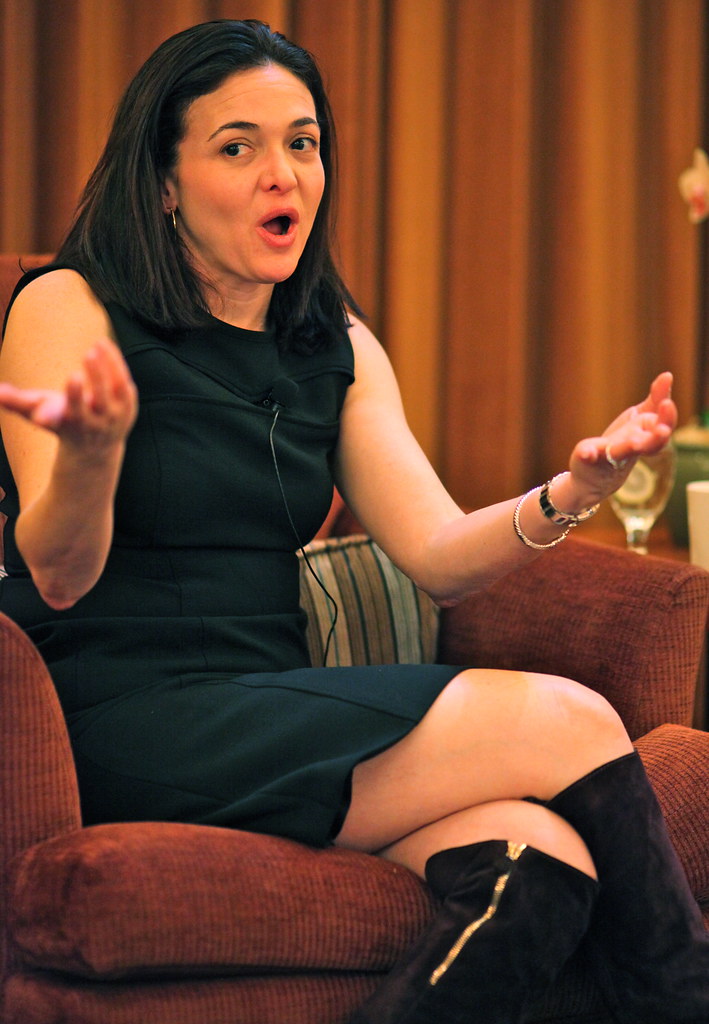
In business terms, Sandberg acted like Zuckerberg’s mom, running Facebook while Zuckerberg got himself into trouble. Later on, Mark Zuckerberg would try to blame Sandberg for some of those problems.
Throughout her life, she has shown incredible passion for her work. She was the one responsible for turning Facebook’s advertising business into the company’s biggest source of revenue (80% of Facebook’s total revenue), building remarkable synergies with major advertisers.
Sandberg has said that she is leaving to spend more time on her family and philanthropy, but everyone senses there is something more behind the departure of Facebook’s chief operating officer. It would be odd for a woman with her profile to leave a company just when it needs her most.
If Facebook still holds investors’ interest, it is because of the profit growth from its advertising business, a business that Sandberg herself grew considerably year after year.
With her departure, uncertain times lie ahead, and the omens for Facebook are bad. It is a company that really has no competitive advantage over other companies, other than the fact that people use Facebook because everyone uses Facebook. And that is not reason enough to hold shares in a tech company, whose value has to be calculated with different financial metrics.
The risk of Facebook’s bet on the metaverse
Facebook will invest more than $10 billion a year for several years to shape its most ambitious project, the metaverse. If it weren’t for this project, investors would already see Facebook’s lack of innovation as a reason to steer clear of its shares.
Facebook would start to die the moment users begin to favour younger social networks, such as TikTok, which is gaining a lot of ground among teenagers.
In YouTube’s case, its biggest rival is Twitch, Amazon’s platform. YouTube has also seen the threat from TikTok, so it didn’t hesitate to add TikTok-style short videos, while TikTok, chasing YouTube’s model, has gone after long videos too.
See also: The most and least profitable IPOs to date
One thing we are sure of: Alphabet (Google) will put all its ingenuity into improving the platform and beating its competition. On top of that, Google has plenty of room to manoeuvre, and remember that it can still raise its operating margin.
But in Facebook’s case, judging by how it deals with competition, it now has too many fronts open to come out unscathed. And “Mom Sandberg” is no longer there to protect the company from its competitors.
Right now, Meta (Facebook) is a company that depends too heavily on one core business, which brings in 80% of its profits. In other words, it has a single point of failure, and if that point fails, chaos follows.
This bet on a future project (the metaverse) with unknown results and variables is still a risk. In fact, it is a risk similar to Elon Musk’s promises with Tesla.
And what about Elon Musk and Tesla?
As we said when we talked about a possible collapse of tech companies, Tesla has spent more than a decade making promise after promise, while its share price has climbed to unreasonable levels. Some analysts think the price is justified, while others believe Tesla’s price isn’t justified by any investment metric at all. Some use the word bubble to describe Tesla’s shares.
Playing devil’s advocate, the only thing I have to say about Tesla as a company is that it carries enormous risk because of its high valuation, even after the correction its share price has gone through in recent months.
As we said back then, it sometimes feels as though Elon Musk sells more hype than cars. Investors saw an innovative genius in Elon Musk, but we shouldn’t forget that, although Musk innovated in this sector and took on the big car empires, they didn’t make a move at the time.
And so Tesla gained a certain lead in electric cars. But does Tesla really have an economic moat deep enough to ignore threats from its competitors? Not really. Any automotive giant could declare war on it. Tesla might win or lose, but they can certainly give it a fight. A big one.
A company that on its own has a larger market capitalisation than the biggest carmakers combined, even though it sells fewer cars and earns less, tells us only one thing: Tesla’s investors face a sniper who is loading his rifle. Once he has loaded it, he may hit or miss, but the sniper is out there. And that is a risk.
The bad omens for Tesla
Elon Musk’s behaviour worries investors quite a bit, especially his determination to take control of Twitter. But what has really made investors suspicious is the mass layoff he is planning at Tesla (around 10,000 workers).
As a rule, mass layoffs tend to go down well with investors, since the company will make more money by saving the cost of those workers. In Tesla’s case, though, the news has not been well received. And with good reason.
To invest or not to invest in the FAANGs?
Although we have only looked at the situation very superficially, I think the idea we are trying to get across is clear. We are not saying these companies have no future or that they are going to go bust. That said, both scenarios are possible. In the stock market, you can never rule out that a company, however safe it seems, ends up going over a cliff. All we can do is weigh probabilities and look at the companies’ real situation.
When we analyse these companies’ economic moats, together with other, more common data and metrics, we can’t ignore that there are very high risks for Facebook and Tesla.
In Netflix’s case it is too early to draw conclusions, but the truth is that Netflix doesn’t have any kind of economic moat at the moment either. It has no competitive advantage over rivals such as HBO or Prime Video.
We don’t rule out Netflix eventually surprising us with an acquisition or an innovation, but right now, its massive loss of subscribers is the first warning sign that its business model could be entering a downtrend.
Amazon is a different story
I have been an Amazon shareholder for some time. What I liked about the company back then was that it was going after everything, not just control of online retail. If you look closely, Amazon is fighting with practically every company we are talking about (for now it isn’t in the electric car business).
It is taking on YouTube, it is taking on Netflix, and it is working on a huge number of projects. Does Amazon have a big economic moat? Put that way, we could say it doesn’t, since it has AliExpress carving out space on one side, the big video platforms giving it a fight too, and thousands of manufacturers competing against its own products on its own retail platform.
But Amazon, as we explained earlier, has an important competitive advantage: its know-how, its innovation, its dedication to the customer. And that is hard to beat.
What’s more, it doesn’t need to charge a high fee for its Prime service. Right now, for a little over 30 euros a year in Spain, you get access to “Amazon’s Netflix”, orders with no shipping costs, cloud storage perks and hundreds of other things. All for a small annual fee.
And best of all, Amazon still has incredible growth potential. It still has a lot left to create and innovate.
Google and Apple do have a wide economic moat
In a technological era, Google is the best-positioned company. Talking about the internet is practically the same as talking about Google. This company does have an economic moat and a big competitive advantage. It also has the best talent. It is a company that isn’t afraid to take controlled risks and innovate.
They don’t buy their competition, but every month they buy a new company that can bring some kind of technology that adds value for users or for Google itself. And as we saw at the start, it can keep raising its operating margin.
When we analyse some companies, it is as if they have already hit their ceiling and need to stray from their path to keep selling innovation to investors. With Google and the way it operates, investors still feel that the company will keep growing and innovating.
And Apple, what can we say about Apple?
Although Apple is included among the FAANGs, as Warren Buffett has said, Apple is not a tech company like the rest. Even though it depends on technology components, for Buffett it should be analysed as a consumer company.
Apple doesn’t need to compete on price with other smartphone brands, it can make bigger profits even when its revenue falls, and it has a solid ecosystem. In other words, Apple does have the economic moat you should demand from a company.
With every crisis and every fall, the company’s death has been predicted (ever since Steve Jobs was alive), but it has come out stronger each time from the bumps it has hit along the way.
So this is simply our opinion on the FAANGs and Tesla. As we always say, we hope it serves only as something to bear in mind as you do your own analysis. Just one more opinion.
See also: 7 safe stocks to invest in during times of crisis, inflation and recession
Featured image: Martin Falbisoner, CC BY-SA 4.0, via Wikimedia Commons.



