

Editor’s note: This article was first published in May 2012. All fees are 2012 figures: Selfbank (€2.95 / €5.95), La Caixa (€9.02, or €7 with a minimum of 24 trades a year), custody, dividend collection and platform prices have all changed since.
Here we explain the total fees you have to pay when buying and selling securities (shares). The aim is to understand why, even though there is no minimum amount for investing, there is a sensible or “ethical” minimum for the investment to pay off: the fees we pay for buying shares are practically the same whether we buy a single share or 100,000.
Each broker (bank) has different fees, although depending on how we invest (short or long term, purchases above €1,500 or small purchases of €1,000), some conditions may suit us better than others. Let’s go through the fees we have to pay.
1. Fee for buying or selling shares (€16)
This is the fee that varies most from one broker to another. For example, at Selfbank, for amounts under €1,500 the fee would be €2.95. For larger amounts up to €6,000 it would be €5.95. At La Caixa, for example, there is a flat fee of €9.02 regardless of the value of the trade. Of course, if we sign up for a special plan, we would pay only €7 per trade, but we would have to make at least 24 trades a year.
As we can see (and will see below), prices for buying and selling shares can also be negotiated. Still, let’s take an average of about €8, which means we’d already start with a cost of €16 (€8 to buy and €8 to sell). Let me repeat: that price would be fixed whether we invest €100 or €200,000 (although for large amounts a percentage is usually charged, around 0.07%–0.15% depending on the broker). International markets would be around €13–€25 per trade.
2. Custody fee (0.35%), €5
The custody fee (or maintenance fee) is charged for keeping our shares deposited with the bank. You could think of it as the price we pay for the management service the bank provides. It also tends to vary a lot from broker to broker, although at most of them it’s 0.35% every six months. Some charge a little less for custody, but usually quarterly. Even so, there is normally a minimum of €3–€5 that we have to pay. For international markets, the custody fee is around 40%. We pay this amount for each security we hold in our portfolio. In other words, we should get used to the idea of subtracting 0.35% from the return on our shares.
That said, many brokers don’t charge a custody fee if we make more than 2 or 3 trades a month.
3. Collection of dividends, interest and other income: 0.30%, €0.60
The broker (bank) takes care of collecting dividends, so it charges us 0.30% of the net value of our shares’ dividends, or a minimum of €0.60.
4. Stock exchange fee
This fee is charged by the stock exchange, that is, the market where we carry out the trade. This exchange fee depends on the amount of the trade and is the same for all banks. The table of amounts by trade size looks like this (Spanish stock exchange fee):
| Trade amount | Fee |
|---|---|
| Up to €300 | €1.10 |
| €300 to €3,000 | €2.45 + 0.024% |
| €3,000 to €35,000 | €4.65 + 0.012% |
| €35,000 to €70,000 | €6.40 + 0.007% |
| €70,000 to €140,000 | €9.20 + 0.003% |
| Over €140,000 | €13.40 |
5. Other payments (costs)
Finally, we should include the price of using the trading platform. Although our bank (broker) gives us a basic platform with delayed quotes (the price shown is not the current price and may lag by 10–20 minutes), the ideal would be to have a real-time platform so we can make quick, well-informed decisions. Platforms of this kind usually cost around €6, €10 or €22, although once we sign up for them we also receive reports prepared by the bank’s analysts, which can sometimes give us information the general public doesn’t have access to (or at least get it a little before everyone else).
Likewise, many banks offer an advanced platform on condition that you make a minimum number of trades a month.
Other miscellaneous costs could arise from a company’s capital increases (the bank handles the paperwork for us) or from transferring shares from one bank to another, but basically you should focus on the first four, since, unless you negotiate with the bank, they have a fixed price. As a rough calculation, we could say that buying and selling a few shares would cost us an average of €23 (€17 at some brokers, €32 at others).
That’s why there is no minimum for investing in the stock market, but there is a minimum you have to pay, and that puts the reasonable minimum for starting to invest at €1,000–€2,000, although at some point, just to try it out and get into the ring, you could start with €400–€500.
We’ll keep covering the basics of stock market investing.
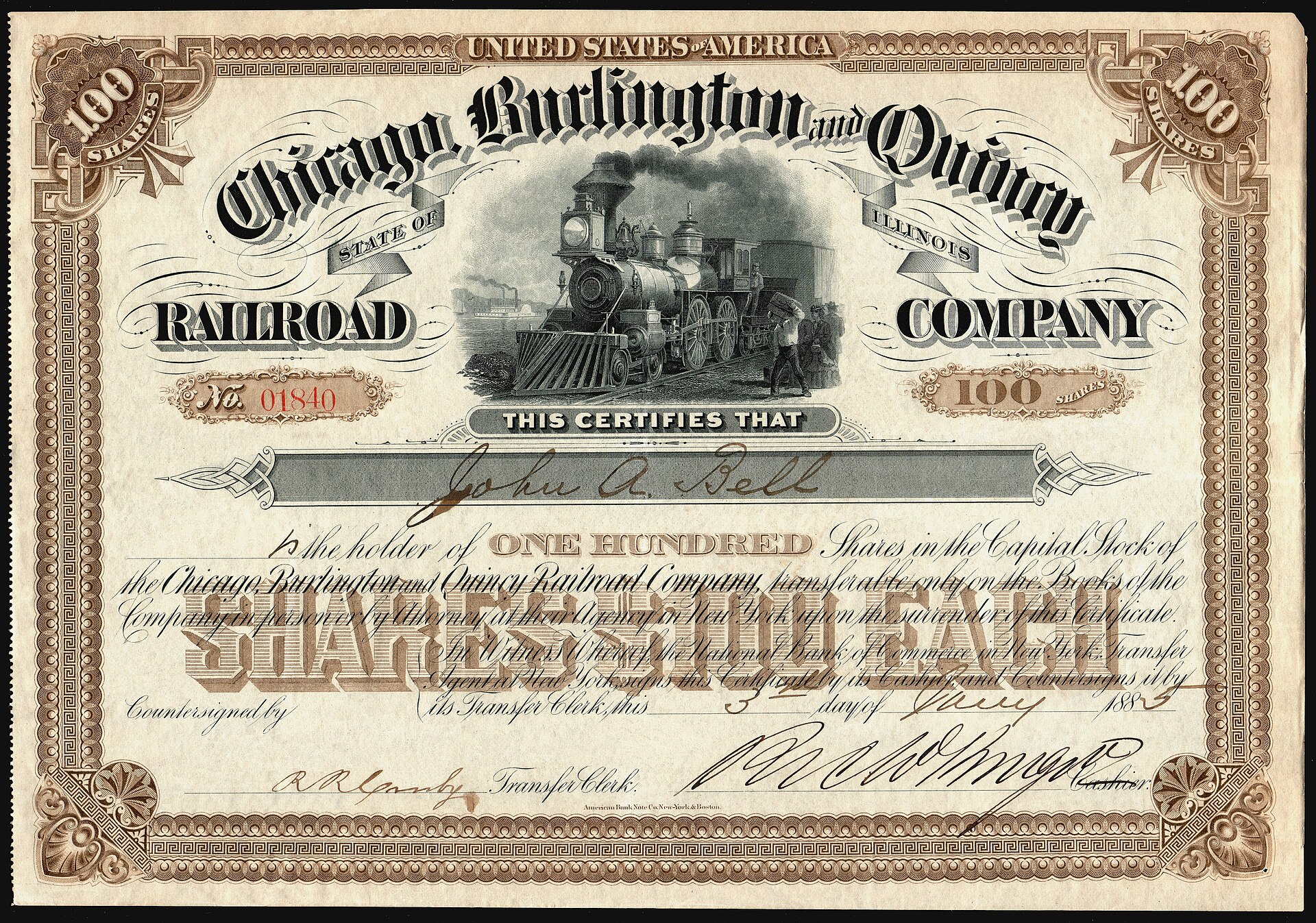
Featured image: Issued by Chicago, Burlington and Quincy Railroad Company in 1885, reproduced from an original document by Palauenc05 ., Public domain, via Wikimedia Commons.



