

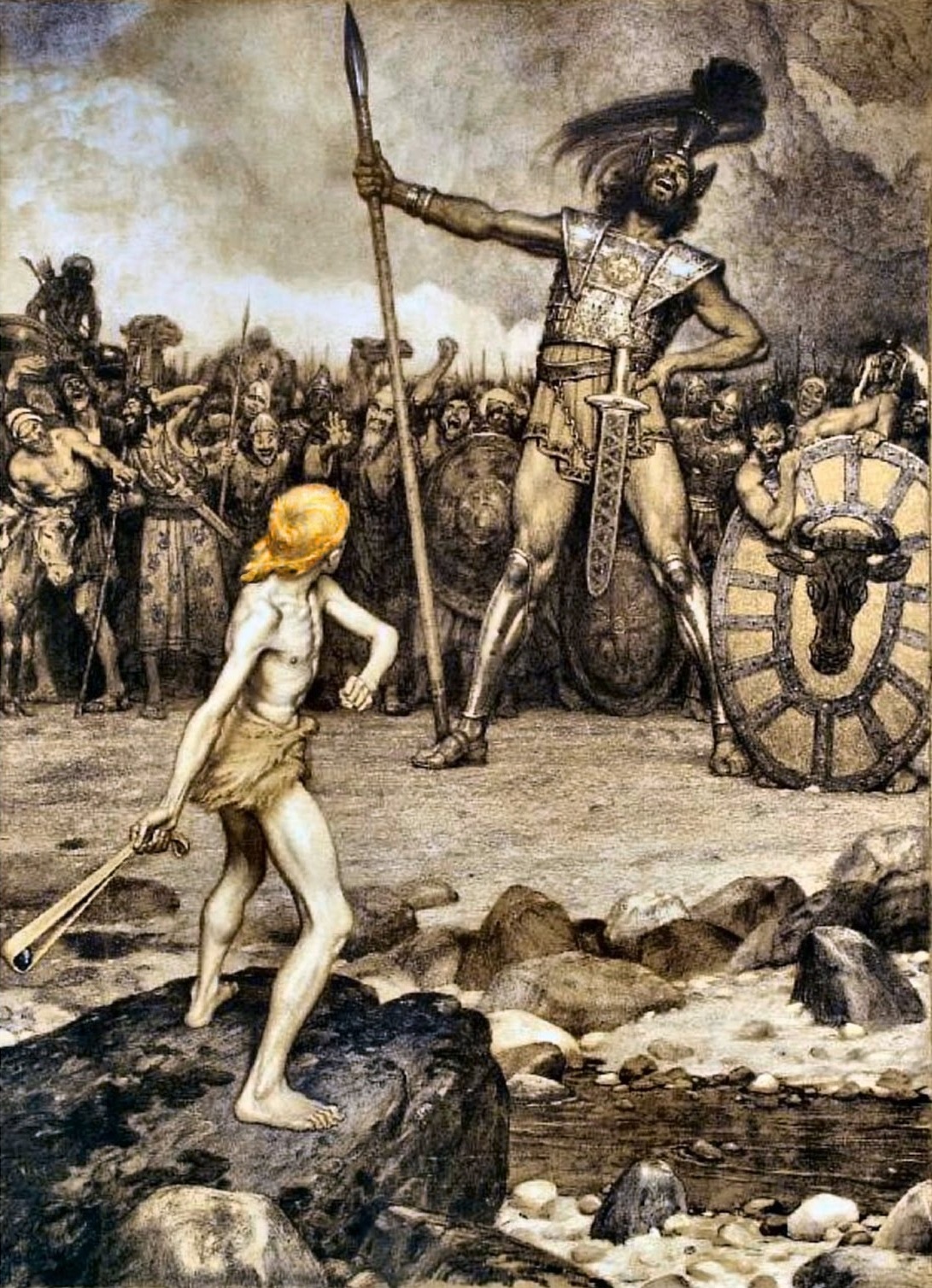
In the Bible story, a young shepherd named David defeated a great giant warrior named Goliath with a sling. The story has gone beyond its biblical origins to become a kind of analogy for the unlikely victory: the small against the big, the oppressed against the oppressor.
But in his TED talk, Malcolm Gladwell gives it a very interesting twist that would explain why Goliath was actually the weak one in the story, not the strong one.
David has been labelled the underdog because he was a young shepherd, while Goliath was an experienced warrior, terribly strong and huge. Goliath was also equipped for combat with heavy armour, a large sword and a large spear, while David, a poor shepherd, was defenceless, unarmed and had only a sling.
Gladwell explains that at the time there were three types of warriors: the great foot soldiers, well armed and covered in massive armour; warriors on horseback; and the common people, who used whatever means they had at hand, such as bows and slings.
David was a soldier with no experience on the battlefield, but he was good with a sling. Goliath was one of the best hand-to-hand fighters, but when he faced his weak opponent, David fought on his own terms, keeping his distance and using the weapon he was good at.
In that kind of fight, Goliath was helpless, while David had a clear advantage. David was smarter, attacking from a distance, while Goliath could do nothing with his strength, his spear and his sword. When the stone, hurled hard from the sling, struck Goliath between the eyes, he fell to the ground, and that was when David walked up and cut off the giant’s head.
Let’s say Goliath went into battle with the wrong weapons, while David, despite being at a disadvantage, made use of the right weapon to beat the giant, turning his disadvantage into a clear advantage.
Gladwell concludes that Goliath was an easy target who never stood a chance.
The moral for business
Always analyse your competitors’ strengths. Many large companies leave gaps that we, as a small business, can fill. And that is where you have to attack. If you compete where the big company is strong (hand-to-hand combat against Goliath), it will crush you. But if you make the most of your own strengths (where your company is good), you will find an opening where you can hurt that big company.
In the art of war applied to business, it is essential to start the right battle (one we can win) and to use the right weapon for that particular battle.
Watch: Malcolm Gladwell’s TED talk on David and Goliath
Featured image: Osmar Schindler (1869-1927), Public domain, via Wikimedia Commons.



