

Editor’s note: This article was first published in October 2012. It is market commentary from 17 October 2012, during the euro debt crisis: the IBEX 35 rally, the risk premium at 383 points, Moody’s decision not to cut Spain’s rating to junk, and the pending bailout request. Spain never requested the full sovereign bailout the article treats as inevitable.
A second day of spectacular gains on the IBEX 35, with the wind blowing in our favour, driven by rumours and by news as positive as it is strange. Yesterday the market shot up on the words of two politicians from Angela Merkel’s party (unknown until now) who supposedly backed European “precautionary aid” for Spain. Today, the rating agency Moody’s gave us an unusual breather by not downgrading Spain’s sovereign debt to junk.
I say unusual because it’s rare for one of the three agencies not to follow through on a threatened downgrade. Mind you, it held off on the assumption that Spain will request, right NOW, the imminent bailout that never arrives but that, sooner rather than later, will have to come. So the risk premium is below 400 points (383), the technical picture for our index points towards 9,000 points, and the other markets seem to be joining the rally. In other words, everything fits together nicely. Given the state of the economy, that means something obviously doesn’t fit, and if we think back, we have lived through this very recently. From 23 October, the tears could return to the markets.
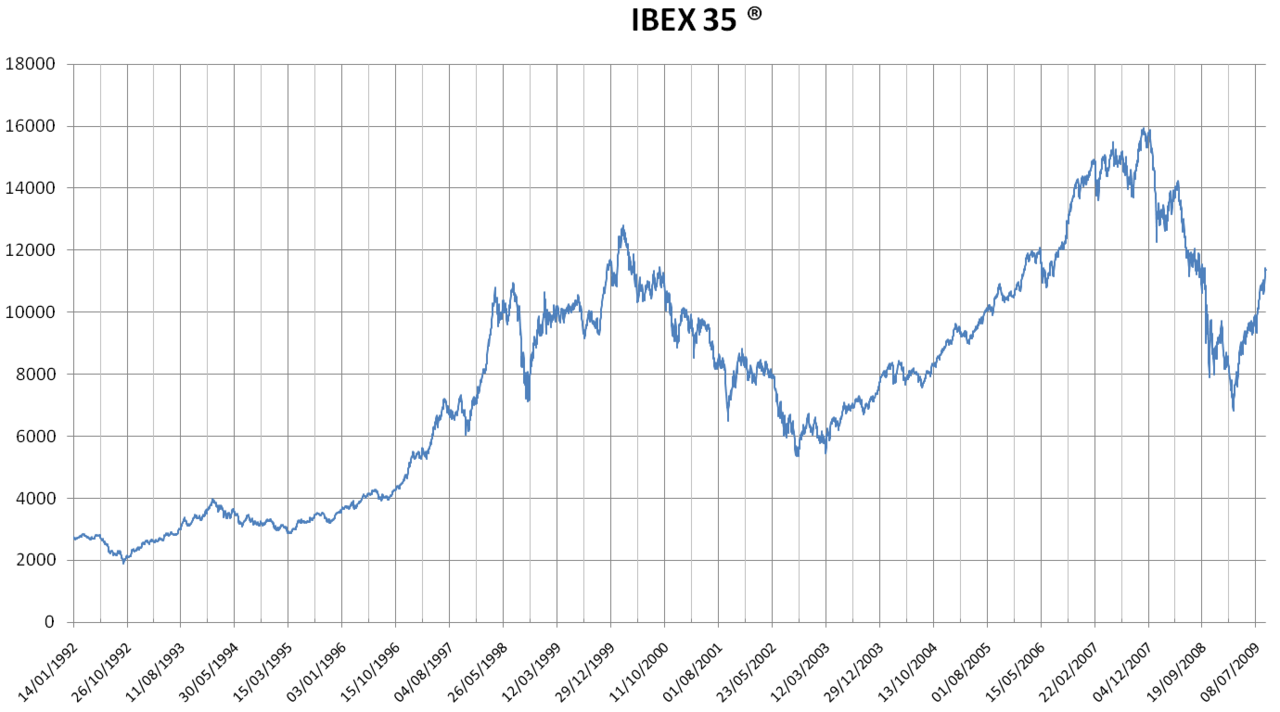
On 23 October, the ban on short positions expires (short selling lets you profit when markets fall). The stock market is at the same level as in 2003, while the economic situation is far, far worse. If we look at the fundamentals, the market is already overinflated, but the more it inflates, the more money there will be to make from its subsequent fall if the bailout doesn’t come, or if the bailout’s conditions involve measures that cut off our chances of economic growth.
What happened on the IBEX before Lehman Brothers collapsed?
The IBEX 35 hit its all-time highs (above 15,000 points) shortly before Lehman Brothers collapsed, coinciding with huge futures and options expiries. On a Friday that year, the IBEX peaked at 15,136 points (remember that futures expire on Fridays, and that Friday was an expiry day). The index rose no less than 400 points. The following Tuesday, the crisis that is still with us began.
Many analysts still believe the IBEX was manipulated with large sums of money, pushing up the shares that move the index, such as Iberdrola, Santander, BBVA and so on. Once the manipulators had made millions cashing in their futures, on the Monday and Tuesday huge volumes of CFDs, futures and options were traded betting against the indices and shares of the Spanish market, so they made millions all over again as the market fell.
That’s why, at the level our index is at now, either Mariano Rajoy requests the bailout or the short-selling ban is extended. If neither happens, the IBEX could bleed heavily: the kind of bloodbath that leaves small and new investors so burned that they never want to set foot in the stock market again.
Of course, it’s also possible that the market keeps climbing past 9,000 points. It wouldn’t be the normal or logical outcome, but it could happen. Still, as the saying goes, things will have to get worse before they get better.
Featured image: Carlos Chiva Robles, CC BY-SA 4.0, via Wikimedia Commons.



