

Editor’s note: This article was first published in October 2014, in the aftermath of the post-2008 recession. The regulatory fight against Uber and Airbnb, PayPal’s small-business loans being “only in the United States” and the open question of how the battle will end all reflect that moment.
In the wake of this crisis, which has wiped out many people’s purchasing power and created high unemployment across half the world, ingenuity has sharpened, backed by new technologies, to shape a new kind of business that falls within the so-called “sharing economy“.
This kind of economy stands out because it offers services in industries that already existed, at lower prices (or free) for the end user, while also giving other people the chance to earn some extra money or build their own business around these services.
Let’s say the recession has dragged on for so long that, with no official solutions in sight, certain entrepreneurs have been forced to open doors that will now be hard to close.
One example is crowdfunding: with banks not lending to finance business ideas, entrepreneurs now find their own ways to raise money without going to a bank, which leaves the banks acting like the dog in the manger, neither eating nor letting anyone else eat. The banks have now seen the problem and are calling for regulation, because the truth is that when they want to open the credit taps again, citizens and business owners may no longer need them.
Without going any further, PayPal now offers loans to businesses that sell online, on excellent terms: in some cases, a percentage of each online sale is deducted to repay the loan. This system is only available in the United States for now, but since it is working, we wouldn’t rule out seeing it in other countries soon.
But the sharing economy’s problems go much further.
Uber is an example of the unrest a tech-based business idea can cause when it takes off. Uber is the first company to have opened “Pandora’s box” by taking over an industry that enjoyed a monopoly and had not innovated for decades.
Uber’s users are happy with the service, and the company already has a base of loyal, satisfied customers. The problem is that Uber has proved to be a profitable business and has grown too much using what many call “an unfair advantage”: anyone can become a “taxi driver”, or Uber driver, with minimal costs.
While most people working for Uber are unemployed, you would also find others who have their regular eight-hour job and also earn some extra money in the evenings working as taxi drivers.
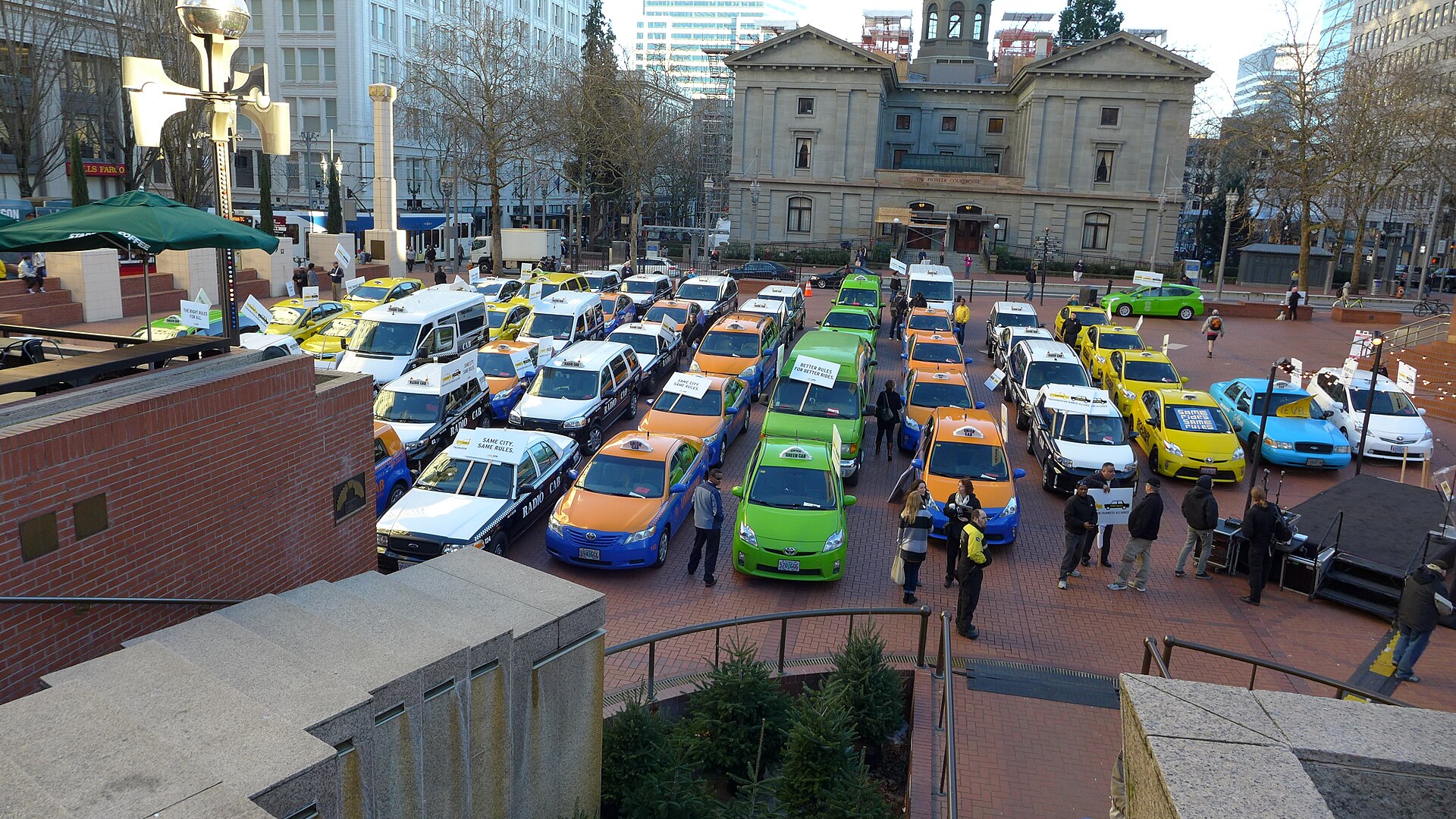
And this has angered taxi drivers across half of the United States and Europe, because they consider that these drivers are not regulated. There have already been several incidents; in France, Uber drivers were even attacked by taxi drivers.
When Uber’s creators started the business, I don’t think they ever imagined how successful they would become worldwide, and as their success has grown, so have their problems.
Governments now believe that anything to do with the sharing economy is a danger and that quick laws are needed to put an end to these companies. But the problem is now much bigger, because a lot of money is at stake: tech giants and billions in venture capital have bet on these ideas. And some of these investors are not willing to lose money.
Uber now faces certain problems it did not count on at the start, even though the company’s leaders keep saying that taxi drivers should not see Uber as a threat but as an opportunity they can join, since it has proved to be a better taxi service: cheaper and safer.
Let’s remember that Uber has a solution to one of the biggest safety problems taxi drivers face every day. To use these cars, you first have to pay for the ride through the app. Not only has the customer already paid, but the customer is also already identified when they get into the car.
Airbnb is the other company at the centre of the controversy.
What started as an idea to let people earn some extra money by offering an empty room in their home for a relatively short period has ended up as a threat to hotels and even to the rental sector.
Airbnb is being accused of undermining the laws on hotels and rental contracts, because through this company many users now rent properties for stays of several months. That is an ordinary rental like any other, but it skips the steps and contracts of traditional rentals. And apart from the odd case that has been given a lot of hype, the truth is that Airbnb users have not had many problems so far.
On the other hand, if someone wants to make a seven-day trip from the United States to Spain, they probably no longer need to call a hotel to make a booking. They just have to open the Airbnb app and see which users can offer them a room or an empty flat for those seven days.
Very bad for hotels, but very good for people who don’t want to let their flat on a long-term basis because of the high rate of unpaid rent, and who can earn some extra money this way by renting out their property for that seven-day stay.
And like Uber, Airbnb has proved to have a solid, profitable business that creates loyal, satisfied users. It is also much cheaper, and it too has the support and funding of tech giants and venture capital.
What was the secret of Uber’s and Airbnb’s success?
The secret of these companies’ business, as with crowdfunding, was simply to give people what they needed and wanted, turning up at the best possible moment to succeed and taking advantage of all the available innovation, such as smartphones, apps, the cloud and social media.
Both companies appeared as a necessity for users who could not spend money, and as an opportunity for users who needed to earn money.
But from now on, these companies will have to operate on increasingly hostile ground and deal with all the legal obstacles that are starting to appear in their way.
For governments and certain industries, the sharing economy is a problem, but for the customers and workers of this new economy, the sharing economy is the solution. How will the battle end? We’ll have to wait and see.
Further reading
- How much money can you really make as an Uber driver?
- Peppr: the app shaking up the world’s oldest profession, an “Uber for prostitution”
Featured image: Aaron Parecki, CC BY 2.0, via Wikimedia Commons.



