Editor’s note: This article was first published in September 2013, when penny-auction sites and Call-TV quiz shows were current in Spain; its “three days ago” refers to September 2013.
Some people think a con works because the con artist takes advantage of the victim’s foolishness, the victim being less intelligent than the swindler. Others think that overly ambitious, greedy people are more likely to be conned by someone else. But then… why do very intelligent people get conned?
The truth is that being ambitious doesn’t make you the victim of a scam, because ambition is a virtue. In fact, the opposite of ambition is complacency.
Great con artists throughout history have explained what a person’s biggest weakness is: the gap through which the swindler can draw you onto his ground and turn you into a victim. They all agree on what makes you a scam victim:
“Thinking, at a given moment, that you can get something for nothing, that you can get a lot for very little, and that you can achieve something easily without effort. If you meet that condition, sooner or later you’ll end up being conned, even by things that aren’t a scam to begin with.”
A good con artist’s job is to recognise that kind of belief in a person.
People still fall for cons and swindles every day, even ones not considered scams
Three days ago someone asked me what I thought of the new fad and supposed rival to eBay: penny auctions. At first I was surprised, because I thought that kind of auction site would have shut down by now, but it hasn’t.
As soon as they told me you can get an iPhone for €7 and a new car for €300, in my case there was no need to go on: clearly something smells fishy. As one of the oldest sayings where I come from puts it, “Nobody hands out five-peseta coins for four pesetas.”
Once I started looking into it, of course there are people who have managed to get certain new products worth €450 for just €23, so they claim it isn’t a scam.
Of course, the system these auctions use shouldn’t really be called an auction, because it’s practically a raffle. In an auction you bid, and if you don’t get the item, you lose nothing. In these penny auctions, by contrast, you first have to buy credits. Those credits are used up every time you bid, and if you don’t win the auction in the end, your credits are gone. In other words, you’re left without your money and without the product.
Dress it up however you like, but when a company sells a €400 product to a customer for just €20, and the company makes more than €1,000 on that product, it’s clear the game isn’t fair, because it means other people have lost the money that makes up the difference to the €1,000 you’ve won. I can vouch that the explanation this guy gives on a forum is exactly how these sites work.
In this case, those people are conned because they think they can get something below its price, and the bait is a few users who were lucky enough to win the raffle or draw (not an auction). Then the obvious question would occur to me (I’m distrustful by nature): who guarantees that a large share of those auctions aren’t won by the site administrators themselves? If I were a swindler, that’s how I’d do it, at least.
Who remembers those Call-TV shows?
Remember those TV programmes where the presenter asked a very easy question, something like this?
Presenter: It’s white, round and laid by a hen. What is it?
Answer: Chenoa (a Spanish pop singer).
Presenter: Nooooo, it’s not Chenoa!!!!
A new contestant’s answer: Justin Bieber.
Presenter: Noooo, it’s not Justin Bieber.
Naturally, there were juicy prizes for whoever got the answer right, so the victims thought everyone else was very stupid and decided to call. They lost the shirt off their backs on the cost of calls to a premium-rate line, without knowing that it was the show’s own people who kept calling in and getting it wrong, while the thousands of people calling every day were never put through.
Brazen as that swindle was, those programmes stayed on television for years and years, and their creators amassed incredible fortunes at the expense of people who thought everyone else was too stupid to know the answer to such a simple question.
Ignorance
Those of us who are investors have probably learned this lesson well: any investor knows there are no high returns without taking on the risk of losses. Even today, banks still tell some of their customers that they guarantee you 12% in a guaranteed investment fund. People keep falling for it without knowing that the only thing a guaranteed fund supposedly guarantees is that you won’t lose the initial capital you deposited.
Need can make you the victim of a scam
Sadly, swindlers don’t only target the gullible; they also go after those most in need. Ironically, it’s much easier to get money out of someone who has no money than out of someone who has a lot of it.
It’s precisely these people in greatest need who have fallen for all kinds of fake job offers, because they’re so desperate that, even when they suspect something, they want to believe what they’re being offered is real.
Need is what makes you fill in those online forms to apply for a loan, where you enter your ID number, phone number and address, and also send a copy of your ID card and your bank account number. These things often end in identity theft, something very common that the media rarely talk about.
Human weaknesses
Another old Spanish saying, a crude one, has it that a pretty woman pulls harder than two ox carts: when a man thinks with his “lower instincts”, his ability to reason usually clouds over. That’s how a fake woman can take a man for $200,000.
Kindness
This is the con artist’s favourite trait, because it’s rare to manage to con a heartless so-and-so. A kind, charitable person, on the other hand, is a piece of cake. And if that charitable person is also in need, the con is 100% guaranteed.
Sometimes I wonder how many people have fallen for those carefully crafted emails that, instead of asking you for money, offered to give you money. That’s a whole other level, because even people I know and consider very intelligent told me: “Well, it could be true.”
In short: weaknesses, needs and kindness are the traits a con artist works on, but all he needs is for you to think, for a few minutes, that you can get that something for nothing, or a lot for very little.
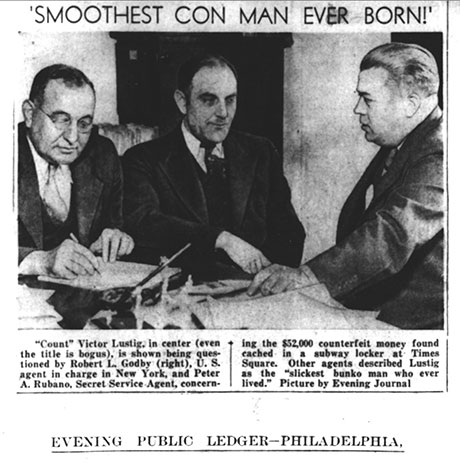
Featured image: Page from a 1935 Philadelphia newspaper, Public domain, via Wikimedia Commons.