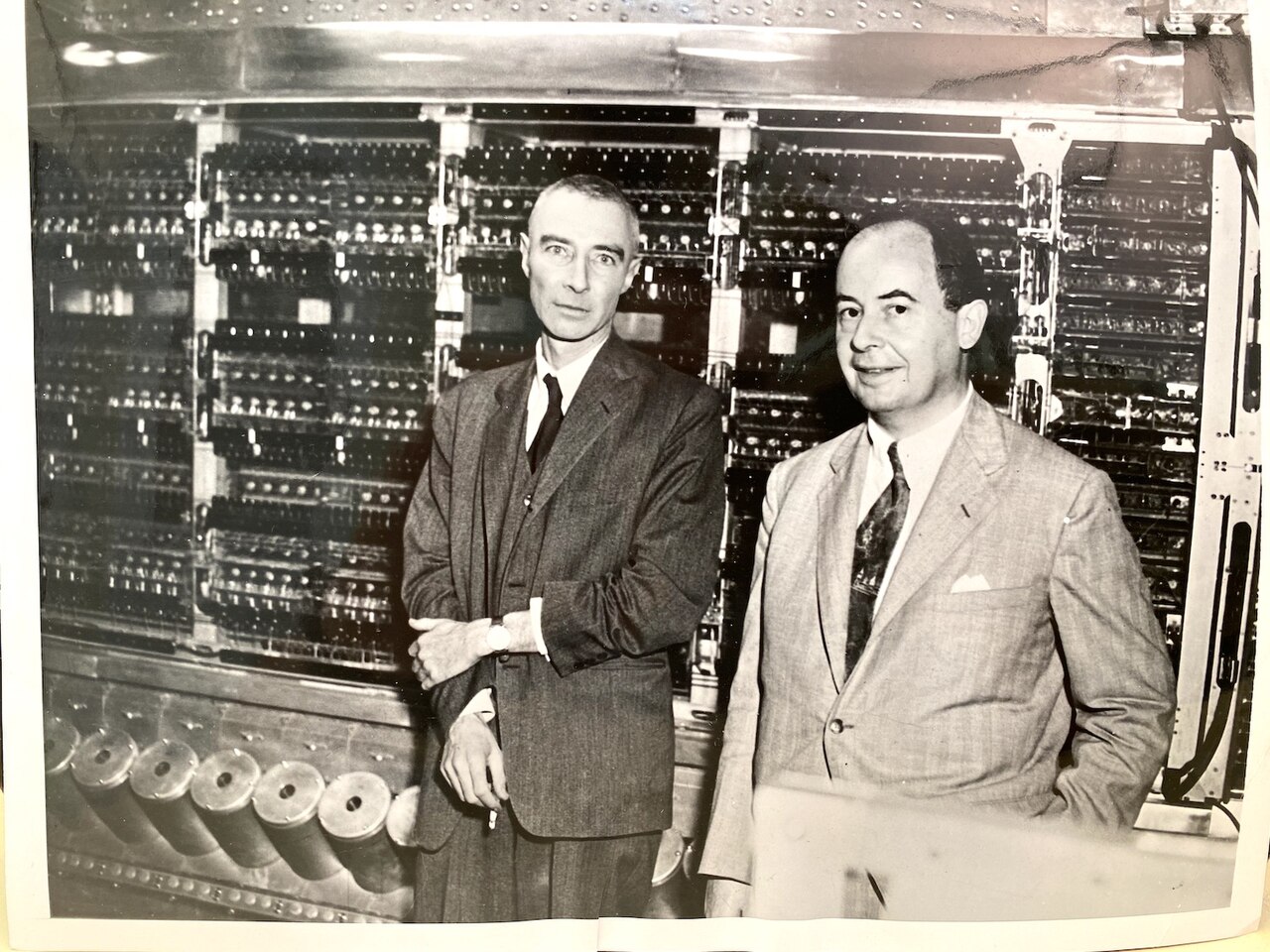
If you ask who was the smartest person of the 20th century, every source and every mention will point you to Albert Einstein. Yet the smartest person may well have been just a few metres away from Einstein, passing him in the corridors of Princeton in 1930. In fact, the smartest person in the world could have sat in on Einstein’s classes.
We are talking about John von Neumann, a mathematician and thinker born in Budapest in 1903 who emigrated to the United States in 1930 to join Princeton as a professor, where he stayed until his death in 1957.
Von Neumann’s talent and intellectual stature were spotted at a very early age. At 8 he could divide two 8-digit numbers in his head. At 19 he published two important mathematical papers, and at 22 he had a doctorate in mathematics with minors in experimental physics and chemistry.
He made major contributions to quantum physics, functional analysis, set theory, game theory, computer science, economics, numerical analysis, cybernetics, hydrodynamics and statistics. (Wikipedia)
During the Second World War, von Neumann joined Einstein and other leading scientists in developing the atomic bomb, and some voices say that much of the project would not have been possible without the work of von Neumann, among many other scientists whom Einstein did not cite as relevant authors.
Nobel Prize-winning physicist Eugene Wigner said that von Neumann had the quickest mind he had ever seen in a person.
For the economist Paul Samuelson there was no doubt: he said von Neumann was the most intelligent person in the world, and probably in all of history.
In fact, if we enjoy computers today, it is thanks to von Neumann. He worked out how to connect the different components to solve a given problem and discovered how to store programs, like software, in the computer’s memory, which would become the basic architecture of how computers work today.
Why Einstein won more fame and reputation than von Neumann is still something of a mystery that fuels debate on economics and mathematics forums. Everything suggests that von Neumann was clearly more intelligent than Einstein, but Einstein was more imaginative and creative. He probably also knew how to build what we now call a “personal brand”.
The fact is that von Neumann’s collaborations, theories and discoveries are practically countless. He did not waste a minute of his life. His mind worked productively on his greatest passion right up to the day he died, and yet, for some reason, it is Einstein who stayed in the collective memory. Could it have something to do with building a personal brand?
Sources: Wikipedia | Business Insider | Cal Poly Pomona
Featured image: Jeremy Norman Collection of Images, CC BY 4.0, via Wikimedia Commons.