

Entrepreneurs get a lot of advice from all kinds of sources. And some of it is bad. In fact, they even get advice from people with no business experience of any kind. Yet advice from someone with no business experience can be just as dangerous as advice from successful business people. Never forget that there are no universal rules in business, and what worked for one entrepreneur might not work for you.
Many factors come into play here, from the entrepreneur’s charisma to a company’s mission. We start from the premise that it’s hard to tell bad advice from good advice. Sometimes only hindsight will tell you whether it was good or bad.
Does that mean we shouldn’t listen to advice? Quite the opposite. Always listen to what others have to say, whether it comes from someone with no business experience or from Jeff Bezos. But always try to look at it from every angle and learn to question everything.
Of course, if someone has built a business empire from nothing, I’m absolutely sure that person has a lot to tell you and many lessons you can learn from.
What follows is a collection of advice commonly given to entrepreneurs, or that they often read just about anywhere. While it might make sense in the right context, in many cases it’s not much use when taken literally or received in the wrong context.
What is the worst advice an entrepreneur can get?
1. “Launch it. There’s a market for everything”
Not true. You can’t create a random product and expect people to buy it because “there’s a market for everything”. While there may well be customers for any silly thing you sell, many factors come into play that could lead you to your first business failure if you follow this advice.
You need to create products or offer services that people are willing to buy. And yes, there’s a market for everything, but before launching the product you need to be very clear about which market you want to target. Your product must solve a problem people have, meet a need, or simply entertain.
Even if there is a market for everything, the entrepreneur who researches and studies the market before launching a product usually has a better chance of success than the one who brings out a product blind and waits for the market to come to them. In business, it doesn’t quite work like that. What’s more, competition is now terribly tough. If you haven’t studied the market and you’re up against an entrepreneur who has, you’ll lose.
See also: The best business advice 9 successful entrepreneurs ever received
2. “Don’t start the business until you’re ready”
Shall I let you in on a secret? You’ll never be ready. There will always be something more to learn, something that could be improved. And that’s true of you as an entrepreneur as much as of your product and your company. There’s always room for improvement, but the best way to be ready to do something is to start doing it.
So if you want to start a business, you’ll have to do it on the basis that you’ll do most of your learning along the way.
Remember this: “Not even 100 years of theoretical study of business will give you the wisdom of a single day running a business.”
But urging people to start a business without feeling ready could also be bad advice if the idea isn’t understood, so I can’t resist giving a useful piece of entrepreneurial advice.
The best way to prepare to start a business is not to start one
WHAT?!!! Relax, stay with me. When you want to start a business in a particular industry without knowing anything about that industry, it’s highly advisable to first work for a company that’s already in the sector you want to enter.
It doesn’t matter whether it’s as a salesperson, an administrator, a secretary or an assistant to the section manager. That’s learning on the very playing field you want to play on later.
3. “Follow your passion and the money will follow”
Like hell it will. Being passionate about what you do is one part of the equation. People being willing to pay for what you do with passion (or without it) is another part.
And this sometimes amuses me, because someone whose passion is sport talks about opening a sportswear shop to follow their passion. What does a passion for playing padel or mountaineering have to do with entering a world where you’ll have to manage orders, deal with suppliers, marketing strategies, online advertising, headaches over paying the bills and the stress of the business when things go wrong?
If you’re going to follow your passion, I just hope you’re clear that your passion has to be business itself.
I’m going to tell you another secret, which I imagine you’ve already heard me say.
This piece of advice is about what matters most in business
These days they tell you that the most important thing is changing the world, or that the most important thing is customer satisfaction. Or no, the most important thing is treating workers well.
Call me a capitalist, but the most important thing in business is money. No money, no business.
Most businesses end up closing for one single reason: they run out of money, or the profit from sales doesn’t cover the costs of the business. Once the business has no money, it won’t be able to change the world or satisfy customers, and it won’t have any workers (if they want to be paid, that is). Quite simply, without money you don’t have a business.
So the advice would go like this: follow your passion, by all means, as long as your passion can be monetised, you have a large market you can reach, and it allows you to make a decent living after covering the costs of the passion business.
See also: Richard Branson’s 10 tips for business and life
4. “If you want to succeed as an entrepreneur, create something innovative”
We live in a time when everyone talks about the need for innovation. And it’s true that innovation is progress, but it isn’t a decisive factor in creating a business. In fact, the businesses that work best are simple ones.
On the other hand, in a time of innovation bubble, sometimes there’s no better innovation than going back to the traditional. It’s something we call “innovating backwards”.
Let’s take an example. There was a time when Denmark had no cars and people got around by bicycle. Then came innovation, with the first motor vehicles, and innovation continued with better diesel and petrol vehicles. And after all that innovating, today Denmark’s streets are full of bicycles again. Whether because of climate change or because people need more exercise, they have gone back to the past.
Another example. In the middle of the technology era, with dating-app giants like Tinder where anyone can meet someone for a date, several entrepreneurs have found highly profitable businesses in old-fashioned matchmaking, where a person puts two people in touch based on their tastes and interests without any technology involved.
Basically, very often the best businesses rely on simplicity, not complexity. That doesn’t mean a business, once created, doesn’t need improvements and as much innovation as possible, but sometimes the apparent need to innovate stops many entrepreneurs from taking the plunge because they don’t feel they can create sufficiently innovative businesses.
5. “They’re employees. Don’t treat them like family”
We can agree that an employee is just a number in the company and that you can let them go as soon as they stop being useful to your company and your purpose. I just hope you weren’t nodding along as you read that.
All I know so far about family and business is that a person would kill for their family, but if they feel like just a number on a team, don’t expect them to do much for you.
This is probably one of the worst pieces of advice given to business owners, and many still follow it.
When a sense of unity and family is encouraged in a company, an attack on the company feels like a personal attack. A leader is going to spend more time with the people in the company than with their own family.
When a team is treated as family, you can see real miracles happen in a company. These people are helping you grow, literally. They’re also helping each other, and they’re helping your customers.
On this point, follow a simple premise: “Treat others as you would like to be treated. Full stop.”
See also: Don’t go it alone in business. You won’t make it
6. “In business you have to seek out risk”
Careful with this one, because here things get complicated. It’s neither bad advice nor good advice. The only thing that can go wrong here is how it’s applied.
In this respect, we take it as a given that simply starting a business already means taking a risk, since nothing about the business’s future is certain. But there are a couple of variables that shouldn’t be ignored: one is randomness and chance, and the other is mathematics and probability. Let me explain.
Randomness
When people talk about the big risks taken by today’s successful entrepreneurs, we’re looking at Black Swan theory and survivorship bias, which explains how, out of hundreds of entrepreneurs who took the same risk, 99 came the cropper of their lives and one succeeded. We hold up the one who survived as the example. Never forget that the risky decisions that lead you to great success are also the same ones that lead you to great failure.
Mathematics and probability
If I can choose an easy path where I can gain 25% in a year with only a 30% risk of failure, or another path where I can gain 50% but have a 90% chance of failing, which path would you advise me to take?
Let me settle it for you. Always choose the easy path with less risk, because in the example I’ve given, if you manage not to fail on the risky path, the result would be down to sheer chance. In fact, if you take that risk several times over, the end result is that you lose.
And make no mistake. I’m someone who feels very comfortable taking high risks, but when I take paths where the risk is very low, that’s when I feel on top of the world.
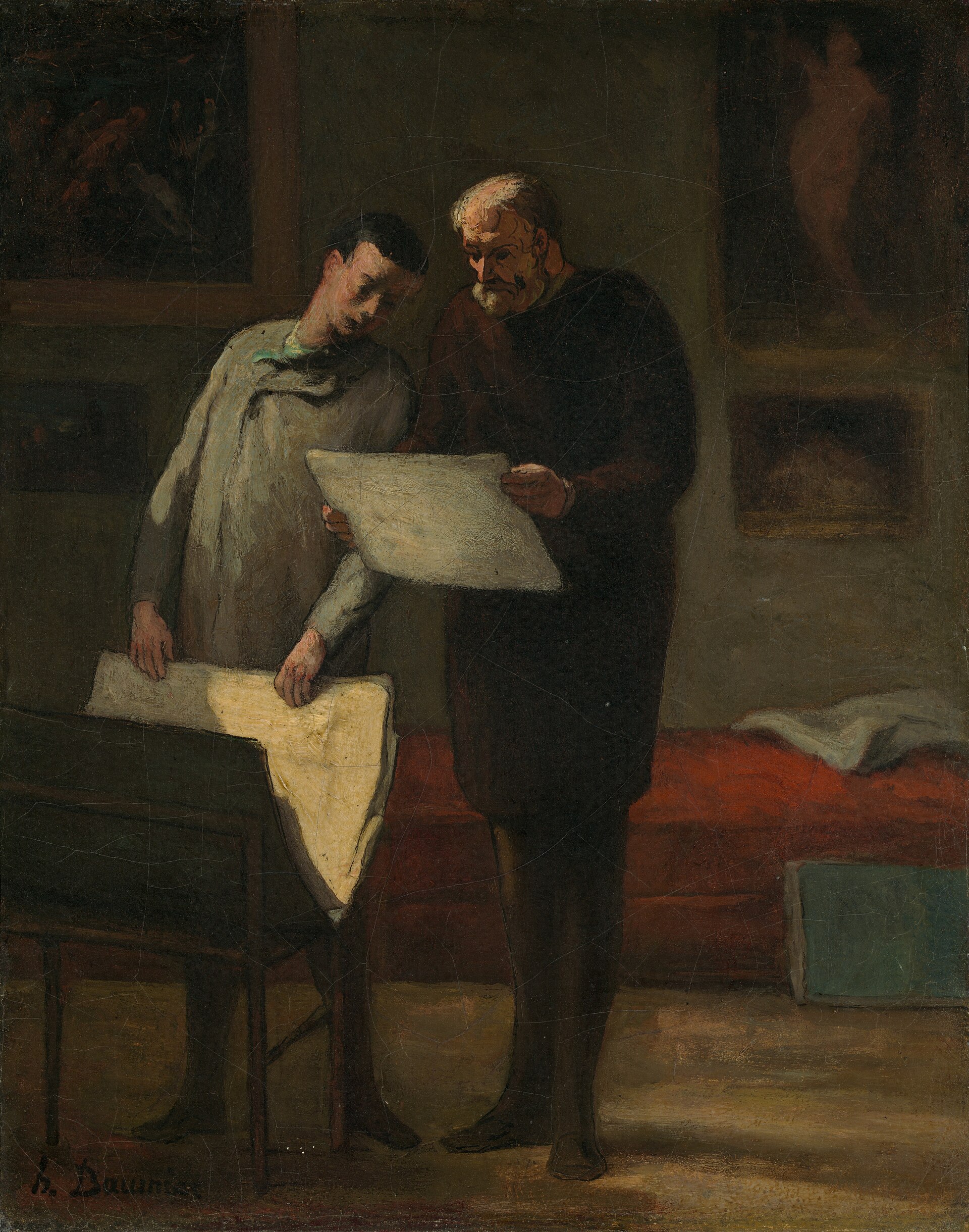
Featured image: Honoré Daumier, Public domain, via Wikimedia Commons.



