

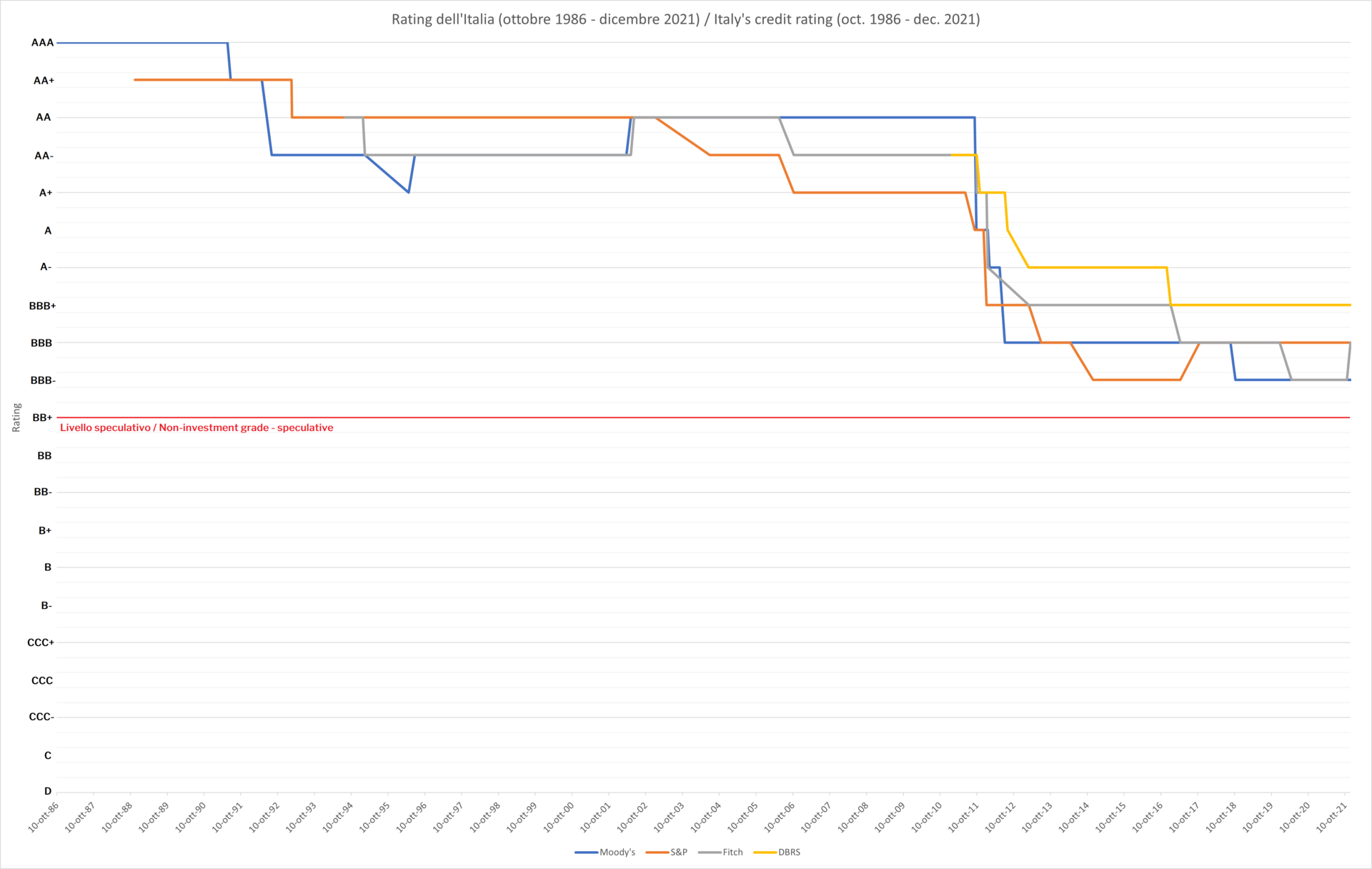
Editor’s note: This article was first published in August 2011, days after Standard & Poor’s downgraded the United States’ credit rating on 5 August 2011. Warren Buffett’s 12.5% stake in Moody’s is a figure from that year.
Here is a short explanation of what a credit rating agency is and how it works. Companies and governments pay these agencies to rate the risk of their debt and give it a “grade”. In principle, at least in theory, this assessment is honest and impartial, and investors use the grade given to a government’s or company’s debt to decide whether or not they want to buy its bonds, depending on the risk that has been assessed.
The rating agency carries out an initial analysis and awards a grade that ranges from “D” (the worst) to “AAA” (the best). As a general rule this grade is reviewed once a year, although the review can be brought forward if there are political, economic or social developments.
The three largest rating agencies, or at least the most influential worldwide, are Moody’s, Fitch Ratings and Standard & Poor’s. The last of these has been at the centre of the downgrade of the United States’ credit rating. The largest investor behind Moody’s, with 12.5% of its shares, is the well-known billionaire Warren Buffett.
A large share of these rating agencies’ income comes from the very governments and companies that hire them to assess the risk of their debt.
Rating agencies in the eye of the storm
A government like that of the United States probably never considered the possibility that a rating agency might think for itself, which is why the US downgrade came as a bucket of cold water at the worst possible moment, when the markets were already rather fragile.
Warren Buffett himself doesn’t understand how the country’s rating could have been cut, with all the consequences that has for the global economy. Former Federal Reserve chairman Alan Greenspan was the first to sound the alarm about the growing distrust of these agencies: according to Greenspan, the risk of the United States defaulting is zero, because, as he put it, the US can print money to pay any debt.
Rating agencies are steadily losing credibility, because people remember them for two specific episodes:
- The Enron case: Just three days before the multinational went completely bankrupt, it still had the highest rating. Enron had a terrible amount of debt and no consistent income to service it, so if it wanted to raise new capital from investors it needed a good grade from these agencies. And that’s what happened: it kept a good grade right up until it went bust, even though its risk had supposedly been assessed and none was found.
- The crisis: It’s understandable that the man in the street didn’t know the bubble was about to burst, but that doesn’t explain how the rating agencies failed to see the crisis coming, since that is supposedly what they do (anticipate risks). During the property boom, these agencies didn’t even downgrade the first banks that went under.
That is why, even though many investors still look at the information these agencies provide, more and more voices point to two possible explanations: “Either the analysts who work at these agencies are incompetent, or the agencies are bought by the clients who hire them and are therefore operating under a regime of corruption.” I’d say it’s 50/50 between the two.
Further reading
Featured image: LucaLindholm, CC BY-SA 4.0, via Wikimedia Commons.



