On the morning of Tuesday, November 3, 2026, Ueno customers opened their banking app and found it down. Cards were declined, transfers failed, and the branches stayed shut. The Central Bank of Paraguay (BCP) had announced that it was putting Ueno Bank into resolution after its solvency ratio fell to less than half the legal minimum.
Within days, the head of the central bank had resigned, the Senate had removed Paraguay’s president from office, and both men were under arrest. By November 11 the deposit guarantee fund had sent about $644 million to financial institutions for advance payments to eligible depositors.
Here’s how Ueno failed, what the deposit guarantee fund has done so far, and what the collapse means for savers.
How Ueno grew
Ueno grew out of Financiera El Comercio, a finance company founded in 1976. Grupo Vázquez, a family-owned group led by Miguel Vázquez, bought the company in 2021 and relaunched it as a digital lender. It began operating as a full bank at the end of 2023 and absorbed Visión Banco in June 2024.
The pitch was simple: open an account on your phone in minutes and earn cash back on purchases. It worked. In less than three years, Ueno reported 2.9 million customers. It opened more than 70 branches, sponsored the national soccer team and put its name on the national stadium. By the end of 2025, it held 8.9% of the banking system’s deposits. It ranked fifth by deposits and first by customer count.
It was also unusually close to power. Santiago Peña, president since August 2023, disclosed an approximately $845,000 stake in Ueno Holding when he took office and held on to it until March 2025. He appointed Carlos Carvallo, who had chaired Ueno’s predecessor company, to run the central bank, which supervises the country’s banks. Public money followed. By October 2026, Ueno held roughly $800 million in public funds, about a quarter of its deposits. Some $355 million of that belonged to the IPS, the social security institute that pays pensions and covers health care costs. The IPS had placed around 9% of its investment portfolio with Ueno.
Timeline of the collapse
- 2021. Grupo Vázquez buys Financiera El Comercio and launches the Ueno brand.
- Mid-2023. Carlos Carvallo leaves his post as president of Financiera Ueno. Santiago Peña takes office in August and puts him in charge of the central bank.
- End of 2023. Ueno starts operating as a bank.
- June 2024. It absorbs Visión Banco.
- March 2025. Peña sells his shares in Ueno Holding.
- December 2025 and June 2026. Hungary’s OTP Bank invests about $47 million in two installments for a 9.99% stake in U Holdings, the Luxembourg company at the top of the group’s banking structure.
- March 2026. Ueno sells $350 million in bonds to international investors. The bonds mature in 2031 and carry a 6.7% coupon. No other Paraguayan bank had bonds trading abroad.
- June 2026. Central bank inspectors find a pattern of lending to companies linked to the bank’s owners. Ordered to shed those loans, Ueno transfers a loan portfolio worth $74.4 million to Vinanzas SA, another company in the same group.
- September and October 2026. Senators ask the central bank about Ueno’s loans to related companies and its public-sector deposits. Peña dismisses the concerns as a smear campaign.
- Monday, November 2. The central bank’s board votes unanimously to put Ueno into resolution.
- Tuesday, November 3. The decision is announced in the early hours. The app goes down, cards and transfers stop working, and branches stay shut.
- Wednesday, November 4. Congress rushes through an emergency law to speed up payments to depositors. Thousands march on Congress, and so many people try to open accounts elsewhere that other banks’ apps crash.
- Thursday, November 5. The first payments go out. Peña announces his resignation in a video. Minutes later, the lower house votes 78–0 to impeach him. A judge orders six Ueno executives, including Miguel Vázquez and the bank’s president, Juan Manuel Gustale, held pending trial and places two more under house arrest.
- Friday, November 6. In the 45-seat Senate, 44 senators vote to remove Peña from office. Vice President Pedro Alliana is sworn in the same evening. Prosecutors order the arrest of Peña and Carvallo.
- Saturday, November 7. Prosecutors charge Peña with breach of trust and using public office for personal gain. A judge orders him held pending trial. Peña denies the charges. Prosecutors also charge Carvallo.
- Wednesday, November 11. The central bank says it has sent the advance funds to the institutions handling the payments. Some depositors still have to verify their claims before they can get their money.
- Tuesday, November 17. The central bank extends the deadline for paying out insured deposits to December 2.
Why it failed
Ueno ran into one of the oldest problems in banking: it lent depositors’ money to companies tied to its owners.
According to the central bank and prosecutors, Ueno lent about $146 million to just three companies linked to Grupo Vázquez. That exceeded the legal limit on lending to related parties, and there wasn’t enough collateral to secure the loans. When the regulator ordered the bank to get those loans off its books, it sold a $74.4 million portfolio to Vinanzas, a sister company. Investigators say Vinanzas couldn’t pay for the portfolio and that Ueno itself indirectly financed the sale. That moved the loans off Ueno’s books without getting the bad debt out of the group.
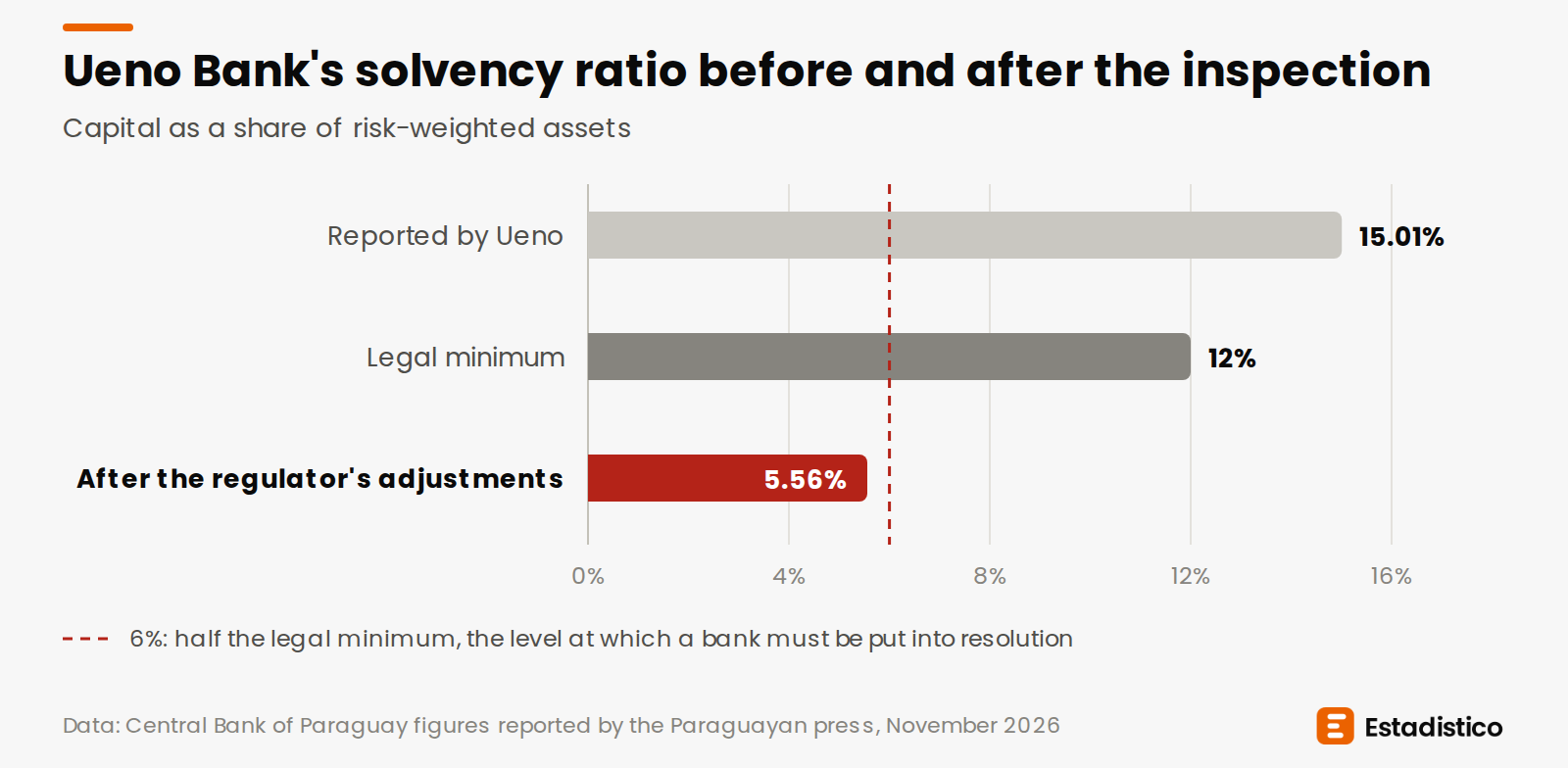
Inspectors also found expenses that had been booked as assets. After the adjustments, which totaled more than 1.6 trillion guaraníes, Ueno’s solvency ratio fell from the 15.01% it had reported to 5.56%. The legal minimum is 12%. When a bank’s solvency ratio drops to less than half the minimum, Paraguayan law requires the central bank to put it into resolution.
Prosecutors have charged 27 people, eight of them Ueno directors, with breach of trust, attempted fraud, improper conduct in a crisis and bookkeeping offenses. Nobody has been convicted. The lawyer for the bank’s president argues that bank boards don’t decide who gets individual loans.
Has the fund paid depositors?
The fund quickly sent the advance money to participating institutions. Depositors still waiting for their claims to be verified didn’t know when they’d get their advances. Those with larger insured balances were also waiting to learn when the rest would be paid.
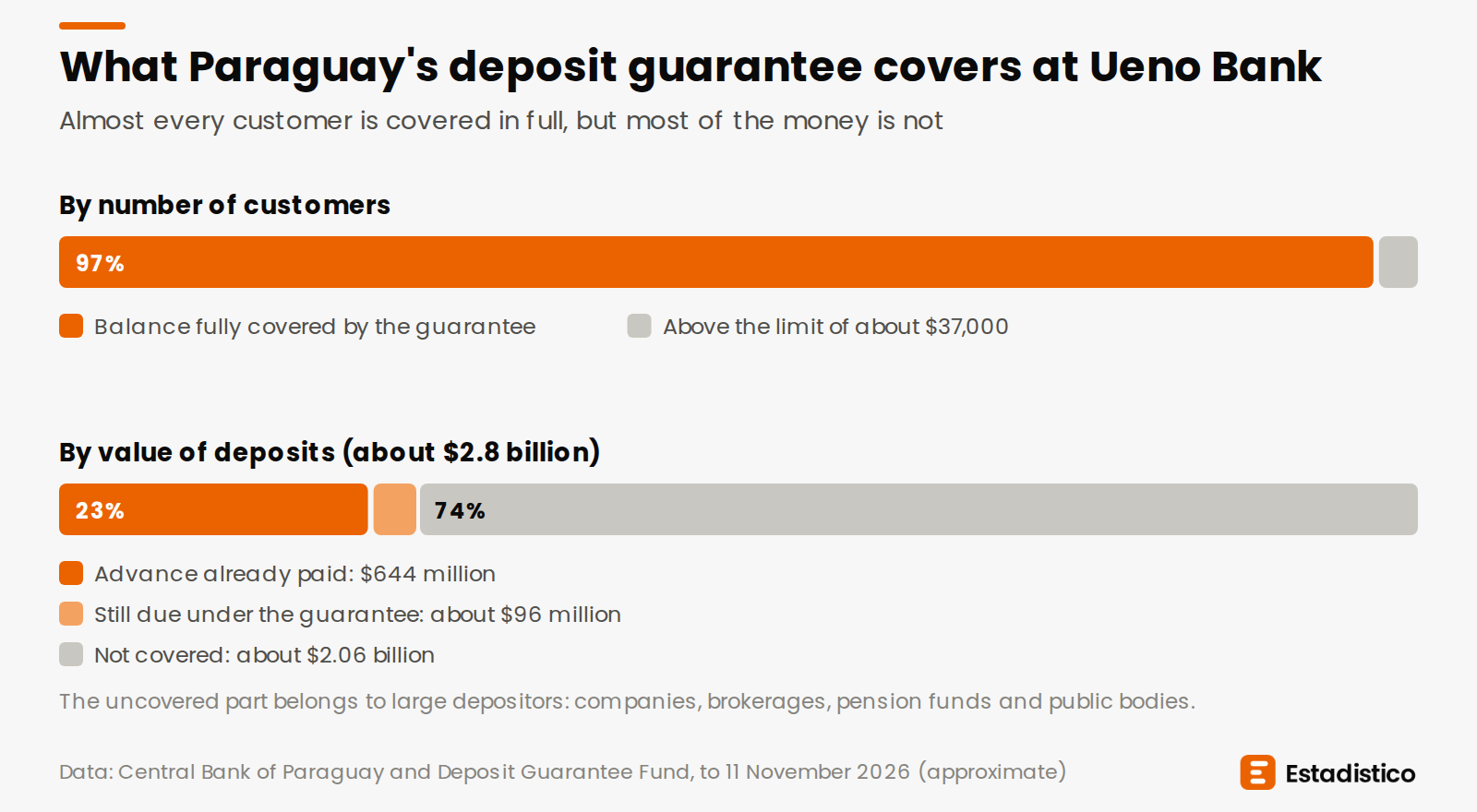
Paraguay’s Deposit Guarantee Fund (FGD) covers up to 75 times the monthly minimum wage per person, per bank. For Ueno’s depositors, that comes to 228.3 million guaraníes, about $37,000. The November 4 emergency law required an advance of up to 40 times the monthly minimum wage (121.76 million guaraníes, roughly $19,800) within five business days.
- Payments began on November 5. The first group included depositors who had up to 10 million guaraníes (about $1,600) in demand deposits, owed Ueno nothing, and already had an account elsewhere.
- By November 11, the BCP reported transfers of 3.99 trillion guaraníes, about $644 million, to financial institutions for 1,812,348 eligible depositors. Holders of savings certificates (CDAs) still had to verify ownership before they could get their money.
- On November 17, BCP Resolution 14 moved the legal deadline for paying out insured deposits to December 2, 2026. As of November 19, the BCP had yet to announce a general payment date for the remaining covered balances, up to the limit of 75 times the monthly minimum wage.
- Under the advance procedure, the money went into an account at another institution. If a depositor didn’t have an account elsewhere, the institution handling the payment was to open one in their name. Any overdue debt to Ueno came out of the payment first. The BCP has separate instructions for verifying ownership of a savings certificate.
Here’s how the November 2026 limits apply to three eligible Ueno balances, assuming the depositors owed the bank nothing. The advance was capped at ₲121.76 million and the full guarantee at ₲228.30 million.
| Eligible balance | Advance | Remaining insured balance | Above the limit |
|---|---|---|---|
| ₲80 million | ₲80 million | ₲0 | ₲0 |
| ₲200 million | ₲121.76 million | ₲78.24 million | ₲0 |
| ₲300 million | ₲121.76 million | ₲106.54 million | ₲71.70 million |
When depositors can use the funds depends on the payment schedule and any checks the BCP still has to complete. The limits and the schedule come from the BCP’s guaranteed deposits page and its payment notices.
The guarantee covers the entire balance of about 97% of Ueno’s customers. But José Maciel, who heads the fund, expects a total payout of around $740 million, or about 27% of the bank’s $2.8 billion in deposits. The other $2 billion or so belongs to large depositors: companies, brokerages, pension funds and the state itself.
What those depositors recover depends on how much the authorities can get for Ueno’s assets. Resolution 14 kept the valuation of the bank’s assets and liabilities on a separate timetable. A central bank board member said the aim was to finish paying out insured deposits, then recover money for the pension funds. President Alliana has promised to make that recovery a priority. How much the funds might get back, and when, remains unclear. Holders of the 2031 bonds are expected to rank behind depositors.
Ueno’s offshore ownership
Ueno was a Paraguayan bank with an international ownership structure. U Paraguay owned 91.21% of the bank. Its shareholder was U Holdings, a Luxembourg company. Grupo Vázquez held 86.73% of U Holdings, Hungary’s OTP Bank held 9.99%, and minority investors held the rest. The bonds were sold to international investors, and the group’s 28 companies employed people in Argentina, Mexico, Nicaragua and Panama as well as Paraguay.
None of that is illegal. Holding companies in Luxembourg are routine in international finance.
- A foreign investor gave depositors no extra protection. OTP says it bought the stake purely as an investment, had no say in management, and considers the loss small for a bank of its size. Bondholders are still waiting.
- The cross-border structure complicates recovery. Assets, claims and lawsuits now span several countries. A Paraguayan judge has frozen the assets of at least 17 companies linked to the group, and tracing the money through them will take time.
- The ownership was international. The risk was concentrated in Paraguay. People who keep part of their savings in another country usually do it to avoid depending on a single bank or government. Ueno’s holding company was abroad, but the loans at the heart of the collapse went to businesses tied to the bank’s owners at home.
What savers can learn
- Know your deposit insurance limit. Find out how the rules work in your country. In Paraguay, the limit is about $37,000. It covered 97% of Ueno’s customers in full, but roughly three-quarters of all deposits fell outside the guarantee.
- The limit is per person and per bank. Splitting a large balance among two or three banks is a simple way to stay within the insurance limit. The same logic applies to diversifying investments.
- Keep a working account somewhere else. Ueno’s advance payments had to go through another institution. Savers who already had an account could use it without waiting for a new one to be opened.
- Rewards are never free. The money for cash back, bonuses, and above-market rates has to come from somewhere. When a bank grows that quickly, take a closer look before trusting it with your money.
- Look at who the bank lends to. Lending to insiders was behind the failure of Bancopar in Paraguay in 1995 and of Ueno in 2026. It’s a pattern that keeps turning up when banks fail.
- Political connections are not a guarantee. Holding deposits from the pension fund and sponsoring the national team made Ueno look safe. Those same ties are now at the center of three criminal investigations.
- A strong solvency ratio can be misleading. Until the inspectors corrected its accounts, Ueno was reporting a solvency ratio of 15%, and just eight months before the collapse, international investors had bought its bonds with a coupon of 6.7%.
- If your savings are large, do not keep them all in one country. Keeping savings abroad is legal, and you have to declare them. Opening an account abroad is harder than it used to be, as we explained in our article on opening an account in Switzerland or Singapore.
What happens next
The next steps are to value Ueno’s assets and liabilities and pay the rest of the insured balances. As of November 19, the bank was still in resolution. Savers should check the BCP’s official notices for payment dates and instructions.
The damage goes beyond the bank. The guaraní lost nearly 7% against the dollar in the week of the collapse. The labor ministry estimates that about 7,000 jobs at the bank and its related companies are affected. The association of private banks says the rest of the system is operating normally.
The criminal cases against the former president, the former head of the central bank and Ueno’s executives are only beginning. The advance was meant to cover some or all of the insured balance for about 1.8 million savers. Some payments were still pending verification. It is still unclear how much pension funds and other large depositors with balances above the guarantee limit will recover.
Frequently Asked Questions
How do I find out which bank got my advance?
The BCP’s payment notice links to a lookup tool that shows which bank or finance company was assigned to you. If there’s no institution listed, the BCP says the assignment is still pending and to check again later. The tool is for looking up the assignment. If you held a savings certificate (CDA), follow the separate ownership verification instructions above. See the BCP’s explanation of the lookup.
How much is covered if I had a joint account and an account of my own?
For a joint account with two holders, each holder can receive up to half the guarantee limit for that account, or ₲114.15 million, depending on the balance. That coverage counts toward the same ₲228.30 million per-person limit that applies to your own eligible deposits at Ueno. Say there’s ₲300 million in the joint account, you have ₲80 million in your own account, and you owe Ueno nothing. Your coverage would be ₲114.15 million from the joint account plus ₲80 million from your own, or ₲194.15 million. See the BCP’s rules for joint deposits.
First published on November 12, 2026. The deposit guarantee figures come from the November 11 advance report. We checked the bank’s resolution status on November 19, 2026. This article will be updated as the resolution moves forward. It is not financial advice.