Editor’s note: This article was first published in November 2012, during Spain’s economic crisis; its picture of e-commerce and the tools it mentions reflect that time. Google Local is now Google Business Profile and Google AdWords is now Google Ads.
We’re approaching the most consumerist time of the year, Christmas, although it will be a Christmas hit hard by the crisis, with most consumers keeping a very tight budget in mind. The competition is big and fierce, so fighting it, and competing with the big retail chains, won’t be an easy task.
But of course… you have to try, and I think these 5 simple steps can help you, although, to be honest, we’re not going to say anything new. We need to catch the attention of our potential customers, and we need to know that drawing up online strategies is just as important as offline ones.
1. Make your website easy to use on every format
E-commerce is still weak in Spain, but the truth is that most users search for a product online before buying it. We need our website to be well optimised both for computers and for mobile phones, since mobile is becoming more and more important in searches. There are different tools, both free and low-cost, that can make your website fully mobile-compatible in a simple, easy-to-use format.
And this is very important, because it’s a mistake many businesses make when designing their website: it takes a huge amount of effort to find the address of the physical shop and a phone number to call. The more ways of contacting you there are, and the more visible they are, the easier you make it for a potential customer.
2. Make the most of local searches
At this time of year the number of local searches tends to grow, both on Google and on Yahoo. People no longer search for “toy shop”, but for “toy shop in Madrid, Granada, Seville…”. So if you still haven’t registered your business on Google Local, you probably won’t be seen by hundreds or thousands of potential customers looking for the product your business sells.
For example, if I search Google for “toys in Granada”, the search engine shows me some results with the website, address and phone number of these shops, and at the top right they appear on a map, where I can see their exact location thanks to Google Street View. And under the map are the results from paying advertisers, the ones that use Google AdWords to appear for specific keywords in searches.
3. Use discount coupons as a hook
We’ve already given our opinion on discount coupons (Groupon and the like). If we plan the strategy properly, they can be profitable for us. At this time of year, though, we can use them as a hook, offering a product with a minimal margin or none at all so that the customer comes to our business. Once they’re there, we can offer them other products.
There’s no doubt that this Christmas, customers will be looking for all kinds of deals, and many of those deals are found in these coupons.
4. Let’s go after offline customers
We’ve already put together a simple online strategy, and now it’s a matter of reaching our potential customers the old-fashioned way.
Leafleting is still the most effective form of advertising, because you take your business straight to the customer’s door, and if your product or offer is good, you may well get good results. The investment in this kind of advertising is usually very low.
5. Donate money
They say the best way to receive is to give. Christmas is the time when people seem to be much more supportive of others, or at least more aware of other people’s suffering. Use that in your business, but make sure it’s genuine.
You could donate 2% of your Christmas profits to a charitable cause, and make sure the customer knows about it. Personally, if I’m going to buy something and I know that a particular shop is going to donate part of its profits to one of the associations for people facing eviction, I don’t think I’d mind paying a bit more for the cause.
And finally, in some places small shops usually join forces to hold a Black Friday or a Small Business Saturday. Basically, it’s a day on which a town or a city neighbourhood promotes shopping at local retailers, so that not everything goes to the big chains. They put out a catalogue of the shops taking part in the initiative and usually hold a concert, a competition or something else in the neighbourhood to attract people’s attention. Outside Spain it usually works.
In the face of the crisis and fierce competition, it’s all about catching the attention of potential customers, so the more visible your business is in every form and format, the better your chances of increasing your sales.
Further reading
- 5 ways to grow your business
- How to increase a business’s sales in a crisis
- Profitable businesses for 2013
- Businesses that work during the crisis
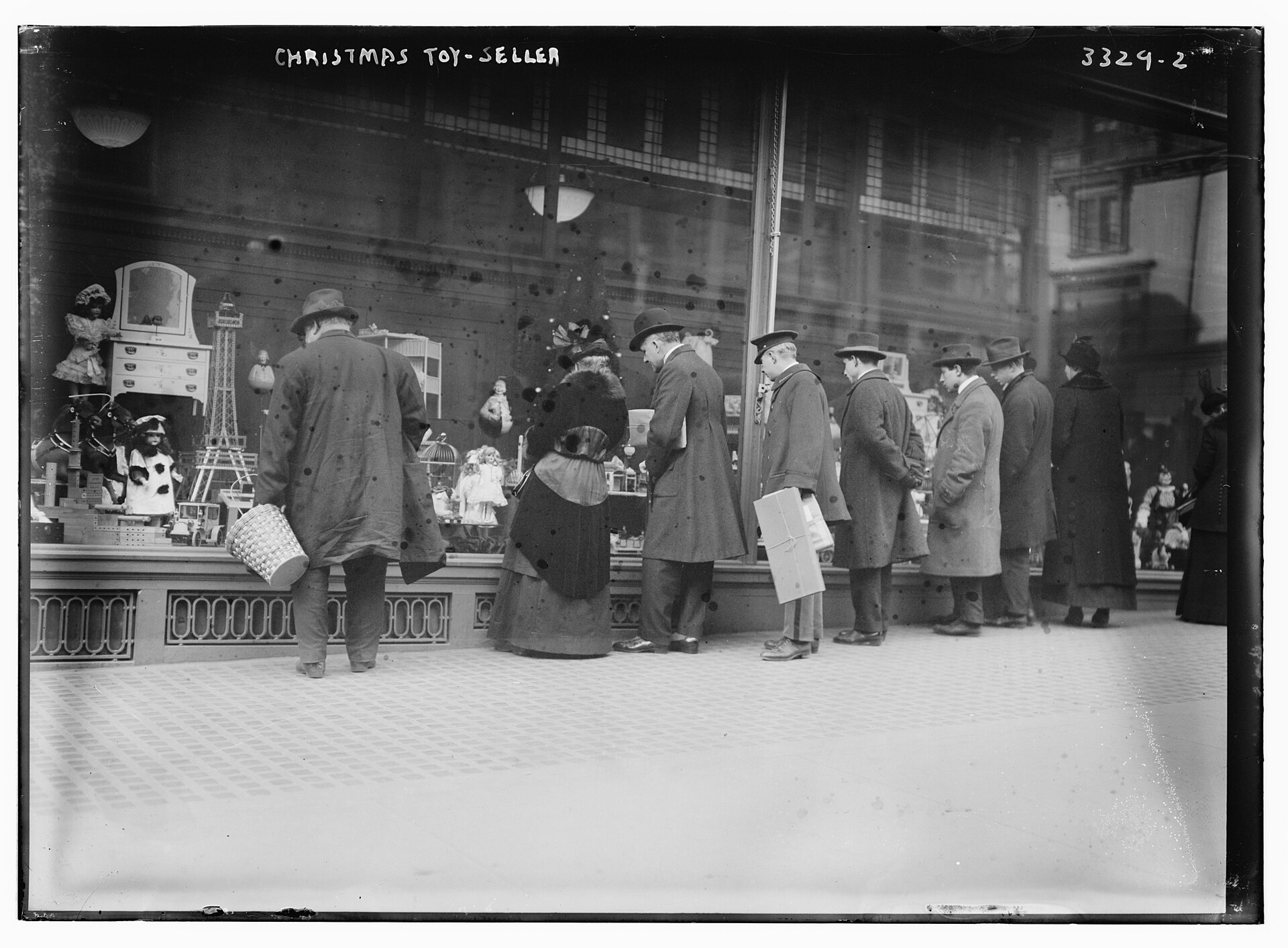
Featured image: Bain News Service, publisher, Public domain, via Wikimedia Commons.