Editor’s note: This article was first published in April 2012, and its opening refers to unemployment in Spain rising month after month in April 2012.
We stand in solidarity with the fundamental right to work enshrined in the Spanish Constitution, at a time when that right is so vilified, crushed and devastated in Spain, where the figures rise month after month with, so far, no remedy in sight.
On 1 May 1886 a general strike was called in the United States to demand that the working day be limited to eight hours (8 for work, 8 for leisure and culture, and 8 for rest). Working conditions were deplorable for children, women and men alike, who were exploited in shifts of up to 18 hours.
It all began in Chicago, then the second-largest city in the US, when workers from different factories answered the unions’ call: more than 200,000 workers took part in more than five thousand strikes. The outcome was harsh repression, with arrests and later death sentences, at a time when spring in the northern hemisphere became a season of demands and protest.
Three years later, in tribute to the Chicago workers, the Socialist Workers’ Congress of the Second International, held in Paris, declared 1 May International Workers’ Day. Curiously, neither Chicago nor the United States celebrates it as such.
The first strike
Chicago was where the strike was more violent than anywhere else, as workers fought against inhuman working conditions. In the city the strike continued on 2 and 3 May, except at the McCormick agricultural machinery factory, which had been on strike since mid-February and was being kept running with strikebreakers. The reason for that strike: a sum was being deducted from the workers’ wages to build a church.
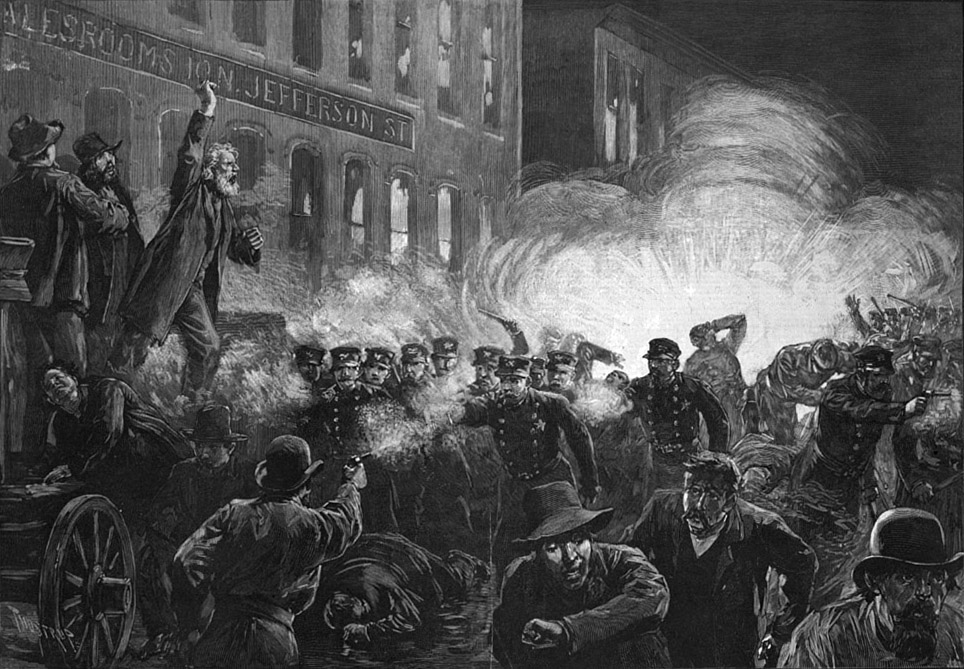
These demonstrations led to major disturbances that ended in a huge brawl, which the police brought to an end, without warning, by firing on the crowd, killing six people and wounding dozens. It was the first of many incidents. The next day, a bomb exploded among the ranks of the police and killed an officer. A state of siege and a curfew were declared, and hundreds of workers were arrested, beaten and tortured, accused of murder. Homes were raided and arsenals of weapons and ammunition were found.
Then came the sham trial, which began on 21 June 1886 against 31 defendants, later reduced to eight. The trial was a farce that violated every rule of procedure, in form and in substance. Although nothing was proven against them, the eight Chicago defendants were found guilty, accused of being enemies of society and the established order. Three of them were sentenced to prison and five to the gallows.
Success against unreason
Winning the eight-hour day was an important milestone for the labor movement worldwide, and by the end of May 1886 employers in several sectors had agreed to grant it to several hundred thousand workers. It was a success for the Federation of Organized Trades and Labor Unions.
In the 21st century, many countries celebrate May Day as the origin of the modern labor movement. Even Pius XII tacitly endorsed this day of collective memory by declaring it the feast of Saint Joseph the Worker.
However, Labor Day is not celebrated on the same date everywhere. The United States, curiously, and Canada celebrate it on the first Monday in September. In New Zealand it is the fourth Monday in October, and other countries have their own dates.
Featured image: Thure de Thulstrup, Public domain, via Wikimedia Commons.