Editor’s note: This article was first published in May 2018 for Spanish investors. Its claim that low-cost index funds “don’t exist as such in Spain”, the fees of 0.20%–0.60% and the minimum investments of 50, 100 or 1,000 euros have changed since; index funds and ETFs are now widely available in Spain, often with lower fees.
Many people have heard or read about the long-term investment strategy of putting money into “low-cost index funds”, an approach Warren Buffett strongly recommends. But then the question comes up: how do you buy an index, how do you invest in a stock market index, and which investment products can you use to invest in an entire index?
That is what we are going to explain in a very simple way, bearing in mind that the “low-cost index fund” we usually mention is a literal translation from English and doesn’t exist as such in Spain. But let’s take it one step at a time.
What does investing in an index mean?
When we invest in the stock market, we can pick a few shares and invest in them. Concentrating a lot of capital in a few companies can, without doubt, be more profitable than any other investment, especially if the share price soars. But such limited diversification also carries greater risk.
We can build a widely diversified portfolio, which gives us more security, on the basis that even if some shares fall, others will rise. In many cases, though, this strategy ends up with the shares that do badly eating up the returns of the ones that did well. In other words, what you gain on one side you lose on the other.
Or we can buy the whole index. In the case of the IBEX (Spain’s benchmark index), that would be like holding all 35 companies that make it up in our portfolio. Careful, though: we don’t own the shares, we own the index.
Why is buying the whole index the favourite investment of big long-term investors?
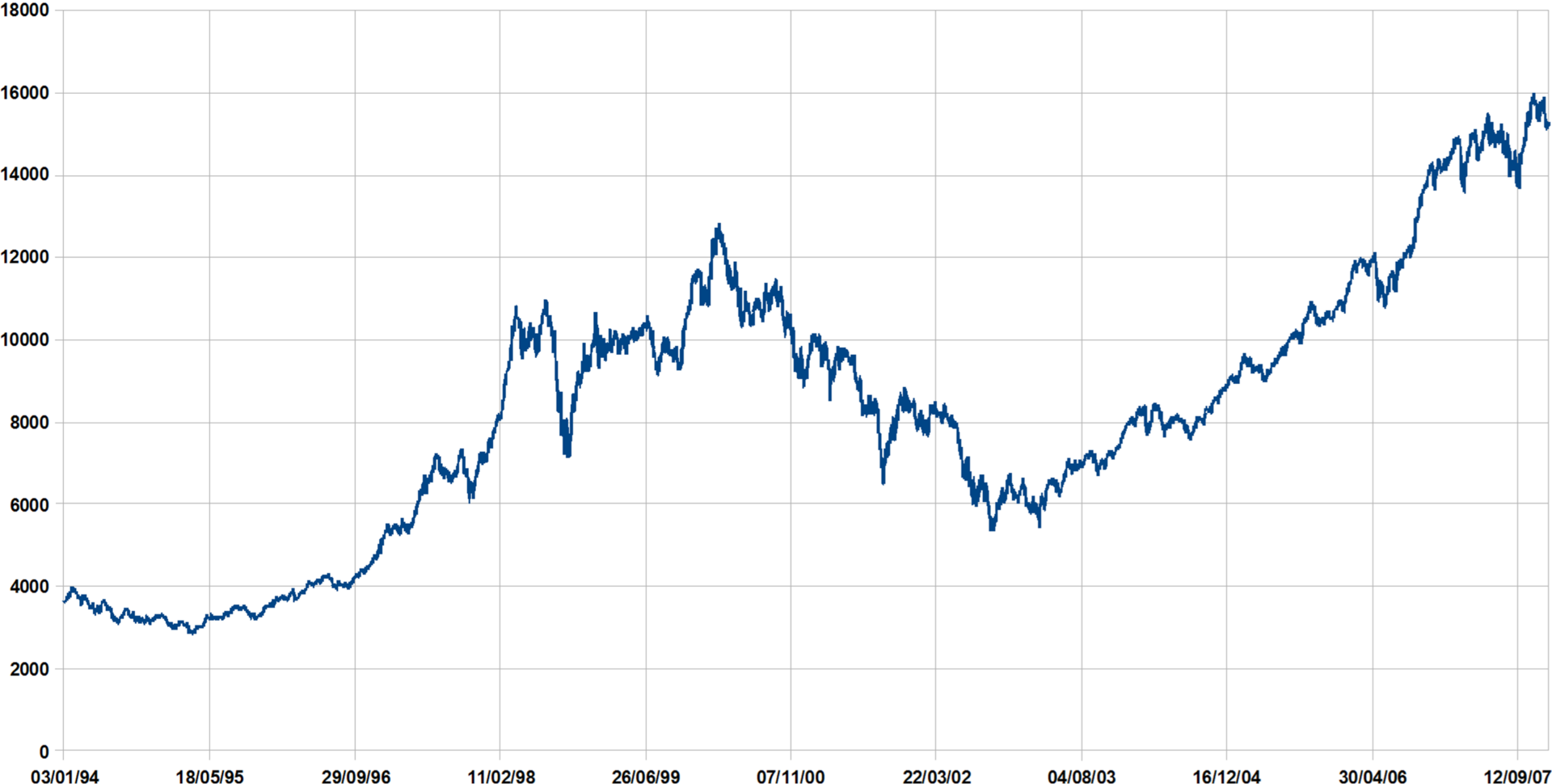
The history of investing shows that if we keep investing our savings month after month in an index fund, regardless of its price and regardless of the economic cycle, nobody has lost money over a 10-year period, because indices tend to rise over the long term.
See also: The pyramid of financial success (after Maslow)
Bear in mind that the main indices are supposedly made up of the best companies, so the aim is for them to include companies that are expected to grow their business and therefore their share price.
That is why, if you buy the index and apply the DCA strategy (dollar-cost averaging), returns are practically guaranteed. And now, let’s get down to business.
Which products to use to buy an index
To buy a whole index, the products we can use are ETFs and index funds. There are also some investment funds that select the strongest companies within the index, or the bank stocks, or those of a particular industry.
The problem with investment funds is usually their high fees, since the vast majority are actively managed.
Index funds and ETFs, on the other hand, are passively managed and therefore charge lower fees.
What are low-cost index funds and ETFs?
In fact, we could define both products as passively managed investment funds, with a few small differences between them.
Both replicate the return of the index in question, unlike actively managed investment funds, which try to beat it, and practically none of which manage to do so in the long run. In fact, passively managed funds have proved more profitable than actively managed ones over the long term.
The most notable difference between index funds and ETFs is that ETFs are exchange-traded funds: they are also listed on the stock market and can be bought as if they were shares.
In the end, the returns of both will be very similar, although there may be slight differences in fees and taxation.
Why do index funds and ETFs have low fees?
It’s simple. Because they are passively managed funds that only replicate the behaviour of an index, they don’t need managers.
In case anyone is wondering how much these funds charge in fees, we are talking about between 0.20% and 0.60%.
Which is better, an index fund or an ETF?
To spare you the long read, I’ll get straight to the point. Personally, I recommend index funds, mainly because it will be easier to find one that lets you invest small amounts of money. In other words, when we tell a young person to start investing, even if it’s only a little, this is the kind of investment we mean.
That said, in this article we explain the difference between index funds and ETFs in some detail.
With some index funds you can invest 50 or 100 euros. Others require you to invest at least 1,000 euros. This time I won’t name any specific index fund, so that the usual smart alec doesn’t turn up saying it’s covert advertising or something like that.
I’ll finish by saying that these funds are ideal for starting to save and invest in pursuit of the much-praised power of compound interest.
See also: 5 books every investor should read
Featured image: Gr1st, CC BY-SA 4.0, via Wikimedia Commons.