We are not as rational as we think. In fact, much of our thinking and many of our decisions are biased or flawed in some way, but not everyone is aware of it. If you have ever assumed that you understand why you think and act the way you do, you are very probably wrong.
Decades of psychological research suggest that people behave in utterly baffling ways.
In a Quora thread, someone asked:
What are some mind-blowing facts about social psychology?
We have gathered the most fascinating answers, which are also well documented.
These are the most interesting findings about why we think the way we do, along with some of the most common psychological mistakes.
(See also: 5 books that will help you get smarter and make better decisions)
1. We go along with the majority opinion, even when the majority is obviously wrong
We take it for granted that the majority opinion is the right one, and we do everything we can to fit in with it.
In an experiment run by the psychologist Solomon Asch, participants were shown 3 lines, one of which was clearly longer than the other. Everyone agreed on which line was the longest.
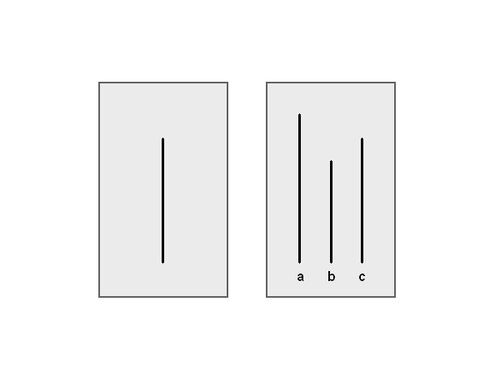
But when everyone else teamed up as accomplices and said that the shortest line was the longest, they got the participants who weren’t “in on it” to agree that the shorter lines were longer than the obviously long line.
That’s why personal development teaches us today not to side with the majority: when it comes to succeeding in life, most people are wrong, and we have to do what very few people believe they should do.
2. We are more influenced by our immediate surroundings than we admit
Nowadays I think everyone knows this, but I don’t think they know just how true it is. The environment we are born into shapes us, and the environment we grow up in shapes our future.
It’s exactly like the famous fable of the eagle that was raised as a turkey. Our actions will always be influenced by the values and messages we pick up in our environment. Our intelligence is the average of the people we spend the most time with, and the same goes for our aspirations and even our success.
If we put a poor salesperson in a team of star salespeople, where the norm is to sign 20 insurance policies a month, that poor salesperson could become a mediocre one signing just 10 policies, and would feel frustrated at being the worst in the team.
If we put a star salesperson in a team of terrible salespeople, where the norm is to sign 5 policies a month, the star salesperson would end up doing 8 policies and would feel like number one in the team, even though they would be signing fewer policies than the worst salesperson in the star team.
During my years in sales, I’ve seen this happen with mathematical precision.
3. We like people who act and behave like us
Copying another person’s body language increases the chances that they will like us. And this is a powerful weapon used both in sales and in the art of seduction.
Chartrand and Bargh’s 1999 experiment concluded that when we imitate another person’s speech quirks, gestures and expressions, producing what is known as the “chameleon effect”, we end up getting that person to like us. When it’s the other person who unconsciously falls in with our gestures and expressions, in seduction this is called a “sure bed”.
4. When people work in groups, they don’t always think rationally
If a group consciously or unconsciously perceives one of its members as a leader, that person’s opinions may carry more weight than those of the rest of the group and condition the group’s thinking.
The psychologist Irving Janis coined the term “groupthink” while studying the United States’ invasion of Cuba in 1961.
Kennedy knew he wanted to get rid of Fidel Castro, so he put a group to work on what seemed to be a sensible plan, created by Kennedy himself. In the end the group was biased into believing it had drawn up a plan, but the plan wasn’t sensible, and Kennedy accepted it as valid.
That’s why the best thing a leader can do to prevent groupthink is to step back from the group and let the group itself analyse the decision by consensus before the final decision is made.
5. We can be more critical and harsher with other people than we would be with ourselves
The so-called “fundamental attribution error”, or “correspondence bias”, makes us judge other people’s behaviour critically, when the same behaviour wouldn’t seem bad at all in our own case.
In other words, if someone we don’t know arrives late, they’re an idiot with no respect, unpunctual and unreliable. If we arrive late, there’s a good reason: the alarm didn’t go off, I got stuck in a traffic jam, and so on.
Basically, we wrongly think that other people’s mistakes are the result of flaws in their personality, whereas in our own case they are only due to circumstances.
6. We are not aware of the power of suggestion
Mental suggestion, used positively, can give us unimaginable power. Many studies have been carried out to see just how powerful suggestion can be. In one experiment, a group of participants were told they would be given capsules that would boost their intelligence for doing maths, but that had a very common side effect: nausea and vomiting.
Of course, there was nothing inside the capsule (a placebo).
A small percentage felt mentally sharper and were able to solve some maths problems they had practically forgotten. They had no side effects.
Most of the group felt nauseous and wanted to vomit.
Conclusion: some people filled their minds with the positive suggestion (mental sharpness), while the great majority filled their minds with the negative one (the side effects). Either way, 75% of the group were influenced by suggestion.
Applied to our field: “Whether you believe you are going to succeed at something or believe you are going to fail, you will bring about the result yourself.”
Fill your mind with negative things and you’ll see everything negatively. And this has nothing to do with the cosmos or spirituality, but with your own brain.
7. We can easily be tricked into paying more than we want to pay
We already talked about the decoy effect in our article “Ways our mind betrays us“. As a rule, we don’t analyse the price of a product but the options we have, so if the options are manipulated, we can see as cheap what looked expensive without them.
The behavioural economist Dan Ariely devised an experiment with The Economist to study the behaviour of its customers and how they could be manipulated with a good marketing strategy.
Users who wanted to subscribe to the magazine had 3 options:
- Subscribe to the web edition for $59.
- Subscribe to the print magazine for $125.
- Subscribe to the print magazine plus the web edition for $125.
It’s clear which of these 3 options we could consider useless. When Dan gave these options to 100 users, 84% opted for the $125 combo, that is, option 3 (print magazine plus web edition), while 16% opted for the cheapest version (web edition for $59). Of course, nobody chose option 2.
Next, Dan removed the second option (the useless one), the print magazine at the same price as the combo.
With only these 2 options left, 70% of people now chose option 1 (web only for $59), while 30% chose the combo.
Sometimes, though, you don’t need to study things that much: many consumers’ brains work so simply that just putting the word “SALE” or “50% off” on a product makes them buy it, even if you have raised its price by 20%.
8. We are terrible at predicting probabilities
Imagine you are playing heads or tails with another person. If we toss a coin, the probability of heads or tails is 50%. If we are about to toss a coin 100 times, there’s a high probability that heads will come up 50% of the time and tails 50% of the time.
Now suppose we have tossed the coin 7 times and it has come up tails all 7 times. The next time we toss the coin, the probability of heads is higher, right?
Well, no. The truth is that the next time we toss the coin, the odds are still 50/50, even if tails has come up 20 times in a row. The odds on individual tosses don’t change.
This is called “the gambler’s fallacy”. In casinos, players think about probability and statistics in terms of individual plays, and so they end up losing their shirts, because “the house” does think about statistics and probability in overall terms.
9. We are greedier and less socially correct when we feel powerful
The psychologist Philip Zimbardo has already explained to us why even good people end up doing bad things, and one of those reasons was being given power. If you give someone great power and very little oversight, regardless of their values and ethics, it’s very likely that they will end up abusing that power in some way.
10. We often assume that attractive people are very talented
The “halo effect” means that when someone is very good at something, we assume they are good at everything. And physical attractiveness is often seen as a gift, so we assume that the person must also have more talent.
(See: 16 ways to be more attractive)
In one experiment involving two female writers (one very attractive and one not very good-looking), each writer’s book was presented to a group, who were asked to rate the quality of the writing and the writers’ ability. The more attractive writer won by a landslide.
Then the same thing was offered to another group, but with the books swapped, so that the good-looking woman was now the author of the plainer woman’s book. The more attractive writer won by a landslide again, even though she had the less popular book.
In other words, looks do matter. Not all of us can be good-looking, but all of us can become more attractive.
And now: 3 ways your mind betrays you and keeps you from moving forward in life
Featured image: Hieronymus Bosch and workshop / Workshop of Hieronymus Bosch / After Hieronymus Bosch, Public domain, via Wikimedia Commons.