Editor’s note: This article was first published in June 2015. Statements such as today, not a single home and the six-homes figure describe the situation at that date.
In late 2011, the Red Cross launched a project to transform the area hardest hit by the earthquake that had struck Haiti the year before. The project, called LAMIKA, involved building hundreds of permanent homes and improving basic services that had been badly damaged by the quake.
Today, according to an investigation by ProPublica, not a single home has been built in Campeche, the hardest-hit area of Haiti, where the Red Cross was going to focus its efforts and the humanitarian aid paid for by the donations it received.
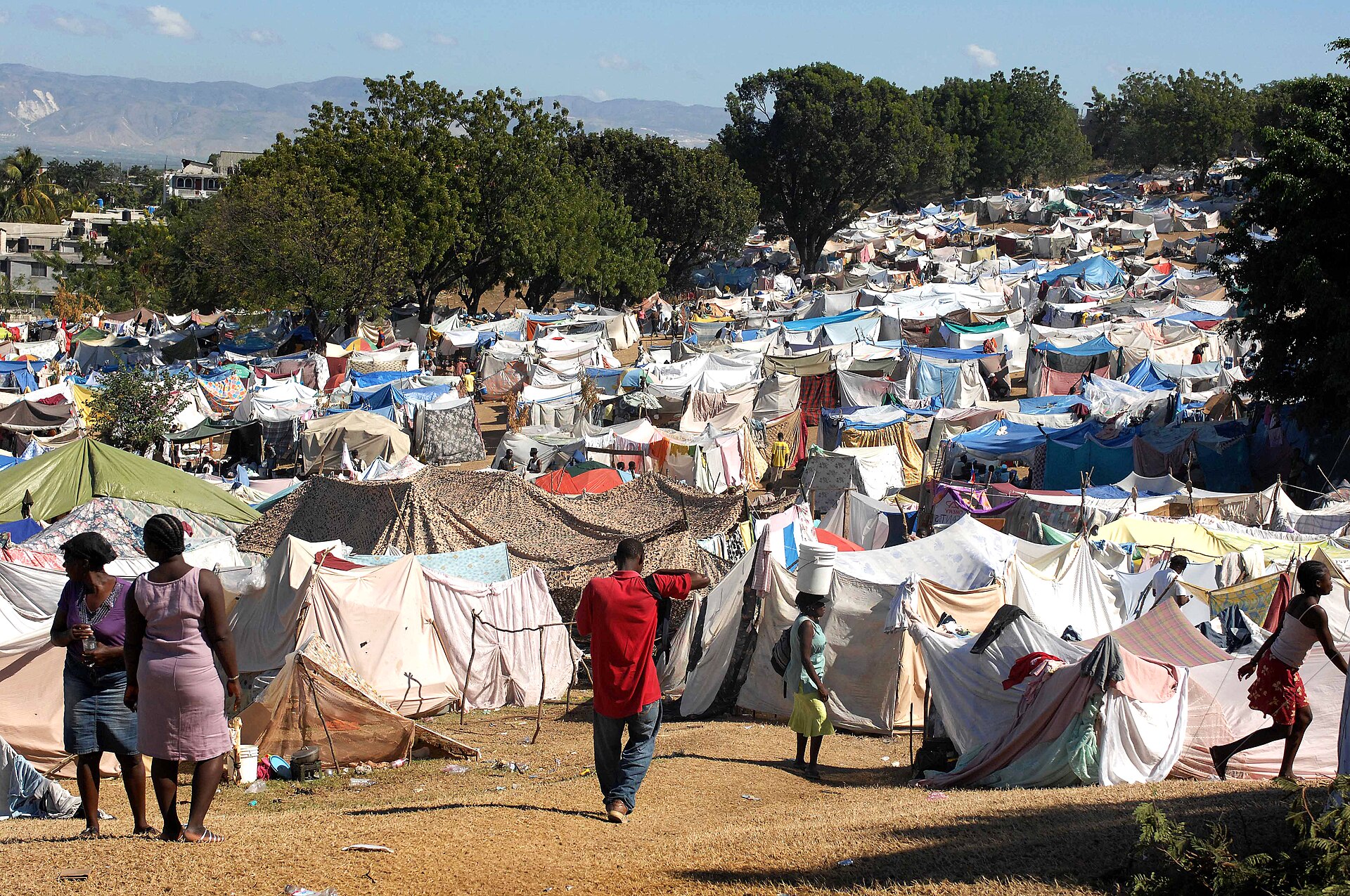
Many residents still live in shacks made of rusty sheet metal, with no access to drinking water, no electricity and no basic sanitation.
People rallied around Haiti, and the Red Cross received a flood of donations totalling roughly $500 million.
The group has publicly celebrated its work, but according to more than a dozen experts, the Red Cross has broken its promises, squandered donors’ money and is making highly dubious claims of success. Put simply, the Red Cross has let down Haiti and its donors.
The Red Cross says it has provided homes for more than 130,000 people. False.
The actual number of permanent homes the group has built in the whole of Haiti is… 6 (six).
After the earthquake, the Red Cross’s chief executive, McGovern, unveiled ambitious humanitarian plans to develop entirely new communities. Once they had the money, according to ProPublica, “not a single community was ever built.”
The Red Cross has pointed to the challenges that every humanitarian group faced on the ground after the Haiti earthquake, including conflicts with Haitian officials, coordination delays with the government, land ownership disputes, the cholera outbreak, delays at Haitian customs and the difficulty of finding qualified staff.
The Red Cross has refused to provide a breakdown of its projects.
In other words, the Red Cross has been unwilling to say exactly where the money went. Its chief executive has said that the group has helped more than 4.5 million Haitians, a claim that Jean-Max Bellerive, Haiti’s prime minister, has called completely false and impossible, since the entire country has a population of only 10 million.
When the earthquake struck Haiti in January 2010, the Red Cross was already going through a crisis of its own: McGovern had become chief executive and inherited a large deficit, at an organisation that had already faced similar scandals after Hurricane Katrina.
The Haiti disaster was seen as a spectacular opportunity for the Red Cross.
The Red Cross saw an excellent fundraising opportunity in the Haiti disaster, with even Michelle Obama, the NFL and a long list of celebrities urging people to donate to the group.
It is believed that the Red Cross may have used part of the donations to wipe out its deficit of more than $100 million.
The other side of the coin was Doctors Without Borders, an organisation that decided to stop fundraising after the earthquake because, it said, it already had enough money to help.
The Red Cross raised far more money than any other charity, supposedly because it had the most ambitious plans to make a positive, lasting impact on the lives of the Haitians affected. Yet today, according to these sources, it is the group that has done the least for Haitians.
Some officials believe the Red Cross worked only for itself.
The difference between other humanitarian groups and the Red Cross.
Every humanitarian organisation that set foot in Haiti faced the same problems the Red Cross uses as excuses, with one difference: those other groups, having raised less money, have built 9,000 homes for Haitians, while the Red Cross has built just “six”.
Internal documents obtained by ProPublica reveal that even in something as serious as controlling cholera, the Red Cross failed, holding up this aid over “internal issues”. By the time cholera had killed more than 6,000 people, the aid still hadn’t arrived.
According to a Haitian official, those 6,000 deaths could have been avoided altogether.
That is why everyone in general, and Haitians in particular, are now asking: what was the money donated for Haiti used for, and wasted on, now that we know it didn’t help Haitians?
This article is based on Justin Elliott’s report for ProPublica. You can read the full article (in English) here.
Featured image: Fred W. Baker III, Public domain, via Wikimedia Commons.