

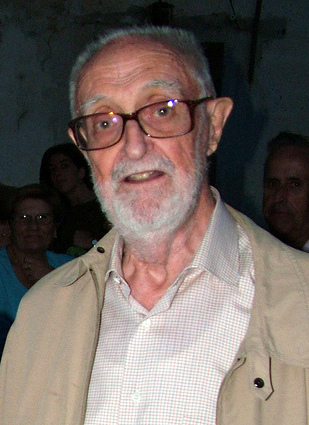
Editor’s note: This article was first published in May 2011, during the euro crisis. The risk of a Spanish bailout, the 5 million unemployed, Iceland’s debt dispute and the forecast that the Partido Popular would probably win the next election (it did, in November 2011) reflect that moment. José Luis Sampedro died in 2013.
Writer, economist and humanist José Luis Sampedro has given his take on the measures the government has adopted to try to pull Spain out of the crisis. It is a coherent, logical analysis, because the (realistic) economic and financial point of view is usually very different from the one we hear when every speech is loaded with political ideals meant to confuse Spaniards, who see acid rain falling but don’t know where it comes from or what really caused it.
Sampedro does not clear José Luis Rodríguez Zapatero of all responsibility, but he doesn’t blame him for some of the measures Spain has had to take to deal with the worst recession the country has ever been through.
“In Spain, everything that could be done has been done, given how serious the situation is.”
According to Sampedro, the government has managed to adapt to the demands of the markets, and Spain is heading in the right direction to get out of the crisis. Spaniards didn’t like some of the measures, but they were necessary to reduce the public deficit.
The famous austerity plan, which caused so much controversy and was not supported by the opposition, was key to keeping Spain from going the same way as Greece and Portugal. Had it not been approved, Spain would already be receiving a financial bailout today.
Here, Sampedro accuses the opposition of taking pleasure in Spain’s troubles and of trying to bring it down completely in order to seize power. He also stresses the need to set politics aside in situations like this and for both parties to row in the same direction.
Finance is a complex world, so when you try to reduce the public deficit, you have to use measures that, at first, can make the middle class and the poor lose purchasing power.
Where does Sampedro see the problem?
The problem is power. When political power is handed over to the financial system, society ends up living under a capitalist system that not everyone is equipped to survive. The banks should not be immune to regulation, starting with the mortgage system, which has driven many Spaniards to ruin and to never-ending debt.
Sampedro favors reforming the mortgage system along US lines, where you hand over the home and the debt is settled, as in France, where the “second chance” law was passed and, as in the United States, the home would settle the debt.
The problem in Spain is that if this system of “handing back” the home were approved today, it would cause huge losses for the banks. Every Spaniard knows that today they are paying for a home valued at less than the debt still outstanding, so we could end up needing a second bailout for the Spanish banks.
A system designed so the banks never lose
What few people know is that the mortgages banks “sell” are insured by insurance companies, which would step in if borrowers defaulted. These policies are rarely used, because once the home is repossessed, it becomes part of the bank’s real-estate assets. A clear example is CaixaBank, where the banks’ new real-estate business is guaranteed to succeed, and that is why Carlos Slim is already one of the biggest shareholders in this new company.
Spain is not Iceland
Iceland will end up paying the debt or will become a “pariah” for the markets. The people’s response there is admirable, but for Spain it is a utopia.
Back to Spanish capitalist power: the Ibex is driven mainly by two stocks, Banco Santander and BBVA, among others. If we had let the banks fall in Spain, we would have been thrown out of the eurozone. “It would have been as if the government had disappeared, because the banks hold the power.”
Conclusion
According to Sampedro, power should be based on a less capitalist and much more ethical system.
For the first time on the program “59 segundos” (a political debate show on Spanish public television), when this subject came up, five of the six people at the table agreed with Sampedro’s view, acknowledging that Spain is so badly screwed that it would be very hard to fix. The one person who disagreed was a columnist for ABC (a Spanish daily), although he shouldn’t be taken into account: when this person talks about economics, he ends up blaming Zapatero for everything down to the extinction of the dinosaurs, and these issues call for more seriousness.
Sampedro trusts that our next generation will be harder to fool in the next bubble. This may be where I disagree, because I think the new generation is influenced by the media, which are neither entirely honest nor impartial when they cover these issues. If another speculative bubble came along tomorrow, the new generation would fall for it again without connecting it to, or recognizing it as, the one our country has lived through in recent years.
The Partido Popular will probably end up governing Spain, and that may be what’s needed, because Zapatero got the measures right as far as the markets are concerned, but not as far as citizens are concerned, whose worry is the 5 million unemployed. That doesn’t change the fact that it will be the first time in Spain’s democracy that an election is won by a party that has not put forward a single economically progressive measure in its program. Nor should we forget that both left and right keep an economic model based on capitalism, so this problem will happen again sooner or later, whoever governs, unless Spaniards push to change some laws and force the government to enforce them.
Featured image: Iñigo González from Guadalajara, Spain, CC BY-SA 2.0, via Wikimedia Commons.



