

Editor’s note: This article was first published in January 2013. It is news commentary from that moment: Spain’s fourth-quarter 2012 GDP contraction, unemployment above 26%, Germany’s -0.5% GDP figure, the 50-euro self-employed rate and the government’s forecast of improvement in the second half of 2013. The prediction of 6.5 or 7 million unemployed is a 2013 forecast.
Spending cuts, austerity, tax rises and labor reform have borne fruit, although, as we expected, the fruit is rotten. Spain’s GDP shrank more than expected in the fourth quarter of 2012, because of excessive corporate and household debt, a lack of competitiveness within Europe and the high unemployment that has been created (over 26%). And even so, the unemployment figures still look good compared with what we are going to see in 2013.
Mariano Rajoy should come clean with the public and say plainly that he is not fighting unemployment, that it isn’t his priority for now. Or, more honestly still, admit that he has no idea how he is going to solve the crisis. For the time being, no self-respecting economist would claim that the government’s measures are designed to create jobs. Can Spain be pulled out of the crisis without Spaniards getting out of the recession?
Fighting the public deficit by making people poorer is a strategy that would work in a small cyclical crisis, but never in a depression like the one we are living through, which has brought us the worst unemployment in the history of our democracy.
Any economist would tell us that to fight unemployment we should cut taxes to encourage consumption, lower interest rates, increase public spending, turn the credit tap back on and take other measures, which would need to be agreed with the rest of Europe, to boost exports.
The government’s measures are obviously the exact opposite: raising taxes and cutting public spending, measures imposed by Germany, where Angela Merkel has made the big mistake of thinking she could drown her neighbors without getting wet herself. Germany’s GDP has also contracted, by 0.5%, because Mrs. Merkel had forgotten that her country is a great economic power partly because it exports to its neighbors. If its neighbors stop buying because of the crisis, Germany sinks along with the rest of Europe.
Spain in search of desperate measures
Since there are no jobs (and there won’t be for a long time), the government has resorted to putting the monthly self-employed contribution on sale: for six months, people under 35 who register as self-employed will pay just 50 euros a month (in Spain, the self-employed, or autónomos, pay a monthly Social Security fee).
In principle it’s not a bad measure, especially if it had been introduced in good times. In the middle of a crisis, though, it will probably serve as the perfect excuse to turn an employee into a self-employed worker for six months.
(Read: The new concept of self-employment in Spain)
The feeling outside Spain is that Europe still has a lot left to fix, and that Spain in particular should make a radical U-turn on its useless austerity, which only generates more recession. A few years ago, Mariano Rajoy himself said that “raising taxes to fix a country’s economy is the solution of a bad ruler”, and on that point I completely agree with our prime minister.
The chief economist at Markit Economics, Chris Williamson, says that consumption in Spain remains very weak and under pressure from high unemployment, and that a rise in domestic demand, especially from households, is unlikely in the short term. So, in the short term, Spain won’t see an economic recovery either.
Meanwhile, Luis de Guindos and Mariano Rajoy believe Spain will see an improvement in the second half of 2013. In principle that is completely impossible, given the mass layoffs coming in the banking sector, plus the layoffs at many foreign multinationals that will have no choice but to cut staff at their Spanish sites because Spanish customers are buying less.
Spain is heading straight for 6.5 million unemployed, and probably 7 million. If that counts as an improvement, I must have missed that kind of economics.
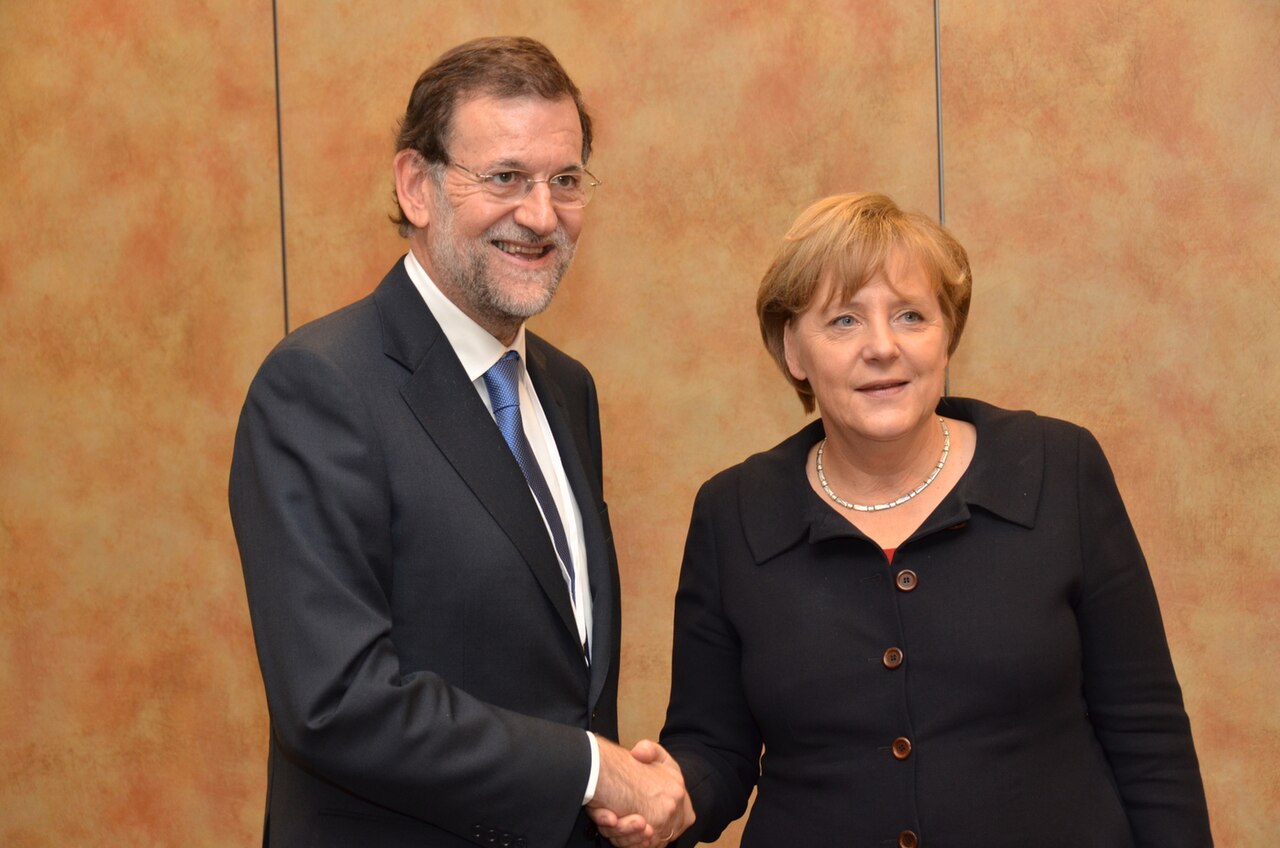
Featured image: European People's Party, CC BY 2.0, via Wikimedia Commons.



