Editor’s note: This article was first published in May 2011, on 18 May 2011, three days after the first 15-M demonstrations. The “5 million unemployed” in the ABC quote is a 2011 figure, and the remark that the movement still lacked proposals belongs to those first days.
Not only are Spain’s national media failing to cover this «revolutionary» event, they are calling these demonstrations ridiculous.
On the one hand, Libertad Digital links this revolution to a far-left movement, where…
«a crowd made up of a motley mass of urban tribes has gathered».
On the other hand, ABC still hasn’t understood that, at the outset, the purpose of this demonstration was not to boycott the government over Zapatero’s handling of the crisis (José Luis Rodríguez Zapatero was then Spain’s prime minister).
«It’s only natural that young people are rebelling, and it’s taken them long enough. They waited until there were 5 million unemployed to realize their future was in danger because of bad management.»
Other media have criticized the protesters’ image:
«Squatters, potheads and lazy people with nothing better to do. They’re making fools of themselves.»
Nor is there any shortage of comments about the political opportunism this demonstration creates, supposedly with the backing of Izquierda Unida (United Left).
«The #Nolesvotes platform is an incredible opportunity for a party that was on the verge of disappearing.»
The fact is that the media haven’t managed to grasp the message, and that may be because no clear message has been put across: the complaint has obviously made itself heard, but now the proposals are missing.
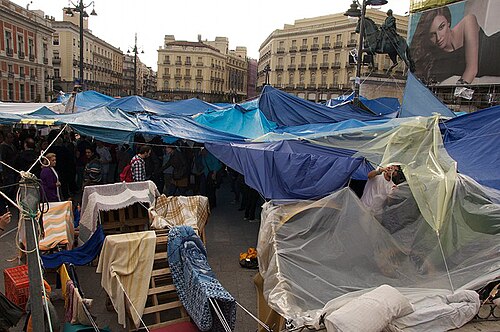
It seems that at this point anyone who doesn’t follow this movement unconditionally risks losing popularity online. But here we put the truth ahead of popularity (even when it hurts), so there are some things I’ve seen at these demonstrations, and specifically at #Acampadasol (the protest camp in Madrid’s Puerta del Sol), that I didn’t like much.
To begin with, a «not very relevant» online outlet that was keen to cover the event, Agora News, went in. It may not be Antena 3 or The New York Times, but it was what there was. I followed the young reporter’s entry into the crowd online, and I’m sorry to say she was treated like dirt, and that’s a luxury they shouldn’t allow themselves.
When this young woman kept asking «What do you want to change?» or «Why are you protesting?», nobody knew how to answer (or wanted to), and between one beer and the next, a joke. That doesn’t improve the image of the demonstration, and it comes across as «not very serious». Nobody has the right to belittle a person’s work, even if they don’t belong to a major media outlet.
In the end, the young reporter made it to the «press desk», where she got an answer:
«We’re sick of this shitty government, these shitty politicians and this shitty system.»
I’m very sorry, but those aren’t the right words, even if some people disagree. We already know what we’re fed up with. Now, what are we looking for, and what are we proposing to improve the system? Said in the right language, young people would even come across as well-mannered.
And finally, a demonstration stops being peaceful when the security forces are called «bastards» and «sons of b…». Likewise, turning a demonstration into a botellón (an outdoor drinking party), joints included, doesn’t look serious, because that doesn’t represent a large part of the public.
I know this article would get more retweets if I said «keep it up, guys, you’re doing really well», but the truth is that there are still things that should and can be improved. I’m with you, as long as I’m following decent people with clear ideas.
Featured image: OsvaldoGago, CC BY-SA 3.0, via Wikimedia Commons.