


Editor’s note: This article was first published in August 2013. The 2.75% rate on a 12-month fixed-term deposit is a 2013 figure from Spain.
Many people know that to build a large fortune we need to rely on the magic of compound interest, where the returns keep being added to the principal. Every now and then I get an email asking which kinds of bank accounts offer compound interest.
In reality, as far as I understand it, there is no such thing as a compound interest savings account: this magic is something we have to create ourselves. When I use the word magic, I mean it literally, because the benefits of compound interest may not be noticeable in the short term, but over a long horizon of 10, 20 or 30 years the results are truly magical.
The example I always use to explain it is Christopher Columbus (if you already know it, skip the next paragraph).
“If Christopher Columbus had put 1 cent into an account at 6% interest, with instructions to withdraw the returns as they were generated, 513 years later that account would hold 31 cents. If, on the other hand, he had left that cent at 6% in an interest-bearing account where the returns are added to the principal (compound interest), the result after 513 years would be more than 95 billion.” That is financial magic.
What is the compound interest formula?
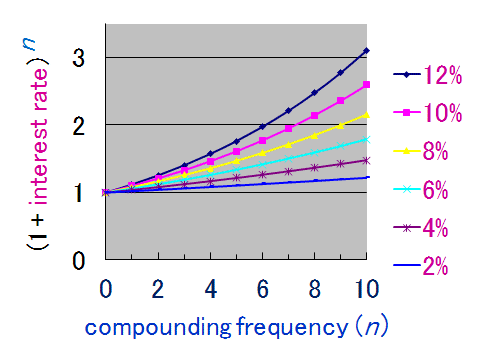
Now, we can achieve this magic both in fixed income (savings accounts, deposits, government bonds…) and in equities (stocks).
Compound interest in fixed income
In fixed income we will get more modest returns, but risk-free (there is always some risk). It would consist, for example, of investing €10,000 in a 12-month fixed-term deposit at 2.75%. At the end of the 12 months we collect our €10,275, add whatever new money we have saved during that time, and reinvest it all, so each time we earn a return on a larger amount of capital.
Of course, to me, using compound interest in fixed income is too slow a way to build wealth (although a safe one). Those who know me already know that I am personally not in favour of tying up money for 12 months for such low returns.
Compound interest in stocks
With stocks, even though we would be taking on a riskier investment (also a more profitable one), the magic of compound interest could arrive much faster, because we no longer rely only on our initial capital but also on share price appreciation and dividends, two factors that multiply our money exponentially. What’s more, if we carry out this strategy in a market that has recently fallen and is starting to recover, a large sum of capital could build up sooner than we expect.
(Read: The essence of intelligent investing to build wealth over the long term)
A practical example of compound interest
Suppose we buy 10,000 shares at €1 each. That year the company pays us a dividend of €0.05 per share, which comes to a total of €500. To do it properly, instead of taking that money in cash, we choose to receive new shares in the company, so instead of 10,000 shares we now have 10,500.
We are assuming the share price has neither risen nor fallen, so the following year, if the company pays us a €0.05 dividend again, we will receive it on 10,500 shares: that is €525, which we can once again take as new shares. And if the share price also rises 20%, the returns would be much higher.
What’s more, in the stock market, if the time comes when we sell our shares because we think the price has risen enough, we always have the chance to reinvest that money (now with large gains) in other companies with room to appreciate that also pay good dividends.
If you know what you are doing in the stock market, it will always be much more profitable than fixed income. It is true that there are risks, but it is also true that by knowing when to get in and where to invest, those risks are reduced considerably.
(Read: 5 steps to building a dividend investing strategy)
That is why a young person who starts saving, investing and reinvesting the returns before taking on debt can have a large sum of money by the age of 30 without any great effort.
See also: 12 things millionaires know that you should learn
Featured image: Sebastiano del Piombo, Public domain, via Wikimedia Commons.




