

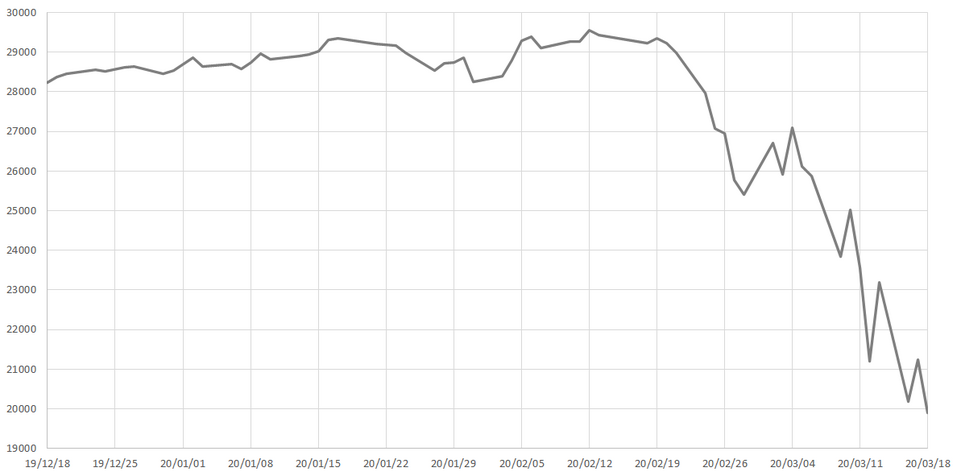
Editor’s note: This article was first published in May 2020, during the COVID-19 market crash. The Banco Santander example was calculated before the crash, and the bank’s share price and dividend history have changed since. Investing in the stock market always carries risk, including during and after a crisis, and past index recoveries do not guarantee future ones. This article is not investment advice.
With or without experience in stock market investing, crisis or no crisis, if we are very clear about having a long-term investment horizon, the odds multiply in our favour. And if, on top of that, we correctly set out a strategy that has already been tested, so much the better. In this case we are not talking about one strategy but two, adapted for making money by investing in the stock market during a crisis. What’s more, the risk is practically zero, which makes for a more than attractive risk-reward equation.
Ways to invest in the stock market during a crisis with little risk and a high probability of profit
Below we explain both investment strategies. Although both can be applied to individual shares, they are really designed to be applied to an index. In other words, buying or investing in an index. If you have any doubts about how to invest in a stock market index, we explain it at that link.
The 30-40-30 investment strategy
When the market has already taken a heavy beating, the question arises of whether the stock market has hit bottom or whether, on the contrary, it could fall much further. We are not fortune-tellers, so we cannot know what the market will do or what events lie in store.
That is why this strategy is useful when the market has already fallen 25% or 30% without any improvement in the economic situation that caused the fall. In other words, there is still a real risk that the market will fall again.
The strategy consists of investing, at that point, 30% of the money we have set aside for investing. We will invest 40% after a further fall of 10% or 15%. The remaining 30% will only be invested once the market has shown a clear sign of a change in trend.
In short:
- 30% now.
- 40% after a further fall of 10–15%.
- 30% after a sign of a change in trend.
The risk of this strategy is that the market does not fall any further and we are late in spotting the change in trend, having invested only 30% of the money set aside for investing.
That is why, for those who do not feel able to identify the stages of a crisis or the signals that point to a change in trend, there is the second investment strategy, which is suitable for any investor, even those with no experience (novice investors).
The DCA investment strategy, with a twist
There is an investment strategy called DCA (dollar-cost averaging), or what I have always called the “eternal average”. Although both strategies can be applied to indices as well as to shares, I would advise novice investors and people without much investing experience to apply them directly to an index. In a crisis everything becomes very cheap, but while indices have historically kept rising, not every company has come out of a crisis.
Any investor who followed this strategy on the S&P 500, starting to invest at the 2007 peak (1,557 points) and riding the fall that took the index down to its 2009 low (680 points), must by now be rolling in money, because indices tend to recover. In the case of the S&P 500, it rose 177% from March 2009 to 2014. By 2019 it had risen much more.
Mind you, the Nasdaq did much better after the dot-com crash of 1999.
Let’s explain the strategy, along with the twists we are going to add to this simple, profitable investment method.
What is the DCA strategy?
Once you are clear that the long term does not worry you, but you are concerned about buying near the top of the market, the DCA strategy basically consists of avoiding going “all in” with your money (investing all our capital at the same time). While it is true that we expect the price to rise above its current level once the crisis is over, the question is: why not wait and buy lower, so that averaging lets us earn a higher return?
The idea is to invest a fixed amount of money in an asset at regular intervals. If the price of the asset falls, we buy; if it falls much further, we buy more (or much more). That way, even if we started investing at the asset’s highest price, we make sure we will also be buying at its lowest price.
We start from the assumption that prices always return to where they were, and so there will come a time when we are buying as many as five times more shares for the same money as in our first purchase.
The advantage is very clear: if we had invested all our capital up front, we would watch it lose value for a long time, and throughout that fall we would be paying the opportunity cost.
See also: The crisis could drag on until 2020–2023, according to Santiago Niño Becerra
Andy Kiersz, a mathematician who works for Business Insider, ran this hypothetical experiment, applying the strategy to the S&P 500 at the most critical moment for the market.
If an investor had started this DCA strategy in October 2007 (the S&P’s all-time high up to then), the worst possible moment to buy shares, putting €50 into an index fund every month, the investor would have made a 48% return. That is an average return of 7.6% a year, despite buying while the market was “collapsing”.
If that investor, gripped by panic, had decided to stay out of the market and put €50 under the mattress every month, they would now have €3,800. With the DCA strategy started at the worst moment, the investor would have €5,631. In other words, they would have made €1,831 (a 48% return).
However, some twists can be added to make the return higher, starting from the same initial money used in the study.
Twists for making more money with the DCA strategy
To increase the potential return without increasing the risk, we can add this twist to the DCA method.
Instead of investing the same amount of money every month, we set a starting point, which is the moment we invest our first €50. It does not have to be €50, and it does not have to be every month. Some people use this strategy by investing every 15 days and others weekly. It all depends on the size of your pocket and your income.
Once we have made our first investment and taken it as our starting point, we make the next investment as follows:
- If the price is above the price of our first investment, we invest the same amount of money (€50).
- If the price is below the price of our first investment, we invest double (€100).
And if, while you are carrying out this strategy, there is a sharp correction of another 10% or 15%, it is up to you to triple the amount, or invest €1,000 straight away, or whatever amount you choose, as if you were carrying out strategy number 1.
That way we always make sure that, when the market has returned to normal, we have made the most of the good buying opportunities, which will translate into an excellent annual return.
The advantage of applying the DCA strategy to shares
Above I said that it is safer to apply this investment strategy to indices, because we limit the risk of a company disappearing or not coming out of the crisis stronger. But if you feel up to it, it can be much more profitable to apply it to individual shares as well. Especially if the shares we apply this formula to pay good dividends.
See also: Compound interest: the first pillar of smart saving and investing
Let’s move on to shares. Some time ago we explained how to build an investment strategy based solely on dividends, with which it was feasible to get a 10–12% annual return.
Some people say dividends are a scam, but I have already explained why all the arguments given to claim that dividends are a scam are empty, nonsensical and, in many cases, completely false or mistaken. Fallacies, in the end.
If we apply the DCA strategy to a solid share with good dividends, our return could run to three digits.
To take an example close to home: if we had invested the same amount of money every month in Banco Santander from its peak before the crisis, our return would still be positive today, even though Santander’s price is still a long way from surpassing its pre-crisis high (in fact, Santander is still in a downtrend and is now suffering the coronavirus crisis like the rest of the sector). The averaging done near its all-time lows, plus the dividends paid over these years, would already have given us our well-deserved reward.
Note: I did this study before the coronavirus crisis, so I don’t know exactly what the return figures look like after this latest fall.
An ideal investment strategy for young people
This strategy is suitable for young people who want to start their own retirement plan, and even for people aged 30 to 40 with considerable capital and a stable income. Let’s say it is a way of making money on the stock market without knowing anything about the stock market, as long as you avoid the most common mistakes investors make.
However, be careful when choosing the company you apply this strategy to, because if the company does not survive the crisis it is going through, which is making it lose value, we put 100% of our capital at risk.
Featured image: Renerpho, CC BY-SA 4.0, via Wikimedia Commons.



